

A Forex Cent account is a live trading account that displays money in cent units rather than whole currency units. A USD 10 balance may therefore appear as 1,000 cents, but its economic value remains USD 10. The larger displayed number does not create more capital or automatically reduce trading exposure.
What Is a Forex Cent Account?
A Cent account uses a smaller denomination for displaying the account balance. In a USD-cent denomination, 100 cents equal one U.S. dollar. Balances, equity and profit or loss may appear in cents, while their real value can still be converted directly into dollars.
Three concepts must remain separate:
- Display or denomination describes how the account presents monetary values.
- Position size describes the volume selected for a trade.
- Market exposure describes the financial effect of that position as prices move.
Changing the display from USD 10 to 1,000 cents changes only the unit shown. Position size and market exposure depend on the selected volume, instrument and contract specifications, while leverage and margin rules determine how much collateral is required to support that exposure.
How Cent Account Balances Work
The easiest way to interpret a Cent-account balance is to convert the displayed cents back into the underlying account currency. Under a normal USD-cent denomination, divide the cent balance by 100:
1,000 cents ÷ 100 = USD 10
If the account later displays 1,050 cents, the economic value is USD 10.50. If it displays 925 cents, the economic value is USD 9.25. The same conversion applies to displayed profit, loss and equity when those values are recorded in cent units.
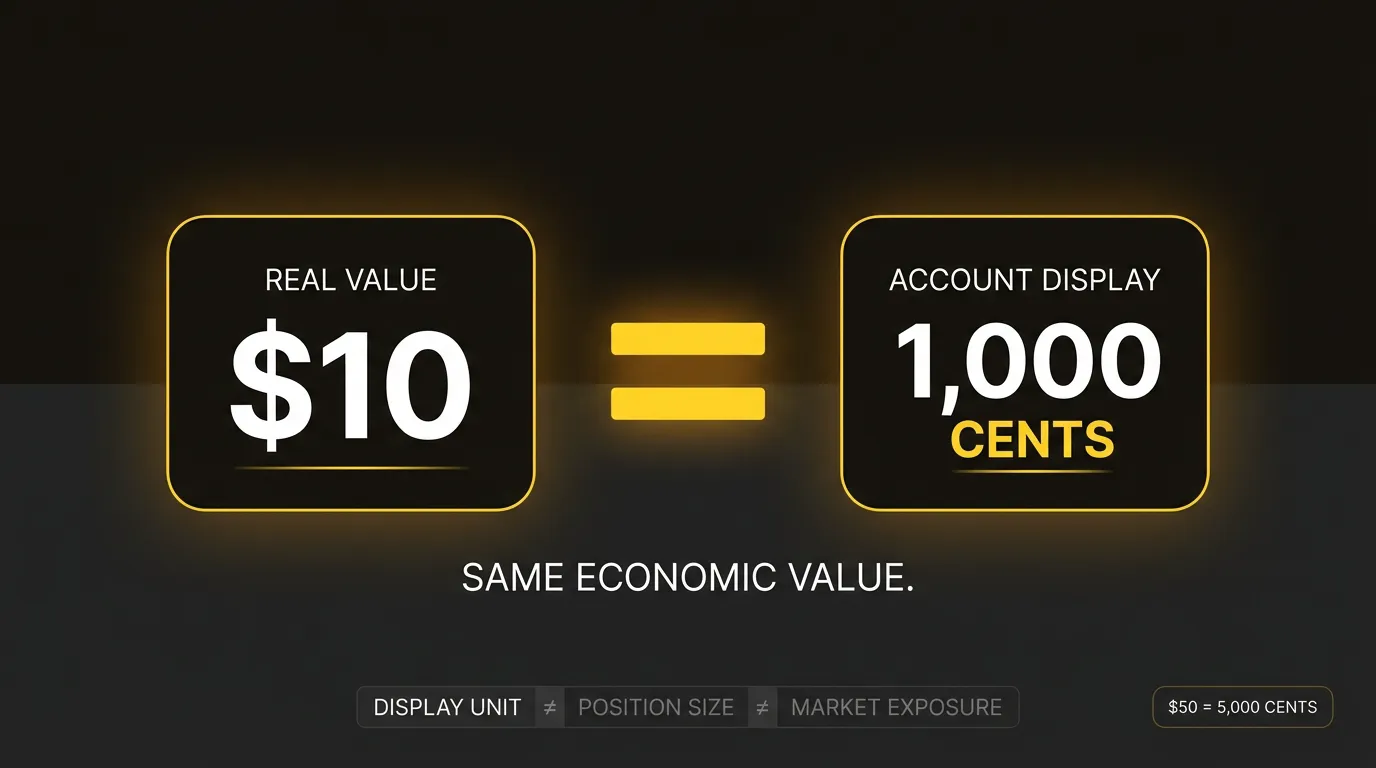
The denomination can make small monetary changes easier to notice because the display uses whole cent units. It does not make a gain larger or a loss smaller. A change of 100 cents still represents USD 1 under a USD-cent denomination.
The account label alone does not define the monetary effect of a trade. A trader must still check the contract size, minimum volume, volume increment and pip-value method for the specific account and instrument.
Cent Account vs Micro-Lot Trading
A Cent account and a micro lot describe different things.
A Cent account is an account denomination or configuration. A micro lot is a trade-volume convention, commonly expressed as 0.01 of a standard lot under a conventional Forex contract structure.
The two concepts can be used together, but they are not interchangeable. A Standard account may permit micro-lot trades, while a Cent account can use account-specific contract sizing and order-volume rules. The word "Cent" should never be treated as proof that every 0.01-lot order has the same exposure or cash pip value found on another account.
This distinction is why the actual contract specification matters more than the account name. Before placing a trade, confirm what the selected volume represents for that instrument.
How a Cent Account Works in Practice
A Cent account uses live funds and live market conditions. A typical workflow is:
- Funds are added to the account and displayed in cent units.
- The trader reviews the available instruments and their contract specifications.
- A trade volume is selected within the account’s permitted minimum and increments.
- Margin is reserved according to the position, leverage and current margin rules.
- Market movement and applicable costs change the account’s equity and profit or loss, which may be displayed in cents.
The account display makes small changes visible, but the trade still operates under live pricing and execution. Spreads can affect a position when it opens and closes. Commissions, overnight financing or swaps, and currency conversion can also affect the result when they apply.
Leverage and margin remain important. A small deposit does not prevent a trader from selecting an exposure that is large relative to the available equity. If losses reduce equity sufficiently, the account’s margin and closeout rules can apply just as they do on other leveraged live accounts.
Benefits and Common Use Cases
The main benefit of a Cent account is the ability to observe live trading mechanics with smaller nominal capital when the account specifications support suitably small exposure.
Practical use cases include:
- Observing live conditions: A trader can see how bid and ask prices, spreads, execution and market movement affect real funds.
- Learning the effect of trade volume: Different permitted volumes show how position size changes the monetary outcome of a price movement.
- Testing a live workflow: Users can practise placing, adjusting and closing live orders and reviewing account history with limited capital.
These benefits do not make a Cent account safe or suitable for everyone. The practical risk depends on the exposure selected relative to the account’s equity, not on whether the balance is displayed in dollars or cents.
Trade-Offs and Limitations
Cent accounts can support small-scale live practice, but the denomination also creates points that require attention.
| Consideration | Why it matters |
|---|---|
| Display scale | A balance such as 10,000 cents can look larger than its USD 100 economic value. |
| Trading costs | Spreads, commissions, overnight charges and conversion costs can be meaningful relative to a small balance. |
| Contract and volume rules | Minimum volume and contract size can differ from those used by a Standard account. |
| Instrument access | The products available can differ by account configuration. |
| Leverage and margin | A cent denomination does not remove leveraged exposure, margin requirements or closeout risk. |
| Account limits | Position limits or maximum volumes may not suit every trading approach. |
The core limitation is that a smaller balance leaves less capacity to absorb adverse price movement and costs. The larger cent-unit display can make that constraint easier to overlook unless the user regularly converts the figures back into the underlying account currency.
Cent-account conditions are provider-specific. Review the current specifications once before trading rather than assuming that another provider’s contract size, minimum volume or product range applies.
Cent Account vs Standard and Demo Accounts
A Cent account normally expresses balances in cent units and may be configured for smaller-scale live activity. A Standard account normally displays balances in whole account-currency units and uses its own contract, volume, pricing, instrument and margin specifications.
The account label does not determine which option is universally better. The relevant differences are the actual contract size, permitted order volumes, trading costs, available instruments, margin rules, platform access and eligibility. A detailed comparison should therefore use the current account specifications rather than relying only on "Cent" or "Standard" in the name.
A Demo account serves a different purpose. It uses simulated funds and is useful for learning platform functions, order types and basic mechanics without putting capital at risk. A Cent account uses real funds and exposes the user to live pricing, execution, costs and the emotional effect of real gains and losses.
Demo practice can come first; a Cent account can then provide a smaller-scale introduction to live-market mechanics. Neither stage guarantees readiness or a particular trading outcome.
What to Check Before Opening a Cent Account
Use the following questions as a practical decision framework:
- How is the account balance denominated and converted back into its underlying currency?
- What does one lot represent for each relevant instrument?
- What are the minimum trade volume and smallest volume increment?
- Which instruments are available on the account?
- What spreads, commissions, overnight charges and conversion costs apply?
- What leverage, margin and closeout rules apply to the intended position?
- Which platforms can access the account?
- Is the account available and appropriate for the user’s market and circumstances?
This information makes it possible to compare the real trading structure rather than the size of the displayed balance.
Cent Accounts at Grand Markets
Grand Markets currently lists a Cent account alongside its Standard and ECN accounts on the Trading Accounts page. The current Cent-account card shows:
- a USD 10 minimum deposit;
- an average spread of 1.6 pips;
- no commission; and
- maximum leverage of 1:1000.
These are current conditions, not permanent universal terms. The page also positions the Cent account for beginner and micro-lot use, but that description does not replace checking its contract size, permitted volumes, instruments, margin rules, platform access and eligibility.
Review the live account card and instrument table before proceeding. Grand Markets’ Fees and Spreads page provides additional general cost information, while the applicable account and instrument conditions remain the deciding source.
Frequently Asked Questions
What is a Cent account in Forex?
A Cent account is a live trading account that displays the balance in cent units rather than whole currency units. In a USD-cent account, USD 10 may display as 1,000 cents while retaining the same USD 10 economic value.
Why does $10 appear as 1,000 cents?
One U.S. dollar contains 100 cents, so USD 10 equals 1,000 cents. The display uses a smaller denomination; it does not turn USD 10 into USD 1,000 or add trading capital.
What are the benefits of a Cent account?
A Cent account can make small monetary changes easier to see and can provide experience with live pricing, execution, costs and real-money decisions using limited nominal capital. Its usefulness still depends on the account’s permitted exposure and the user’s understanding of risk.
Is a Cent account the same as micro-lot trading?
No. A Cent account describes balance denomination or account configuration. A micro lot describes trade volume. Standard accounts may also permit micro-lot trades, and Cent accounts can have their own contract-size and volume rules.
Does a Cent account reduce trading risk?
Not automatically. The cent display does not change the economic value of the balance or determine exposure. Risk depends on position size, price movement, leverage, margin, costs and account equity.
What is the difference between a Cent and Standard account?
A Cent account normally displays balances in cent units, while a Standard account normally displays whole account-currency units. Their contract sizes, minimum volumes, pricing, instruments, margin rules and platform access must be compared using the current specifications.
A Cent account can be a useful bridge between simulated practice and live-market mechanics, but its value comes from the account’s actual structure, not from a larger number on the balance display. Convert cents back into the underlying currency, verify the contract and cost conditions, and keep exposure proportionate to the funds available.
Forex and CFD trading involve significant risk and can result in substantial losses. A Cent account does not remove market, leverage, execution or cost risk, and educational information is not a recommendation to trade.
Disclaimer:
This content does not constitute any offer, solicitation or advice. You should always seek independent professional advice before making any investment decision. Please note that Grand Markets may restrict or prohibit some or all services to users from restricted regions. Please read the User Agreement for more information.