

A Forex currency pair expresses the value of one currency relative to another. The first currency is the base currency, and the second is the quote currency. EUR/USD, for example, tells you how many U.S. dollars correspond to one euro. This relationship is the foundation for reading quotes, bid and ask prices, spreads, pips and common pair categories.
Base and Quote Currencies
A Forex pair always contains two currencies because each quote compares one currency with another. The three-letter currency codes are separated by a slash:
EUR/USD = 1.1000
In this example:
- EUR is the base currency because it appears first.
- USD is the quote currency because it appears second.
- 1.1000 is the amount of quote currency corresponding to one unit of the base currency.
The quote therefore means 1 EUR = 1.1000 USD. It does not mean that one U.S. dollar equals 1.1000 euros.
When EUR/USD rises, the euro has increased in value relative to the U.S. dollar. When it falls, the euro has decreased in value relative to the U.S. dollar. That statement describes the relationship between the two currencies; it does not explain why the price moved or predict its next direction.
The same reading rule applies to other pairs. If USD/JPY is quoted at 150.00, one U.S. dollar corresponds to 150.00 Japanese yen. USD is the base currency, while JPY is the quote currency.
In retail derivative trading, buying or selling a Forex pair normally creates exposure to that currency relationship rather than delivering physical banknotes. A long EUR/USD position represents long-EUR and short-USD exposure. A short EUR/USD position represents the reverse. The precise product structure and settlement terms depend on the instrument and provider.
How to Read a Forex Quote
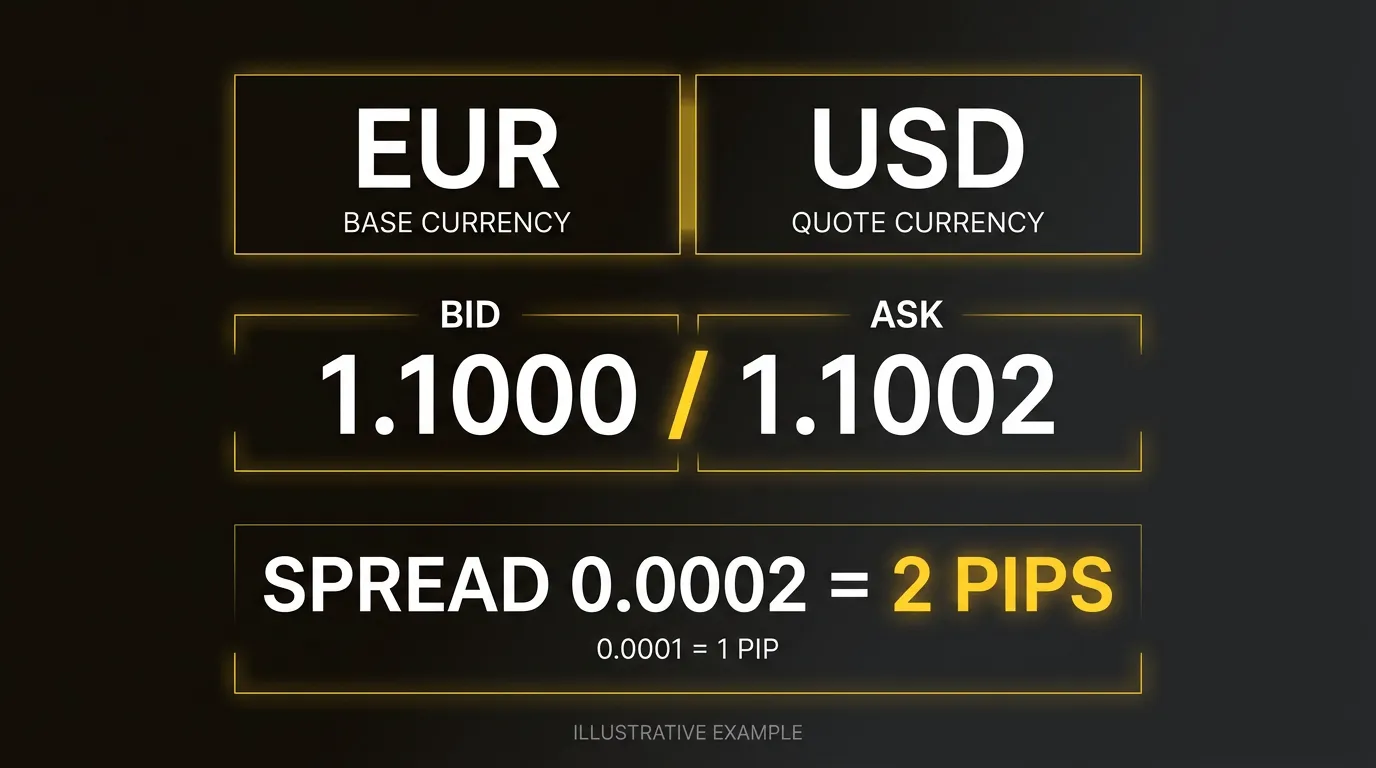
A Forex quote commonly displays two prices rather than one. Consider this illustrative two-way quote:
EUR/USD 1.1000 / 1.1002
The first price, 1.1000, is the bid. The second price, 1.1002, is the ask.
- The bid is the price at which the customer can sell the pair.
- The ask is the price at which the customer can buy the pair.
- The difference between them is the spread.
This quote is illustrative only; it is not a live market price or a Grand Markets price.
If a customer opens a long EUR/USD position, the entry is based on the ask. If the customer opens a short position, the entry is based on the bid. The available closing price is on the opposite side of the quote, which is why a newly opened position can initially show a negative difference before any market movement or other applicable cost.
The number of displayed decimal places can vary by currency pair and platform. Some quotes include an additional fractional digit, often called a pipette. The extra precision does not change which side is the bid or ask.
Bid, Ask and Spread
The spread is calculated by subtracting the bid from the ask:
Ask − Bid = Spread
Using the illustrative EUR/USD quote above:
1.1002 − 1.1000 = 0.0002
For many non-JPY currency pairs, one pip conventionally equals 0.0001. A difference of 0.0002 therefore equals 2 pips.
Spreads are not necessarily fixed. They can differ between instruments, account structures and market conditions. A spread is also only one potential part of trading cost. Commissions, overnight financing, currency conversion or other disclosed charges may apply depending on the product and account. Current Grand Markets information about trading fees, spreads and commissions should be reviewed before making a decision.
This article keeps the focus on how a spread is read from a quote. A complete cost assessment requires looking at all applicable charges together rather than treating the spread as the only cost.
What Is a Pip?
A pip is a conventional unit used to describe a movement in a Forex quote. It makes changes easier to discuss without repeatedly reading several decimal places.
For many non-JPY pairs, one pip is conventionally the fourth decimal place:
- EUR/USD moving from 1.1000 to 1.1001 is a movement of 1 pip.
- EUR/USD moving from 1.1000 to 1.1010 is a movement of 10 pips.
- EUR/USD moving from 1.1000 to 1.0985 is a downward movement of 15 pips.
For many JPY pairs, one pip is conventionally the second decimal place:
- USD/JPY moving from 150.00 to 150.01 is a movement of 1 pip.
- USD/JPY moving from 150.00 to 149.90 is a downward movement of 10 pips.
A pipette, or fractional pip, is commonly one-tenth of a pip. On a five-decimal non-JPY quote, 0.00001 is one pipette. On a three-decimal JPY quote, 0.001 is one pipette. A move from EUR/USD 1.10000 to 1.10005 is therefore five pipettes, or half a pip.
Pip Movement Is Not the Same as Cash Pip Value
A pip measures a price movement, not a universally fixed amount of money. The cash value of a pip can vary with factors including the currency pair, position size, account currency and relevant conversion rate.
For that reason, "the market moved 10 pips" does not by itself state the monetary profit or loss. Calculating pip value, position size and full profit or loss is a separate step and should use the specifications and calculation method applicable to the actual instrument.
Major, Minor and Exotic Currency Pairs
Educational and provider materials often group currency pairs into major, minor and exotic categories. These labels are useful shorthand, but classification terminology can vary somewhat between sources.
| Category | Common description | Examples |
|---|---|---|
| Major pairs | The commonly recognised group of heavily traded pairs involving the U.S. dollar | EUR/USD, GBP/USD, USD/JPY, USD/CHF, USD/CAD, AUD/USD, NZD/USD |
| Minor pairs or crosses | Pairs involving widely traded currencies that do not include the U.S. dollar | EUR/GBP, EUR/JPY, GBP/JPY |
| Exotic pairs | A widely traded currency paired with a less-traded or emerging-market currency | USD/MXN, USD/ZAR (illustrative classifications only) |
The category alone does not guarantee a particular spread, level of liquidity, volatility, risk or product availability. Those characteristics can change with market conditions, and the instruments available depend on the provider and account.
The direction of the currency codes still matters in every category. EUR/GBP expresses the value of one euro in pounds sterling, while GBP/EUR would express the value of one pound in euros. The two quotes describe inverse relationships and are not interchangeable.
How the Forex Market Is Structured
The global foreign exchange market is primarily an over-the-counter (OTC) market. Rather than trading through one single central exchange, transactions take place across a network of reporting dealers, banks, other financial institutions and non-financial customers in different locations.
The final 2025 BIS Triennial Survey tables report average daily OTC foreign exchange turnover of approximately USD 9.5 trillion per day in April 2025, about 27% higher than in April 2022.
That figure describes the broad OTC FX market captured by the survey. It includes institutional activity and several instrument types, including spot transactions, outright forwards, foreign exchange swaps, currency swaps and options. It is not just the trading volume of one retail broker or one trading platform.
Because Forex trading takes place across a distributed market, quotes can vary between providers. Available pricing can also change as liquidity and market conditions change. The bid and ask shown on a trading platform therefore need to be read as the current two-way quote offered for that instrument, not as one universal global price displayed identically everywhere.
Why These Mechanics Matter
Base and quote currencies explain what is being compared. Bid and ask explain the two sides of the quote. The spread measures the difference between those sides, while pips provide a conventional way to describe price movement.
Together, these concepts help a reader interpret what a platform displays before considering more advanced topics such as position sizing, leverage, margin, pip value or profit and loss. They do not remove market risk, and they do not indicate whether a trade is suitable.
A practical reading sequence is:
- Identify the base and quote currencies.
- Check which figure is the bid and which is the ask.
- Calculate or review the spread.
- Note the pair’s decimal and pip convention.
- Confirm the instrument specifications and applicable costs before trading.
Frequently Asked Questions
What is a Forex currency pair?
A Forex currency pair expresses the value of one currency relative to another. The first currency is the base currency, and the second is the quote currency. The quoted number shows how much quote currency corresponds to one unit of the base currency.
What is the base currency and quote currency?
The base currency appears first in a pair, while the quote currency appears second. In EUR/USD, EUR is the base currency and USD is the quote currency. A quote of 1.1000 means one euro corresponds to 1.1000 U.S. dollars.
What is the difference between bid and ask?
The bid is the price at which the customer can sell a currency pair. The ask is the price at which the customer can buy it. The ask is normally higher than the bid, and the difference is the spread.
What is a spread in Forex?
The spread is the difference between the ask and bid prices. If EUR/USD is quoted at 1.1000 / 1.1002, the spread is 0.0002, which equals two pips under the conventional non-JPY pip definition.
What is one pip in Forex?
For many non-JPY currency pairs, one pip conventionally equals 0.0001. A movement from 1.1000 to 1.1001 is one pip. A pip measures quote movement; its cash value is not universally fixed.
Why do JPY pairs use a different pip decimal convention?
Many JPY pairs are quoted with one pip conventionally represented by 0.01, the second decimal place, rather than 0.0001. If USD/JPY moves from 150.00 to 150.01, that is a one-pip movement.
Where can I view Forex quotes on the Grand Markets platform?
Readers who want to see how bid and ask prices, decimal precision and order terminology appear in trading software can explore Grand Markets’ MetaTrader 4 desktop resource and MetaTrader 5 desktop resource. Check the current platform and instrument information before proceeding, as availability can vary.
Understanding how a quote works is a foundation, not a trading recommendation. Forex and CFD trading can involve significant risk, including the risk of loss. Review the applicable product terms, costs and risk information, and consider whether the product is appropriate for your circumstances before trading.
Disclaimer:
This content does not constitute any offer, solicitation or advice. You should always seek independent professional advice before making any investment decision. Please note that Grand Markets may restrict or prohibit some or all services to users from restricted regions. Please read the User Agreement for more information.