
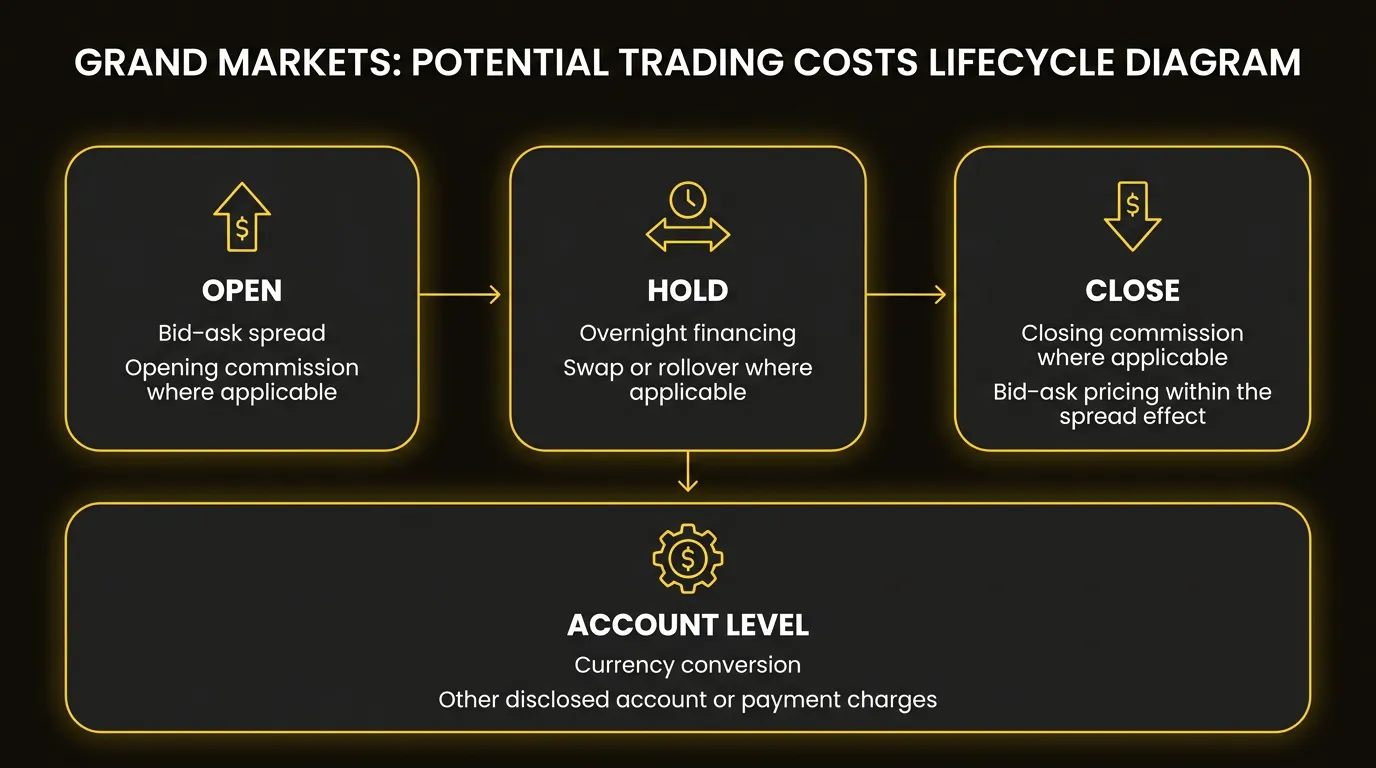
Total trading cost is the combined economic cost of opening, holding and closing a trade. Depending on the instrument, account and transaction, it may include the bid–ask spread, a separate commission, overnight financing, currency conversion and other applicable charges.
A headline spread or "commission-free" label shows only part of that picture. To understand what a trade could actually cost, compare the full pricing structure for the same instrument, position size, holding period and market conditions.
What Makes Up Total Trading Cost?
Trading costs can arise at different points in a position’s life. Some are reflected in the price at entry, some are charged separately, and others depend on how long the position remains open.
| Cost component | What it represents | When it may matter |
|---|---|---|
| Spread | The difference between the bid and ask prices | When entering or exiting at bid/ask prices |
| Commission | A separate charge under the relevant pricing model | At entry, exit or both |
| Overnight financing | A holding cost or adjustment for an eligible position kept open past a cutoff | When a position remains open overnight |
| Currency conversion | Converting a trade result or charge into the account currency | When the instrument and account use different currencies |
| Other applicable charges | Product-, account- or payment-related charges disclosed in the relevant terms | When the specified condition or service applies |
Not every component applies to every trade. The relevant product terms, account model and current fee information determine which costs should be included.
Spread: The Cost Built Into Bid and Ask Prices
The spread is the difference between the bid price and the ask price. The ask is generally the price at which a trader can buy, while the bid is generally the price at which a trader can sell. For a deeper look at how these prices work in currency markets, see our guide to Forex currency pairs, bid/ask prices, spreads and pips.
Because a position is opened on one side of the quote and valued or closed on the other, the spread creates an immediate economic difference at entry. The cash effect depends on the size of the position and the instrument’s pricing conventions.
Spreads can vary. Liquidity, market activity, volatility, trading hours and provider conditions may all affect the difference between bid and ask prices. A narrow displayed spread at one moment therefore does not establish the cost of every future trade.
What Is a Good Spread?
There is no universal number that is always a "good" spread. A meaningful comparison uses:
- the same instrument;
- a similar time and market environment;
- a comparable position size;
- the same type of pricing or account model;
- any separate commission; and
- overnight costs if the position may be held beyond the relevant cutoff.
A lower spread can reduce one component of cost, but it does not automatically mean the total pricing structure is cheaper. A narrow-spread model with a separate commission may cost more or less than a wider-spread model without one, depending on the actual charges and how the trade is managed.
How Trading Commissions Work
A commission is a charge stated separately from the spread. Its format depends on the product and pricing model. For example, it may be quoted per side, per round trip, per lot, per contract or as a percentage.
The key is to compare like with like. A per-side commission applies when opening and again when closing, while a round-trip figure may already include both. A commission described per lot or contract must also be considered alongside the intended position size.
"Commission-free" does not mean cost-free. The spread, overnight financing, conversion or other applicable charges may still affect the transaction. Conversely, the presence of a commission does not by itself make a pricing model expensive; the spread and all other relevant costs must be considered together.
Overnight Fees, Swaps and Rollover
An eligible leveraged position kept open past a specified cutoff may receive an overnight financing charge or adjustment. Depending on the product and terminology, this may be described as an overnight fee, financing, swap or rollover.
The treatment can vary by instrument, trade direction, product structure, day and provider terms. Some schedules may also apply a multi-day adjustment on a particular day to account for non-business days. The current product specification or platform information should explain the applicable basis and timing.
Overnight cost matters because it accumulates with holding time. A position that appears inexpensive to open may have a different total cost when held through one or more financing cutoffs. Short-term and longer-term trades should therefore not be compared using entry costs alone.
This is the practical answer to "What are overnight fees in CFD trading?": they are potential holding costs or adjustments associated with maintaining an eligible CFD position beyond the relevant daily cutoff. They are not necessarily identical across all CFDs.
Other Costs That May Apply
Currency Conversion
If a trade is priced or settled in a currency different from the account currency, conversion may be required. A conversion rate or charge can affect the final account-level result even when the instrument’s spread and commission remain unchanged.
Account and Payment Charges
Depending on the provider and service used, account or payment-related charges may apply. Examples can include an inactivity charge under specified conditions or third-party banking and conversion costs. These are not necessarily costs of every individual trade, but they can affect the overall cost of using an account.
Instrument-Specific Charges
Some products may have charges or adjustments specific to their market structure. These should be taken from the current instrument specification rather than assumed from another market or account type.
Slippage Is an Execution Effect, Not a Published Fee
Slippage occurs when an order is executed at a different price from the price expected when it was submitted. It can improve or worsen the economic outcome, particularly when markets move quickly or available liquidity changes.
Slippage is not the same as the spread and should not automatically be described as a broker fee. It is an execution outcome. It still matters when reviewing realised cost, but it belongs in a different category from a stated commission or financing charge.
How to Estimate the Cost of a Trade
Before entering a trade, identify the possible costs at each stage:
- Opening and closing: account for the bid-ask spread consistently across the trade, together with any opening or closing commissions. Do not count the same spread effect twice.
- Holding: check whether overnight financing could apply during the expected holding period.
- Account-level effects: consider conversion and other applicable disclosed charges.
Then combine the relevant amounts using the same currency. A simple framework is:
Estimated total trading cost = spread cost + commission + overnight financing + other applicable charges
If you are unfamiliar with how a CFD position moves from opening through closing and settlement, see our guide to how Contracts for Difference (CFDs) work.
Illustrative Example
The following numbers are hypothetical and are not Grand Markets pricing.
Suppose a CFD position has an illustrative spread of 4 points, a point value of $1, and a quantity of 2 units. The spread cost is calculated as:
4 points x $1 point value x 2 units = $8 spread cost
If the total opening-and-closing commission is $6, and one overnight financing charge of $3 applies, the illustrative total is:
$8 spread cost + $6 commission + $3 overnight financing = $17 estimated total trading cost
The example is intentionally simple. Actual costs depend on the instrument, position size, execution, holding period, account currency and current terms.
Margin should not be added to this calculation as though it were a fee. Margin is collateral set aside to support a leveraged position. Leverage changes the exposure controlled relative to that margin; it is not itself a charge. However, larger exposure can increase the cash impact of spread, commission, financing and market movement.
What Can Change Total Trading Cost?
Two trades in the same instrument can have different total costs. Important variables include:
- Position size: per-lot, per-contract and spread-related cash amounts can scale with size.
- Holding period: more overnight cutoffs may mean more financing adjustments.
- Market conditions: spreads and execution can change when liquidity or volatility changes.
- Time of day: market participation and available liquidity are not constant throughout a session.
- Trade direction: overnight treatment may differ between long and short positions.
- Account or pricing model: spread and commission structures can differ.
- Account currency: conversion may apply when currencies differ.
- Instrument terms: contract specifications and charging methods vary across markets.
This is why a single promotional rate cannot answer "How much does CFD trading cost?" The answer depends on the complete pricing model and the details of the intended trade.
How to Compare Trading Costs Properly
Use a consistent comparison rather than choosing the smallest isolated number. For each option, check:
- the same instrument and comparable market conditions;
- the typical or current spread, not only the lowest advertised value;
- whether commission is per side or round trip and how it scales;
- the expected holding period and possible overnight treatment;
- currency conversion and other applicable charges;
- the position size used in the comparison; and
- where current terms and specifications are published.
This approach also clarifies what fees CFD brokers may charge. Depending on the product and model, the cost can include spread, commission, overnight financing, conversion and other disclosed charges. No single list applies identically to every provider, instrument or account.
Where to Check Current Grand Markets Costs
Grand Markets has its current fees, spreads and commissions information explained separately from its trading account options.
Review both pages together, along with the relevant instrument specifications and platform information, before making a cost comparison. Current conditions can change and may vary by account, instrument and eligibility.
Frequently Asked Questions
What Is Spread in Forex Trading?
The spread is the difference between the bid and ask prices of a currency pair. It creates an economic cost because a position is opened on one side of the quote and valued or closed on the other. Its cash effect depends on position size and current pricing.
What Is a Good Spread for Forex Trading?
There is no universal spread that is always good. Compare the same currency pair under similar market conditions, using the same position size and account model. Include any separate commission and relevant overnight cost rather than judging the spread alone.
What Are Overnight Fees in CFD Trading?
Overnight fees are potential financing charges or adjustments for eligible CFD positions kept open beyond a specified daily cutoff. They may also be called swaps or rollover. Their amount and treatment can vary by instrument, direction, day and product terms.
How Much Does CFD Trading Cost?
CFD trading cost depends on the instrument, position size, spread, commission, holding period, overnight financing, conversion and other applicable charges. Review the complete pricing structure for the specific trade instead of relying on one advertised rate.
What Fees Do CFD Brokers Charge?
Depending on the provider, instrument and account model, costs may include the spread, a separate commission, overnight financing, currency conversion and other disclosed account or transaction charges. Not every charge applies to every trade.
Are Margin and Leverage Trading Fees?
No. Margin is collateral used to support a leveraged position, while leverage describes the exposure controlled relative to that collateral. Neither is automatically a fee. Greater exposure can, however, increase the cash effect of costs and market movements.
Is Slippage a Broker Fee?
Not necessarily. Slippage is the difference between an expected order price and the actual execution price. It is an execution outcome rather than the same thing as a stated spread, commission or financing charge.
Understanding total trading cost means looking beyond one headline number. Compare the cost of opening, holding and closing the same position under realistic conditions, and verify current terms before trading.
Leveraged CFD and Forex trading involves a high level of risk and may result in significant capital loss. Costs can reduce returns and increase losses. This material is educational and does not constitute investment, legal, tax or financial advice.

Disclaimer:
This content does not constitute any offer, solicitation or advice. You should always seek independent professional advice before making any investment decision. Please note that Grand Markets may restrict or prohibit some or all services to users from restricted regions. Please read the User Agreement for more information.