
A contract for difference (CFD) is a derivative that gives a trader exposure to the price movement of an underlying market without normally owning the underlying asset. The position opens at one price and closes at another; the difference, adjusted for position size and applicable costs, determines the result.
In ordinary CFD trading, you do not become a shareholder when trading a share CFD, take delivery of a commodity, or receive voting rights in a company. Instead, you enter a contract with a broker that tracks price movement in a supported market, such as forex, indices, commodities, or shares. That structure makes CFDs a form of derivative trading and speculative trading, with risks that can be amplified by leverage.
What Is a Contract for Difference?
A contract for difference is an agreement whose value is linked to the movement of an underlying market. The underlying may be a currency pair, index, commodity, share or another supported market, depending on the provider, product terms and jurisdiction.
The CFD is separate from the market it references. A trader normally receives economic exposure to the price movement rather than ownership of the underlying asset itself. For example, a share CFD may follow the price of a share, but it does not normally provide shareholder ownership or voting rights.
The word difference refers to the change between the position’s opening and closing prices. For a long position, a higher closing price produces a positive gross result and a lower closing price produces a negative one. For a short position, the directional relationship is reversed.
How CFD Exposure Works
Exposure describes the amount of the underlying market movement that affects a position. It depends on the position size and the contract specification, not simply on the amount of cash committed as margin.
Suppose a CFD position represents 10 units of an underlying market priced at 100. Its initial market exposure is 1,000 in the relevant currency. If the provider requires only part of that amount as margin, the position still responds to price changes across the full 1,000 exposure.
This is the key distinction:
- Position exposure is the market value affected by price movement.
- Margin is the collateral required to open and maintain that exposure.
Because the exposure may be larger than the margin posted, leverage magnifies both gains and losses relative to the committed margin. Exact margin requirements and contract units vary, so the current product specification controls.
The CFD Lifecycle
A CFD usually moves through six connected stages:
| Stage | What happens | What to check |
|---|---|---|
| Choose the underlying market | The CFD is linked to a reference market and price. | Product availability and contract specification |
| Define the exposure | Position size determines how strongly price movement affects the trade. | Units, contract size and account currency |
| Open the position | The trader chooses long or short and enters at the applicable quote. | Buy/sell price, spread and required margin |
| Monitor the open position | Unrealised profit or loss changes as the market and quoted prices move. | Available margin, market conditions and holding costs |
| Close the position | The trader exits through the platform at the applicable closing quote. | Closing price and any transaction charge |
| Settle the result | The realised result and applicable costs are reflected in the trading account. | Provider terms and currency conversion where relevant |
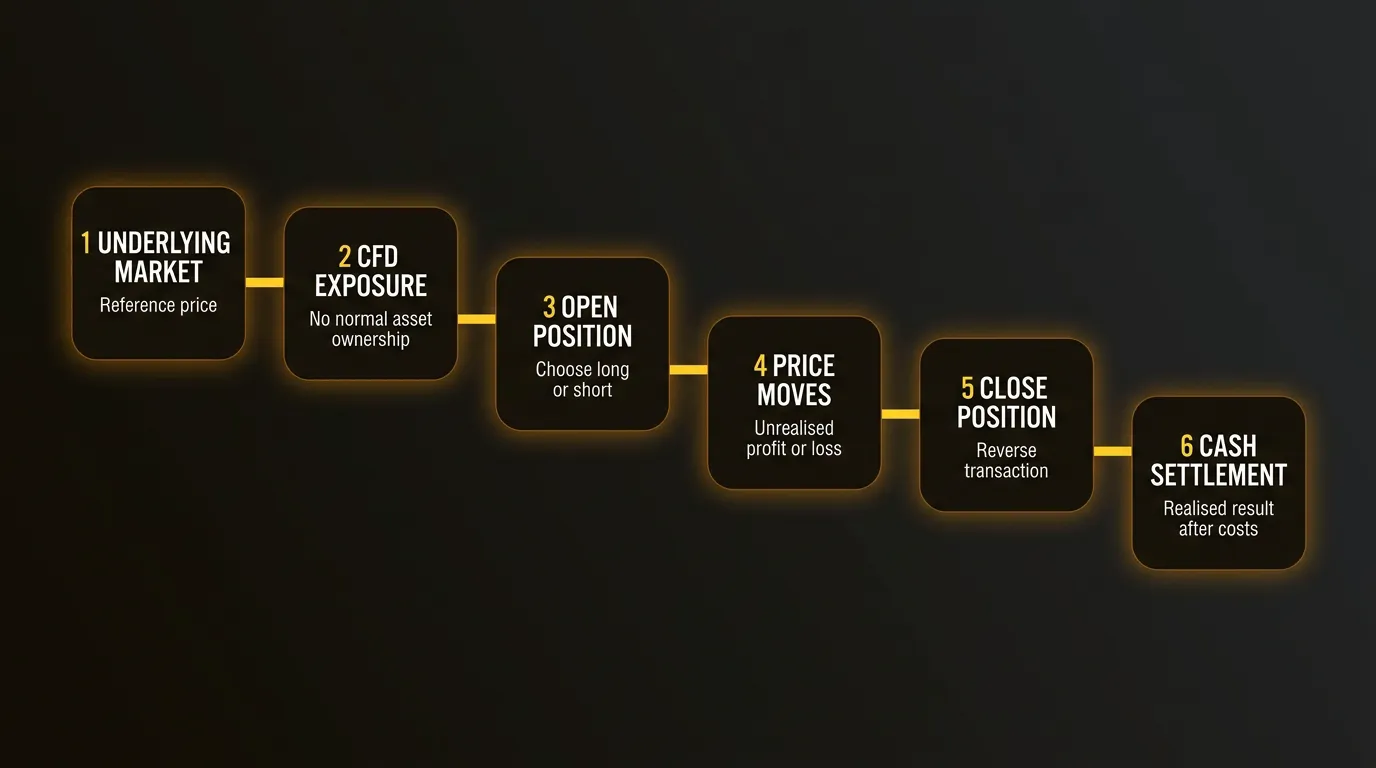
Singapore’s official MoneySense explanation of CFDs describes the same core structure as an opening trade followed by a reverse closing trade, with the CFD capturing the underlying asset’s price difference between them.
Opening a CFD Position
Opening a CFD position involves four practical choices:
- Select the underlying market. The CFD’s price is linked to that market, subject to the provider’s quoting and contract terms.
- Choose a direction. Open long for rising-price exposure or short for falling-price exposure.
- Choose the position size. This determines how much each unit of price movement affects the result.
- Accept the opening quote. The position begins at the applicable buy or sell price shown by the platform.
The quote matters because providers normally display separate buy and sell prices. A long position generally opens at the buy price and closes at the sell price; a short position generally opens at the sell price and closes at the buy price. The gap between those prices is the spread.
Opening the position does not mean buying the underlying asset. It starts a derivative contract whose value changes with the reference market.
Long and Short CFD Positions
A long and a short CFD use the same contract structure but respond to market direction in opposite ways.
Long position: The trader opens with a buy. If the relevant closing price is above the opening price, the position has a positive gross price difference. If it is lower, the difference is negative.
Short position: The trader opens with a sell. If the relevant closing price is below the opening price, the position has a positive gross price difference. If it is higher, the difference is negative.
Neither direction is inherently safer. A long position can lose when the market falls, and a short position can lose when it rises. Fast price moves, gaps and changes in liquidity can also affect the price available when a position is closed.
What Happens While the Position Is Open?
While a CFD remains open, the platform marks the position against current quoted prices. The resulting profit or loss is unrealised: it changes as the quote changes and is not final until the position closes.
Several factors can affect the displayed result:
- movement in the underlying market;
- the position’s long or short direction;
- position size and contract specification;
- the difference between buy and sell prices;
- commission where applicable;
- overnight financing, swaps or other holding adjustments where applicable;
- currency conversion or other product-specific adjustments.
Margin requirements also continue to matter. If adverse price movement reduces the available account equity, the trader may need more funds to maintain the position, or the provider may close positions under its margin and close-out rules. Those rules differ by provider, product and jurisdiction.
Closing a CFD Position
A CFD position is normally closed through the trading platform. Economically, this means completing the reverse side of the transaction: a long position is closed with a sell, while a short position is closed with a buy.
The closing quote ends the position’s exposure. At that point, its price difference is no longer unrealised. It becomes a realised result, subject to position size, the contract specification and any applicable costs or adjustments.
Some platforms allow separate opposing positions rather than automatically closing an existing one. Traders should therefore use the platform’s intended close function and understand its netting or hedging rules instead of assuming that every opposite order closes the original position.
How CFD Settlement Works
Retail CFDs are normally cash-settled. This means the provider does not usually deliver the underlying asset when the position closes. Instead, the economic difference between the opening and closing transactions is calculated and reflected as a credit or debit in the trading account, together with applicable costs and adjustments.
In this context, settlement does not mean that the trader receives shares, a commodity or another physical asset. It means that the contractual difference has been realised in cash-account terms according to the provider’s process.
The exact calculation may depend on the instrument’s units, contract multiplier, account currency, quote convention and product terms. Settlement timing and withdrawal availability are separate operational matters and should not be inferred from the closing of a position.
A Simple CFD Example
Consider an illustrative long CFD:
- Underlying reference price when opened: 100
- Long position size: 10 units
- Closing price: 105
- Price movement: +5 per unit
For this simplified example:
Gross CFD result before costs = (closing price − opening price) × position size
(105 − 100) × 10 = 50
The gross result is positive 50 in the relevant currency before spread effects, commissions, financing, conversion or other applicable adjustments.
If the same long exposure closed at 95 instead, the calculation would be:
(95 − 100) × 10 = −50
The gross result would be a loss of 50 before applicable costs. A short position reverses the directional relationship: a fall from 100 to 95 may create a positive gross difference, while a rise to 105 may create a negative one.
This example uses simple units and matching reference prices to explain the mechanics. Actual CFD results depend on the buy and sell quotes used to open and close, the contract specification and the provider’s current terms.
Where Leverage, Margin and Costs Fit
Leverage and margin determine how much collateral is needed to support a given exposure; they do not change the direction of the price difference. Because the full exposure responds to market movement, losses can be large relative to the margin committed.
Costs affect the result after the price movement is considered. Depending on the CFD, they may include the spread, commission, overnight financing or swaps, currency conversion and other disclosed charges. Current specifications and fee schedules should be reviewed before opening a position.
The UK Financial Conduct Authority describes CFDs as high-risk products that are not suitable for all retail consumers. Product availability, leverage limits, protections and eligibility differ by jurisdiction.
Explore Grand Markets Trading Accounts
Readers who understand the CFD lifecycle and want to review current account structures can explore Grand Markets trading accounts. If you are comparing different account formats, our guide to Forex cent accounts explains how they work, their benefits, trade-offs and common use cases. Check the live account cards, instrument tables, platform terms and risk information before deciding whether a product is appropriate for you.
Frequently Asked Questions
What Is a Contract for Difference?
A contract for difference is a derivative linked to an underlying market’s price movement. The trader normally does not own the underlying asset. The result is based on the difference between the opening and closing transactions, adjusted for position size, costs and contract terms.
What Are CFDs and How Do They Work?
CFD trading starts when a trader chooses an underlying market, direction and position size, then opens at the applicable quote. The position’s unrealised result changes as prices move. Closing ends the exposure, and the realised difference is normally cash-settled through the account.
Do You Own the Underlying Asset When Trading CFDs?
Normally, no. A CFD provides economic exposure to price movement rather than direct ownership of the referenced asset. Ownership rights, such as shareholder voting rights, do not normally arise from holding a share CFD.
What Happens When You Open a CFD Position?
Opening creates a long or short derivative position linked to a reference market. The opening quote and position size establish the starting point for measuring subsequent profit or loss, while margin is set aside under the provider’s rules.
How Do You Close a CFD Position?
You normally close a CFD through the platform’s close function, completing the reverse side of the original transaction. A long closes with a sell and a short closes with a buy. The applicable closing quote ends the exposure and realises the result.
How Are CFDs Settled?
CFDs are normally cash-settled. After a position closes, the difference between the opening and closing transactions—adjusted for position size, costs and other contractual items—is reflected as a credit or debit in the trading account rather than through delivery of the underlying asset.
Can You Go Long and Short With CFDs?
Yes. A long position has positive exposure to a price rise and negative exposure to a fall. A short position has positive exposure to a fall and negative exposure to a rise. Either direction can result in a loss.
How Does Leverage Affect a CFD?
Leverage allows the market exposure to exceed the margin posted. Price movement therefore affects the full exposure, which can magnify both gains and losses relative to the committed margin. Exact leverage and margin rules depend on the product, provider and jurisdiction.

Disclaimer:
This content does not constitute any offer, solicitation or advice. You should always seek independent professional advice before making any investment decision. Please note that Grand Markets may restrict or prohibit some or all services to users from restricted regions. Please read the User Agreement for more information.