
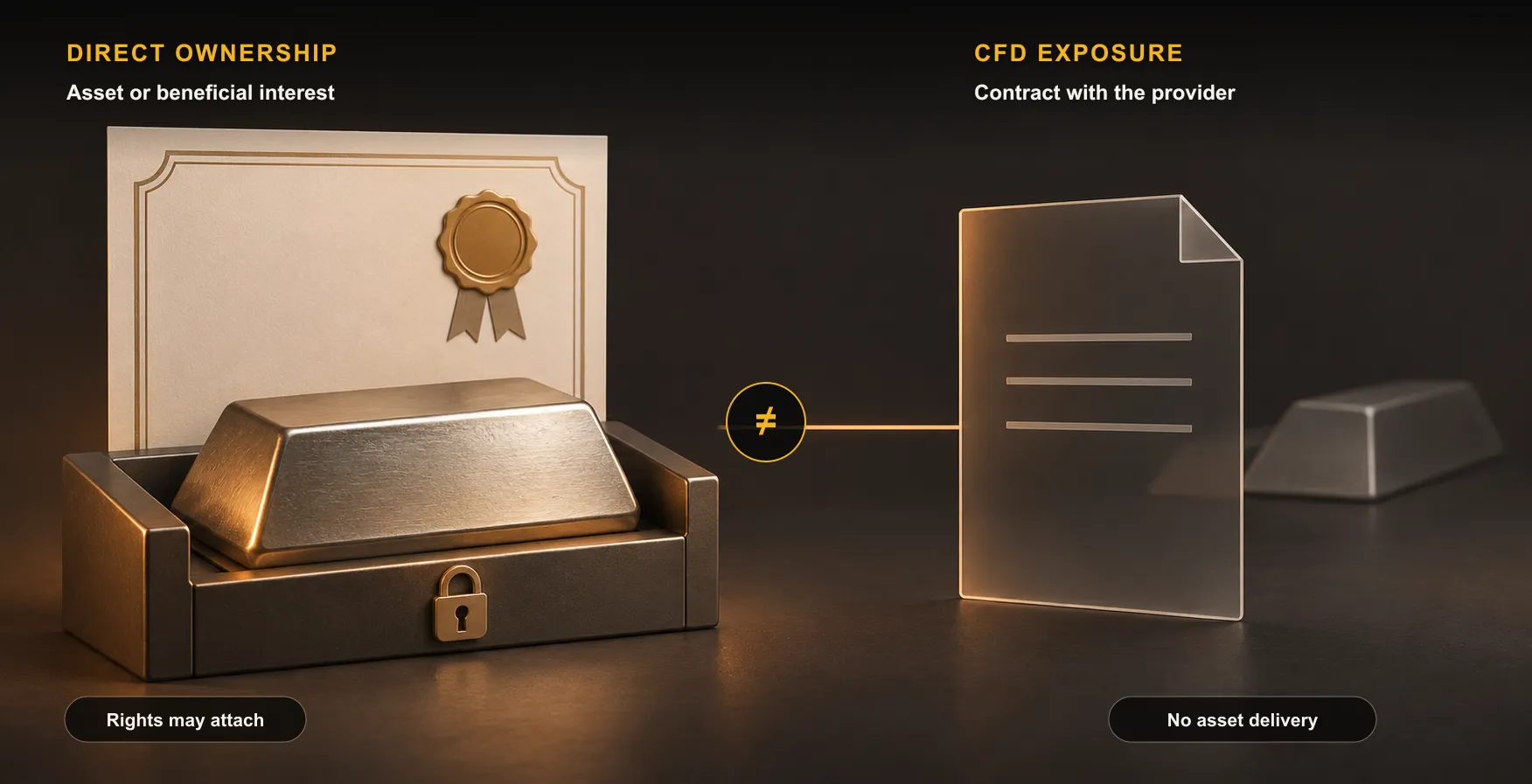
A CFD provides contractual price exposure to a market, while buying the underlying asset can provide ownership and the rights that go with it. In a CFD vs underlying asset comparison, the decisive issue is not simply which route has lower upfront capital. It is whether you need to own the asset itself or only gain exposure to its price movements.
A contract for difference can use margin, which may increase buying power but also magnifies losses. Direct ownership normally requires paying the full purchase value, unless you separately use borrowing or margin. Neither route is automatically suitable for every objective, market, or holding period.
CFDs are complex leveraged products and may not be suitable for all traders. Price changes, spreads, financing, margin requirements, liquidity, and execution can all affect results. Read the current Grand Markets risk disclosure before considering a CFD position.
CFD vs underlying asset: How price exposure differs from legal ownership
The central CFD vs underlying asset distinction is legal structure.
A CFD is a derivative agreement between you and the provider. Its value reflects the difference between the opening and closing price of a referenced market, such as a share, index, currency pair, commodity, cryptocurrency, or ETF. You generally do not receive delivery of the underlying asset.
Direct ownership means you buy the asset itself or obtain a beneficial interest through a broker or custodian. For example, buying shares can make you an eligible shareholder, subject to the share class, custody arrangement, local law, and the broker’s process.
| Feature | Direct underlying asset ownership | CFD position |
|---|---|---|
| What you hold | The asset, security, or beneficial interest | A contract referencing the market price |
| Asset ownership | Usually yes, depending on the asset and custody structure | Generally no |
| Voting rights | May apply to eligible shareholders | Generally no voting rights |
| Dividends | Eligible holders may receive declared distributions | A contractual dividend adjustment may apply |
| Upfront capital | Usually the full purchase value plus costs | Initial margin is often a fraction of notional exposure |
| Short exposure | May require stock borrowing or a separate arrangement | Sell positions may be available, subject to terms and availability |
| Ongoing financing | Usually none for fully paid holdings | Overnight financing or swap charges may apply |
| Corporate actions | Governed by issuer, exchange, and custodian processes | Handled under the provider’s CFD terms |
| Counterparty exposure | Includes broker, custodian, issuer, and market infrastructure risks | Includes provider performance risk under the CFD contract |
The deposit used for a leveraged CFD is margin. Margin is collateral that supports a larger market position. It is not a purchase price and does not create ownership rights.
This distinction is especially important for shares. A person who buys shares may have investor rights associated with those shares. A person who opens a share CFD has an agreement that tracks price changes, but normally does not become a shareholder.
For indices, the comparison differs slightly because an index is not usually a directly ownable asset. Investors may instead buy a fund or ETF designed to track the index. Holding ETF units can provide an interest in the fund, whereas an index CFD remains a price-exposure contract.
CFD vs underlying asset: Ownership rights, dividends, and corporate actions
Ownership rights are one of the clearest differences in an asset ownership comparison. Direct holders may have economic or governance rights, while CFD holders generally receive contractual treatment defined by the provider.
For share ownership, potential rights may include:
- Voting at shareholder meetings, where eligible.
- Receiving corporate communications through the applicable custody process.
- Receiving declared dividends when eligibility requirements are met.
- Taking part in certain corporate actions, such as rights issues or takeovers.
- Holding the security beyond a provider’s CFD product availability, subject to the issuer and market remaining available.
A CFD holder does not normally receive these rights directly. Grand Markets states in its risk disclosure that CFD transactions concern price differences and do not confer ownership or voting rights in the underlying asset.
Dividends are a useful example. An eligible shareholder may receive a dividend declared by a company. A long share-CFD position may instead receive a dividend adjustment intended to account for the expected price effect around the ex-dividend date. A short CFD position may be debited.
That adjustment is not the same as receiving a shareholder dividend. Its calculation can depend on the contract specification, applicable withholding assumptions, position direction, and provider policy.
| Corporate event | Direct owner | CFD holder |
|---|---|---|
| Cash dividend | May receive a declared distribution if eligible | May receive a contractual credit or debit |
| Stock split | Share quantity and price are adjusted | Contract size, price, or terms may be adjusted |
| Merger or takeover | May receive cash, shares, or election rights | Provider may adjust, close, or cash-settle the CFD |
| Rights issue | May receive rights or instructions through the custodian | Treatment follows CFD terms and may be an adjustment |
| Spin-off | May receive shares in a new entity if eligible | Provider may amend the contract or apply an adjustment |
| Delisting or suspension | The owned security may become illiquid or uncertain | Pricing, margin, or closure can be affected by provider terms |
Investor rights also depend on the specific market. Owning a cryptocurrency token, for instance, can involve wallet control and on-chain transfer capability, not conventional shareholder voting. A crypto CFD provides price exposure but does not provide token custody, private-key control, or network-transfer rights.
Before trading any product, review the provider’s terms for dividend adjustments, corporate actions, suspensions, and delistings. Client money protections and insolvency arrangements can also vary by legal entity and jurisdiction. The Grand Markets customer protection information should be read alongside the client agreement and risk disclosure.
CFD vs underlying asset: How leverage trading changes risk and capital use
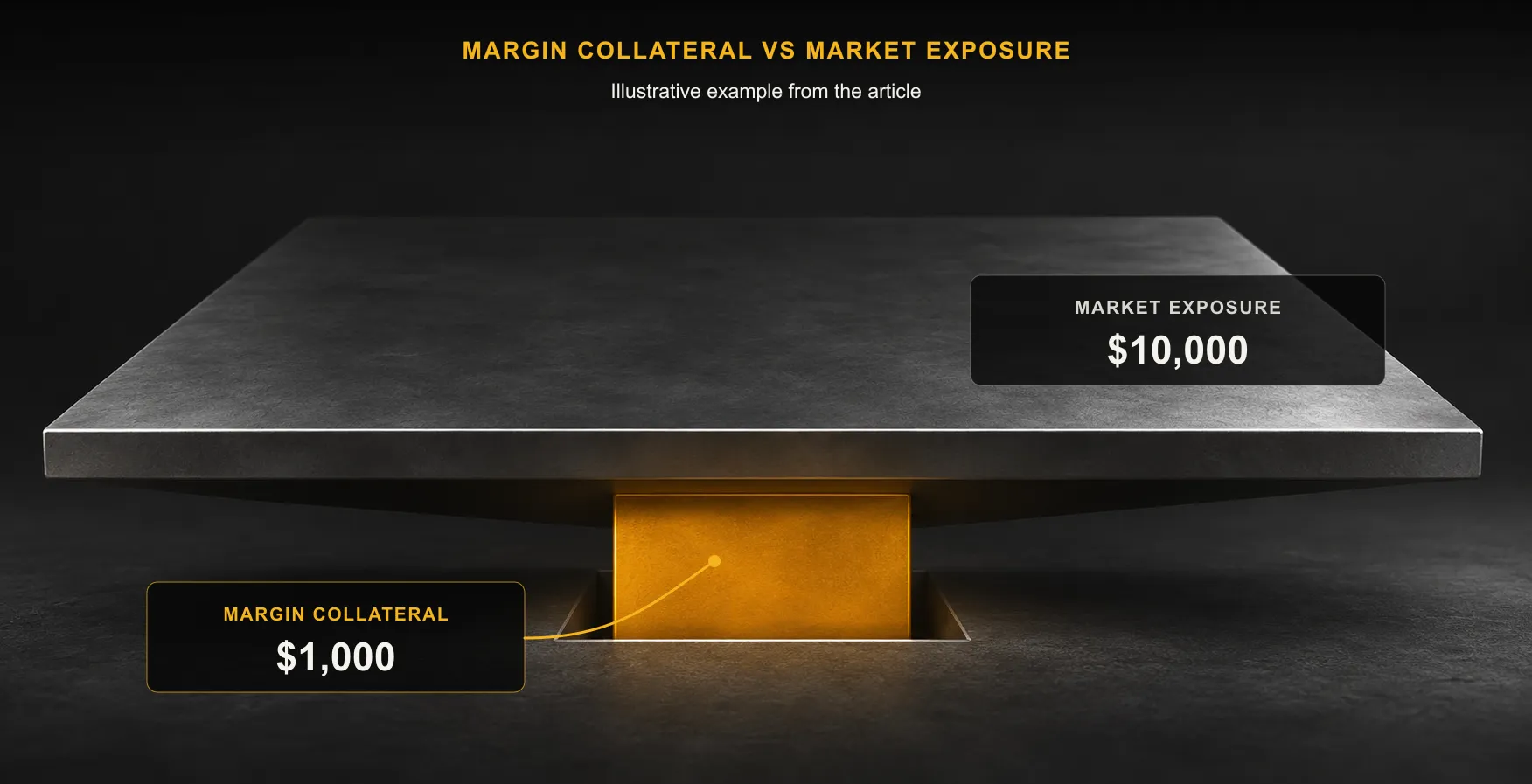
Leverage trading allows a smaller amount of capital to control a larger notional position. This can make a CFD position appear capital-efficient, but it also means losses are measured against the larger exposure, not only against the initial margin.
Consider a purely hypothetical example:
- CFD notional exposure: $10,000.
- Initial margin: $1,000.
- Implied leverage: 10:1.
- Market decline: 5 percent.
- Spread, commission, financing, tax, and slippage excluded.
A 5 percent decline on $10,000 equals a $500 loss. That is 50 percent of the $1,000 margin, even though the referenced market moved by only 5 percent.
This example is educational only and does not represent actual trading results. In real conditions, spreads, financing, volatility, market gaps, and execution conditions can make outcomes different.
With a fully paid direct asset purchase, the asset can decline in value substantially and may even become worthless. However, there is generally no routine margin close-out mechanism unless you used borrowed funds or a margin account.
With CFDs, adverse movements can reduce account equity quickly. Depending on the applicable terms, this may lead to:
- A lower margin level.
- A request to add funds or restricted trading.
- Automatic closure of one or more positions.
- A realised loss at available market prices.
Negative balance protection may apply for some retail clients in some jurisdictions, but it is not universal. It can differ by country of residence, legal entity, account classification, and product terms. Do not assume that it applies without checking the current agreement for your account.
For context, European regulatory measures established retail CFD protections including leverage limits, margin close-out rules, negative balance protection, and standardised risk warnings. The European Securities and Markets Authority explains that these safeguards are jurisdiction-specific and do not eliminate market risk.
Practical risk controls include smaller position sizing, monitoring free margin, understanding stop-loss limitations, and checking the calendar for earnings, central-bank announcements, and other events that can increase volatility. A stop-loss order is not necessarily a guaranteed exit price during fast or gapping markets.
CFD vs underlying asset: Trading costs over short and long holding periods
Trading costs should be compared over your intended holding period, not through a single spread or commission figure. A CFD may have lower initial capital requirements, but recurring financing can materially affect a position held overnight or longer.
| Cost category | Direct ownership | CFD exposure |
|---|---|---|
| Bid-ask spread | May apply when buying and selling | Commonly applies and can vary with market conditions |
| Commission | Broker or exchange charges may apply | May apply depending on account and instrument |
| Financing | May apply only when using borrowed funds | Overnight financing or swap charges may apply |
| Currency conversion | May apply for foreign assets or distributions | May apply when account, quote, and P&L currencies differ |
| Custody or account fees | May apply depending on broker or custodian | May be replaced by account or platform-related fees |
| Corporate-action treatment | Governed by issuer and custodian processes | May involve contractual adjustments |
| Taxes | Depends on residency, asset, and local rules | Depends on residency, product classification, and local rules |
CFD trading costs can include spread, commission, financing or swap charges, conversion costs, and instrument-specific adjustments. Grand Markets notes in its risk disclosure that applicable charges can include commissions, settlement fees, exchange fees, regulatory levies, legal fees, and swap fees.
A fully paid share or ETF purchase does not usually carry a daily leveraged-position financing charge simply because you continue holding it. However, direct ownership can still involve brokerage, exchange, custody, fund-management, foreign-exchange, and tax costs.
The holding period matters:
- Shorter-term CFD exposure: Financing may be less significant than for longer holding periods, but spread, volatility, and margin risk can still be substantial.
- Longer-term CFD exposure: Recurring overnight charges can accumulate and reduce net performance.
- Longer-term direct ownership: There may be no daily leverage financing cost on a fully paid position, but market losses, fund expenses, FX changes, and tax obligations remain relevant.
Review current pricing and account conditions before acting. The Grand Markets trading accounts page can help you locate account-specific information, but live terms, availability, and eligibility should always be confirmed.
Tax treatment is not universal. It can depend on your residence, activity, holding period, account structure, and how local law classifies the product. Seek independent tax advice for your circumstances.
CFD vs underlying asset: Comparing shares, forex, commodities, crypto, and ETFs
The meaning of "underlying asset" changes by market. The ownership comparison is strongest for shares and ETFs, while other markets require a more specific explanation.
| Market | What direct exposure can mean | What a CFD provides | Important distinction |
|---|---|---|---|
| Shares | Ownership or beneficial interest in a company | Price exposure to a share | CFD holders generally have no voting rights |
| ETFs | Ownership of ETF units | Price exposure to ETF units | ETF ownership differs from owning its individual holdings |
| Indices | Usually exposure through a fund, future, or option | Price exposure to an index level | An index itself is not a single purchasable asset |
| Forex | Holding one currency against another through a spot or bank arrangement | Contractual price exposure to a currency pair | No shareholder rights exist in either route |
| Commodities | Physical ownership may involve storage, delivery, and insurance | Price exposure without normal physical delivery | Physical ownership can be operationally complex |
| Cryptoassets | Holding tokens through self-custody or a custodian | Price exposure without wallet control | CFD holders do not control the token or private keys |
For forex, holding currency through a bank, exchange service, or spot arrangement differs from trading a currency CFD. Neither typically involves voting rights, but financing, rollover, settlement, and counterparty structures may be different. Readers researching currency markets can review forex trading information from Grand Markets.
For commodities, direct ownership may mean holding physical metal, energy products, or agricultural goods. This can introduce storage, transport, insurance, quality, and delivery considerations. A commodity CFD generally offers price exposure without those physical obligations. For a market-specific example, see Gold Trading.
For cryptoassets, direct ownership may provide the ability to transfer tokens, use a wallet, or interact with a blockchain network. A crypto CFD does not normally provide those features. It is a contract based on price movements and may include leverage, financing, and provider risk.
CFD vs underlying asset: Choosing based on objectives, rights, and trading education
Direct ownership is generally more aligned with people who need asset ownership, shareholder participation, direct dividend entitlement, or long-term exposure without routine CFD financing. It can also suit investors who prefer to avoid the margin close-out mechanics associated with leveraged derivatives.
A contract for difference may be relevant for people who specifically want flexible price exposure, the ability to take a short view where available, or access to multiple markets through one platform. Those potential features come with CFD risks and benefits that must be evaluated together, not separately.
Use this checklist before deciding which route to research further:
- Do you need ownership rights, voting rights, or direct corporate-action participation?
- Are you looking for a long-term holding or shorter-term price exposure?
- Can you explain how margin, stop-outs, and overnight financing work?
- Have you calculated all trading costs for the expected holding period?
- Do you understand what happens to your position during dividends, stock splits, or a takeover?
- Which Grand Markets legal entity and client classification apply to your account?
- Are negative balance protection, margin-close-out rules, and client-money arrangements confirmed in writing?
- Have you considered whether a fully paid asset purchase better matches your objective?
Good trading education means understanding the contract before placing a trade. You can review CFD trading information, explore the MetaTrader 5 platform, or use the available download options to practise order entry and margin monitoring where a demo environment is offered.
CFD vs underlying asset is ultimately a comparison between contractual price exposure and holding an asset or beneficial interest in it. Ownership can bring rights and responsibilities. CFDs can provide leveraged exposure, but they also add financing, margin, execution, and counterparty considerations. Confirm the current legal documents, costs, and protections that apply to your account before making any decision.
Explore CFD Trading With Grand Markets
If you understand the difference between owning an underlying asset and gaining price exposure through a CFD, the next step is to review the actual trading conditions that apply to the product you want to trade.
Grand Markets provides different trading account options and platform access for eligible clients. Before opening a CFD position, check the current instrument specification, minimum trade size, margin requirement, spread, commission or swap charges, trading hours and any account-specific conditions.
You can review the current Grand Markets Trading Accounts, explore the MetaTrader 5 platform, or view the available platform downloads. Always confirm the legal entity, product availability and applicable terms for your account before trading.
Risk Disclaimer
CFDs are leveraged products and involve a significant risk of loss. The information in this article is provided for general educational purposes only and does not constitute investment advice, a recommendation, or an offer to buy or sell any financial instrument.
Product availability, leverage, margin requirements, protections and trading conditions can vary by instrument, jurisdiction, legal entity and client classification. Before trading, review the applicable product specifications, Client Agreement and Grand Markets Risk Disclosure, and consider whether the product is appropriate for your circumstances.

Disclaimer:
This content does not constitute any offer, solicitation or advice. You should always seek independent professional advice before making any investment decision. Please note that Grand Markets may restrict or prohibit some or all services to users from restricted regions. Please read the User Agreement for more information.