
Leverage is the ratio between market exposure and the capital required to support it, while margin is the collateral committed to a leveraged position. They are related, not interchangeable. If equity or margin measures fall to provider-defined levels, a margin call or other position-management action may follow.
Leverage, Margin and Margin Calls at a Glance
Leverage, margin and margin calls describe different parts of the same mechanism. Leverage defines the relationship between exposure and collateral. Margin is the collateral required to open or maintain the position. A margin call concerns the account condition when equity no longer meets the provider’s applicable margin requirements.
| Concept | What it means | What it affects |
|---|---|---|
| Leverage | The ratio between market exposure and the capital or collateral required to support it | How much exposure can be controlled relative to committed capital |
| Margin | The collateral allocated to open or maintain a leveraged position | How much account equity is committed to supporting open positions |
| Margin call | A provider-defined account condition reached when equity or margin measures fall below an applicable requirement | May require attention or lead to restrictions or position management under the provider’s terms |
The difference between leverage and margin is therefore straightforward: leverage is a relationship expressed as a ratio, while margin is an amount of capital.
How Leverage Works in Trading
Leverage allows a position’s market exposure to be larger than the collateral assigned to support it. A leverage ratio of 10:1 means that each USD 1 of required margin supports USD 10 of market exposure under the assumptions of the example.
Leverage describes exposure; it does not describe profit probability. It also does not make the underlying market move more or less. Instead, it increases the effect that a given price movement has relative to the capital committed as margin.
If two positions have the same USD 10,000 market exposure, their gross profit or loss from the same price movement is the same before costs, even if their required margin differs. The more leveraged position commits less collateral to support that exposure, so the profit or loss represents a larger proportion of the committed margin.
How Margin Works in Trading
Margin in CFD trading and other leveraged products is collateral, not a purchase price and not a fee. The provider allocates part of the account’s equity to support the open leveraged position. That amount is commonly called required margin or used margin.
The conceptual calculation is:
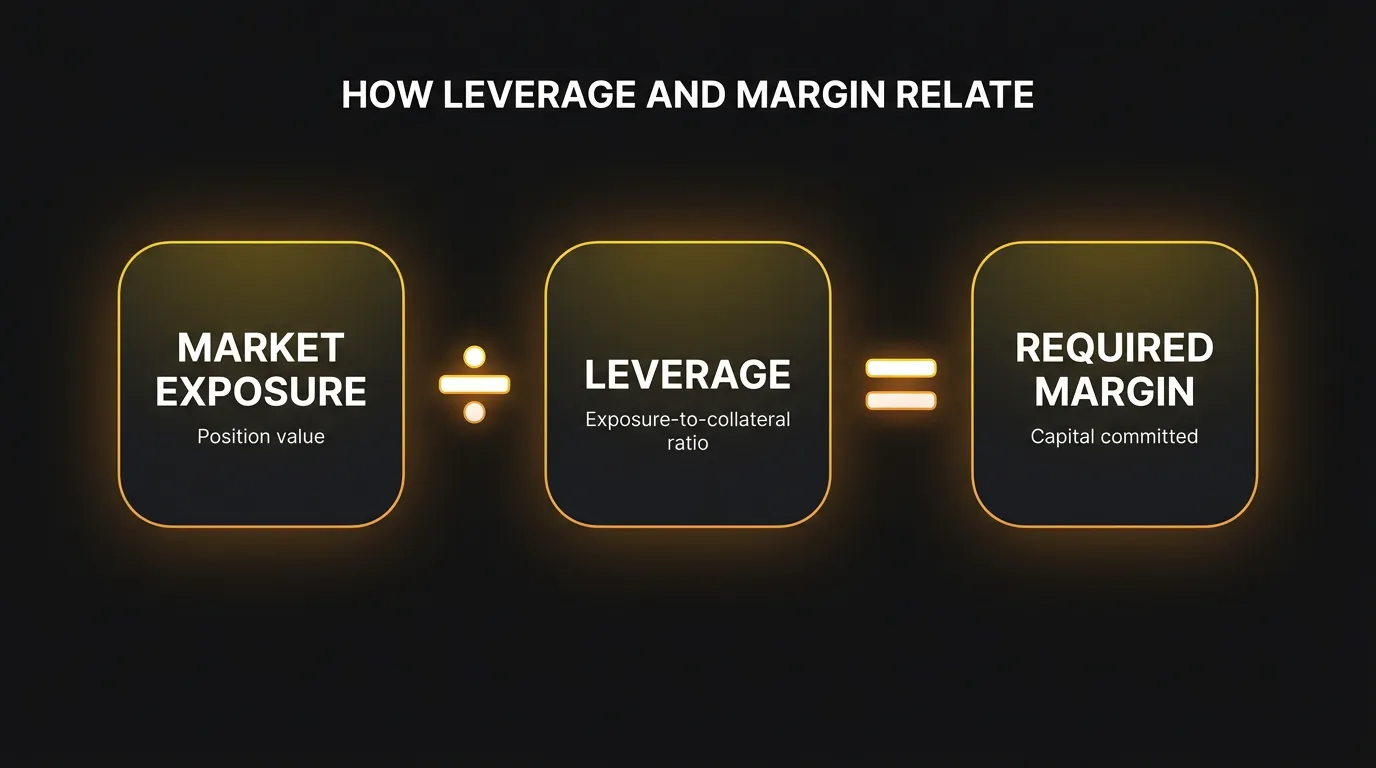
Required margin = market exposure ÷ leverage
The same relationship can also be expressed through a margin requirement. For example, 10:1 leverage corresponds conceptually to a 10% margin requirement because one-tenth of the exposure is required as collateral.
Actual calculations can depend on the instrument, position size, account currency, current conversion rates, account type, applicable leverage tier and provider rules. Margin requirements can also change. The trading platform’s current contract specifications and account terms therefore control the amount required for a real position.
Worked Example: Exposure, Leverage and Required Margin
Assume an illustrative position with:
- Market exposure: USD 10,000
- Leverage: 10:1
- Required margin: USD 1,000
The calculation is:
USD 10,000 ÷ 10 = USD 1,000 required margin
The USD 1,000 does not represent the maximum possible loss. It is the collateral required to support USD 10,000 of exposure under the example’s assumptions.
If the market moves 1% against the USD 10,000 position, the gross position loss would be USD 100 before trading costs:
USD 10,000 × 1% = USD 100 loss
That USD 100 is 1% of the market exposure but 10% of the illustrative USD 1,000 margin. A favorable 1% move would produce the same relationship in the other direction before costs. This is how leverage magnifies both gains and losses relative to the collateral committed.
This example is mathematical, not a Grand Markets account condition or a recommended leverage level. Real margin, leverage and loss calculations depend on current instrument and account specifications.
How Equity and Available Margin Change
An account’s margin condition changes as open positions gain or lose value. Several platform terms help describe what is happening:
| Account measure | General meaning |
|---|---|
| Balance | The account value before the unrealized profit or loss on open positions is included |
| Equity | The account value after current unrealized profit or loss is included |
| Used margin | The collateral currently allocated to support open leveraged positions |
| Available or free margin | The remaining capacity that may be available after used margin is considered |
| Margin level | A platform measure that compares equity with used margin, often displayed as a percentage |
Labels and calculations can differ by platform and provider. Available margin is commonly understood as the part of equity not committed as used margin, but the current trading system and account terms determine the displayed figure.
When the market moves against a position, unrealized losses reduce equity. Used margin may remain allocated while the position stays open, so available margin and the displayed margin level can decline. New positions may become unavailable before an account reaches a margin-call or stop-out condition.
Profitable movements increase equity and may increase available margin. This does not remove the exposure or guarantee that the favorable movement will continue.
What a Margin Call Means
A margin call happens when an account reaches a threshold set by the provider’s margin rules. In simple terms, it means the account’s equity has fallen too low relative to the margin being used to support open positions.
The term does not always mean that someone will contact the trader. Depending on the provider, product and account agreement, the system may display a warning, restrict new orders, require more funds or reduced exposure, or begin closing positions under separate stop-out rules. The sequence and available actions are not universal.
A margin-call level and a stop-out level should not be treated as synonyms unless the provider’s terms define them that way. A margin call may describe an earlier account condition, while stop-out rules may govern automatic position closure. Exact thresholds must be checked in the current account and product terms.
The illustrative USD 10,000 position above does not supply enough information to calculate a margin call. That would require the account balance, other positions, current unrealized profit or loss, used margin and the provider’s verified threshold rules. No universal percentage can be applied.
Leverage in CFD Trading
Leverage in CFD trading allows the contract’s market exposure to exceed the margin committed to the position. Profit and loss are calculated from the full position exposure and the price movement, not only from the margin amount.
This is why a small market movement can create a relatively large change in account equity. Higher available leverage can reduce the margin required for the same exposure, but it does not reduce the monetary effect of that exposure’s price movement.
CFD opening, closing and settlement mechanics are separate from the leverage calculation. The key point here is that margin supports the exposure; it does not cap the position’s potential gain or loss.
Higher Available Leverage Does Not Set Position Size
Available leverage is an account or product condition, not a position-size recommendation. A trader may have access to high leverage without using the maximum exposure available. Position size should be based on the trader’s risk plan, while leverage and margin determine how much collateral is required to support that position.
Margin Is Not a Trading Fee
Required margin is capital allocated to support a position. It is not automatically deducted as a charge when the position opens. When the position closes, the allocation is released subject to the resulting profit or loss and other account conditions.
Spread, commission, overnight financing, conversion and payment charges are different concepts. They can affect net results or the account balance, but they should not be added to required margin as though they were the same type of amount.
Explore Grand Markets Trading Accounts
To see the current leverage and margin conditions available at Grand Markets, review the Grand Markets trading accounts page. Account conditions can vary by account type and instrument. If you decide to get started, you can register for a Grand Markets account.
Frequently Asked Questions
What Is Leverage in Trading?
Leverage is the ratio between a position’s market exposure and the capital or collateral required to support it. At 10:1 leverage, USD 1 of required margin conceptually supports USD 10 of exposure, subject to current instrument and provider conditions.
What Is Margin in Trading?
Margin is the collateral allocated to open or maintain a leveraged position. It supports the exposure but is not the position’s purchase price, a trading fee or a guaranteed maximum loss.
What Is the Difference Between Margin and Leverage?
Leverage is a ratio showing exposure relative to required capital. Margin is the actual amount of collateral committed to support the position. Higher leverage generally means less required margin for the same exposure, while the exposure itself remains unchanged.
What Does a Margin Call Mean?
A margin call means the account has reached a condition defined by the provider’s equity and margin rules. Possible consequences can include warnings, order restrictions, a requirement for action or position closure under applicable terms. The process and thresholds differ between providers and products.
Does Higher Leverage Mean Higher Profit?
No. Higher available leverage does not make a trade more likely to succeed. It can permit the same exposure with less required margin or allow greater exposure, but gains and losses still depend on the full position size and market movement.
Is Margin a Trading Fee?
No. Margin is collateral allocated to support a leveraged position. Trading fees and costs, including spread, commission, financing and conversion where applicable, are separate and affect the account differently.
Can Leverage Increase Losses?
Yes. Leverage magnifies the effect of price movement relative to the capital committed as margin. An adverse move is calculated against the full market exposure, so losses can represent a large proportion of the collateral supporting the position.
Leverage, margin and margin calls form one connected mechanism: leverage defines the exposure-to-collateral relationship, margin supports the open position, and the account’s changing equity determines how much margin capacity remains. The provider’s current product and account rules determine the real thresholds and available actions.

Disclaimer:
This content does not constitute any offer, solicitation or advice. You should always seek independent professional advice before making any investment decision. Please note that Grand Markets may restrict or prohibit some or all services to users from restricted regions. Please read the User Agreement for more information.