
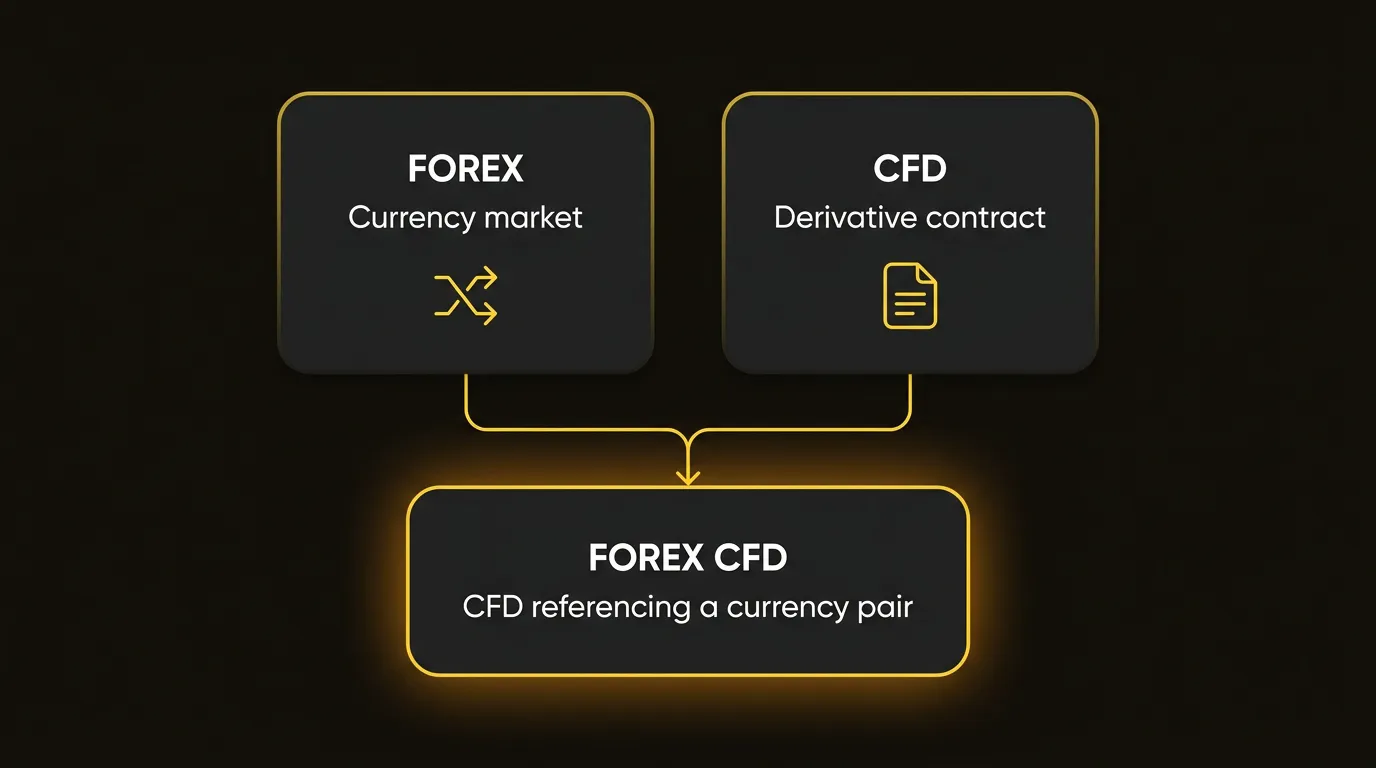
Forex is a market category built around exchanging or gaining exposure to currencies, while a CFD is a derivative contract that can track a currency pair or another market. The two can overlap: a Forex CFD provides currency-market exposure through a CFD product structure.
That distinction matters because "CFD trading vs Forex trading" is not always a simple choice between unrelated products. Forex describes the market being accessed. CFD describes one possible instrument used to access a market. Before comparing costs, risks or trading conditions, first identify the exact product behind the label.
This guide compares the two at a practical level without assuming that every Forex position is a CFD or that every CFD references currencies.
The Core Difference: Market vs Product Structure
Forex, short for foreign exchange, is the market for currencies. A Forex price is normally expressed as a currency pair, such as EUR/USD, showing the value of one currency relative to another.
A contract for difference, or CFD, is a derivative whose value follows the price movement of a referenced market. Depending on the provider, product terms and local availability, that reference may be a currency pair, share, index, commodity or another eligible market.
This creates an important overlap:
- A currency pair is part of the Forex market.
- A Forex CFD is a CFD that references a currency pair.
- A share or index CFD is a CFD, but it is not Forex.
- Currency exposure may also be obtained through instruments other than CFDs.
Foreign-exchange activity includes spot transactions, forwards, swaps, options and other structures. The Bank for International Settlements reports these categories separately in its 2025 Triennial Central Bank Survey of foreign exchange and OTC derivatives markets.
| Comparison point | CFD trading | Forex trading |
|---|---|---|
| Core meaning | Trading through a derivative contract linked to a reference market | Trading or gaining exposure to one currency relative to another |
| Market scope | May reference currencies and other eligible markets | Limited to currencies |
| Product structure | A CFD contract | May involve a Forex CFD, spot-style or rolling product, forward, future, option or another structure |
| Ownership | Normally provides price exposure without ownership of the referenced asset | Depends on the product; retail leveraged Forex does not necessarily involve delivery of currencies |
| Common terminology | Contract, underlying market, spread, commission, financing and position size | Currency pair, base currency, quote currency, bid, ask, spread, pip and lot |
| Trading hours | Depend on the referenced market and product schedule | Depend on the currency product, provider schedule and market conditions |
How the Two Types of Exposure Work
Forex exposure
A Forex position expresses a view on one currency relative to another. If a trader buys EUR/USD, the position is long the euro and short the US dollar in relative terms. If the quoted rate rises, the euro has strengthened against the dollar; if it falls, the euro has weakened against the dollar.
That description explains the market exposure, but not the legal product structure. The trade could be offered as a Forex CFD, a rolling retail product, a deliverable transaction, a future or another instrument. Product documentation is needed to determine what is actually being traded.
CFD exposure
A CFD position follows the price movement of its reference market. A long position may gain when the reference price rises and lose when it falls. A short position may gain when the reference price falls and lose when it rises. The result is based on the price difference, position size and applicable costs under the contract terms.
The trader normally receives price exposure rather than ownership of the referenced asset. The precise calculation method, contract size, settlement treatment and available order types depend on the specific CFD.
Where Forex CFDs fit
A Forex CFD combines both concepts. The reference market is a currency pair, while the instrument used to gain that exposure is a CFD. It therefore uses familiar Forex terminology – such as base currency, quote currency and pips – within a CFD contract structure.
This is why the instrument name matters more than a broad platform label. Two products may display the same currency pair but apply different settlement, margin, financing or contractual conditions.
Market Scope and Underlying Exposure
Forex has a focused market scope: currencies are always compared with other currencies. The range of available pairs may differ, but the underlying relationship remains one currency against another.
CFDs can have a broader scope because the contract can reference different markets. A provider may offer CFDs linked to currency pairs, indices, shares, commodities or other instruments. That does not mean every provider offers every category, or that every instrument is available on every account, platform or in every country.
Ownership is another useful distinction. A CFD normally tracks price movement without transferring ownership of the referenced asset. Forex requires more careful wording because the outcome depends on the instrument. Some foreign-exchange transactions involve settlement and delivery, while many retail leveraged products provide rolling or derivative exposure instead.
The practical check is simple: identify the reference market, then identify the product structure used to access it.
Pricing, Costs and Trading Mechanics
Both CFD and retail Forex products may show bid and ask prices. The difference between them is the spread, which can affect the cost of entering and exiting a position. Depending on the product and account, additional charges may include commission, overnight financing, swap or rollover adjustments, and currency-conversion costs.
The terminology can differ even when the economic effect is similar. An overnight charge may be described as financing on one CFD and as a swap or rollover adjustment on a Forex position. A commission may be included in the spread for one account and charged separately for another.
Neither label proves that a product is cheaper. A useful comparison needs the same position size, holding period and market conditions, together with the current spread, commission and financing rules. Grand Markets keeps current account-level information on its Trading Accounts page; readers should review the maintained conditions rather than relying on a generalinformation for dynamic values.
Long and short mechanics are also broadly similar at a high level: gains or losses depend on whether the market moves in the direction of the position. The actual calculation unit may be expressed in contracts, units, lots, points or pips, depending on the instrument.
How Gains and Losses Are Calculated
The two categories use different conventions to translate a price move into a gross result. Neither convention is more complex than the other; they simply use different units.
These examples are illustrative only and exclude spread, commission, financing, slippage and other charges. They are not a live quote or a Grand Markets price.
CFD calculation convention: points moved x units x point value = gross movement.
Assume a trader buys 100 CFD units on an index quoted at 5,000 points, where each point is worth $1 per unit.
| Calculation | Illustrative result |
|---|---|
| Gross P&L if the index rises 10 points | 10 x 100 x $1 = +$1,000 |
| Gross P&L if the index falls 10 points | 10 x 100 x $1 = -$1,000 |
Forex calculation convention: gross movement can be estimated from the price change multiplied by the base-currency position size, or from the number of pips moved multiplied by the pip value for that position.
Assume a trader buys 0.10 lot of EUR/USD at 1.1000 and closes at 1.1020.
- Position size: 0.10 lot, or 10,000 EUR of notional base-currency exposure.
- Price movement: 1.1020 minus 1.1000 = 0.0020, equivalent to 20 pips for most non-JPY pairs.
- Approximate gross P&L: 10,000 EUR x 0.0020 = approximately +$20 gross movement.
If EUR/USD had moved to 1.0980 instead, the approximate gross P&L would be -$20.
In both examples, the gross result is determined by the full market exposure and the instrument’s calculation convention, not by the amount of margin posted.
Leverage and Margin: Where They Overlap
CFDs and many retail Forex products use leverage. Leverage allows a position to create market exposure larger than the margin initially committed. That increases sensitivity to price movements: both gains and losses are based on the full exposure, not only on the margin amount.
Margin is the capital required to open or maintain a leveraged position. Required margin, margin-call processes and close-out rules vary by product, provider, account and jurisdiction. A lower margin requirement does not make a position less risky; it means less capital supports the same exposure.
The most useful comparison is therefore not "Are CFDs leveraged, but Forex is not?" Both may be leveraged. Instead, compare the actual exposure, margin requirement and loss potential of the specific products being considered.
For example, a 5% margin rate means that an illustrative $20,000 position could require $1,000 in initial margin. The position still moves according to the full $20,000 exposure: a 1% favourable movement would create a gross gain of $200 before costs, and a 1% adverse movement would create a gross loss of $200 before costs. This is why a lower margin requirement does not mean lower risk — it means less capital is required initially to support the same market exposure.
Trading Hours and Product Conditions
Forex is traded across international financial centres during the working week, but that does not guarantee continuous access to every pair or product. Provider schedules, maintenance periods, holidays, liquidity and local market conditions can affect availability.
CFD trading hours normally follow the schedule set for the referenced market and the product. A CFD linked to a share or index may have different hours from a Forex CFD. Some products may also have daily breaks, expiry dates or rollover arrangements.
For either category, check the current instrument specification rather than assuming that a broad "24-hour" description applies to every product. Trading-hour differences can also affect spreads, liquidity and the handling of orders around market openings or closures.
Risks and Availability
CFDs and leveraged retail Forex products share several material risks:
- Leverage can magnify losses as well as gains.
- Prices may move quickly during volatile or thin market conditions.
- Spreads can widen, and orders may execute at a different price than expected.
- Overnight charges can affect positions held beyond a daily cutoff.
- Margin rules may lead to positions being closed when account equity falls.
- Product protections and eligibility can differ by legal entity and jurisdiction.
The reference market can add its own risks. Currency pairs may react to interest-rate expectations, economic data and central-bank decisions. CFDs linked to shares, indices or commodities may respond to different market schedules and events.
Regulatory treatment also varies. For example, the UK Financial Conduct Authority describes CFDs as high-risk products and includes rolling spot foreign exchange within its UK CFD oversight framework. Its CFD information is useful jurisdiction-specific context, but UK rules and protections should not be assumed to apply globally.
No product is universally safer because it carries a Forex or CFD label. Risk depends on the exact instrument, leverage, position size, volatility, holding period, costs and applicable protections.
How to Think About the Choice
The most useful choice is usually not simply “CFD or Forex?” because these categories can overlap. Start by identifying the market you want exposure to and then the product structure being used to access it.
If your focus is specifically on currencies, compare the Forex product being offered: how it is structured, how prices are quoted, what costs apply, how margin works and when the product can be traded.
If you want access to a broader range of markets through a derivative structure, CFDs can reference currencies as well as other eligible markets such as indices, shares or commodities, depending on the product offering.
If the Forex product itself is a Forex CFD, then Forex and CFD are not competing alternatives. The better comparison is between the actual products available to you: their market exposure, pricing model, margin requirements, trading hours, contract terms and applicable protections.
A practical way to frame the decision is:
- Primarily interested in currency markets: focus on the specific Forex product and its terms.
- Interested in several market categories through one derivative structure: compare the available CFD products.
- Comparing a Forex CFD with another CFD: focus on the underlying market and contract specifications rather than the labels alone.
- Choosing between two actual trading products: compare costs, margin requirements, trading hours, product structure and risk on a like-for-like basis.
Neither label determines which product is better. The most useful decision comes from comparing the specific exposure and terms that apply to the products being considered.
Which Differences Matter Most to a Beginner?
For a beginner, the category distinction is useful only if it leads to better product checks. Before considering a trade, ask:
- What market does the position reference? Is it a currency pair or another market?
- What instrument is being offered? Is it a CFD, spot-style Forex product, future, option or another structure?
- Does the position provide ownership or only price exposure? Read the contract rather than inferring from the symbol.
- What is the full exposure? Compare the economic position size, not only the required margin.
- Which costs can apply? Review spread, commission, conversion and overnight charges.
- When can the product be traded? Check its current schedule and any breaks or expiry conditions.
- Which protections and restrictions apply? Confirm the legal entity, local eligibility and risk disclosures.
The aim is not to decide that CFD or Forex is universally better. It is to understand the market, identify the instrument and compare its current terms on a like-for-like basis.
Frequently Asked Questions
Is CFD trading the same as Forex trading?
No. Forex is the market for currencies, while a CFD is a derivative contract that can reference a currency pair or another market. They overlap when the product is a Forex CFD.
Can you trade Forex through CFDs?
Yes. A Forex CFD tracks the price movement of a currency pair through a CFD contract. The exact contract size, margin, costs and settlement treatment depend on the product terms.
Do you own the underlying asset when trading a CFD?
Normally, no. A CFD generally provides contractual exposure to the referenced market’s price movement rather than ownership of the underlying asset or its associated rights.
Are CFDs riskier than Forex?
There is no universal answer because the categories overlap. A Forex CFD is both Forex exposure and a CFD. Risk depends on the instrument, leverage, position size, volatility, costs, holding period and applicable protections.
Do CFDs and Forex have different costs?
They can, but the label alone does not determine cost. Both may involve spreads, commissions, overnight financing or rollover, and conversion charges. Compare the current terms for the specific instrument and account.
Can CFDs cover markets beyond currencies?
Potentially. Depending on the provider, product terms and jurisdiction, CFDs may reference shares, indices, commodities, currencies or other eligible markets. Current availability should always be verified.
Where can I review Grand Markets account and platform options?
Review the current Grand Markets Trading Accounts and the desktop resources for MetaTrader 4 and MetaTrader 5. Product and platform availability may vary, so check the current information before making a decision.
Risk notice: This article is educational and does not provide investment advice or a trading recommendation. Leveraged Forex and CFD products involve a high level of risk and may result in significant capital loss.

Disclaimer:
This content does not constitute any offer, solicitation or advice. You should always seek independent professional advice before making any investment decision. Please note that Grand Markets may restrict or prohibit some or all services to users from restricted regions. Please read the User Agreement for more information.