

Forex scalping is a short-term trading style that aims to capture relatively small price movements through brief trades, often held for seconds or minutes. Because the target movement is usually limited, spreads, commissions, slippage and execution quality can have an unusually large effect on the final result.
Scalping may involve many trades during a session, but there is no universal holding period, trade count or chart interval that defines it. A short holding period also does not mean low risk: losses can develop quickly, and frequent trading repeats both opportunities and costs.
What is scalping in Forex?
Scalping in Forex means opening and closing currency positions over short periods to seek relatively small price movements. It is generally an intraday approach, so positions are normally closed rather than carried for days.
The defining idea is not simply “trading fast.” A complete scalping approach needs:
- a clear setup and entry condition;
- a planned exit if the trade moves as expected;
- an invalidation point if it moves the other way;
- a position size based on the amount at risk;
- costs and actual execution included in the result.
Some scalp trades last seconds and others last several minutes. Market conditions, the instrument and the trader’s rules matter more than an arbitrary time limit.
Scalping focuses on small short-term movements because the trader is trying to complete the trade before a much larger market move develops. That can create more possible decision points during a session, but it does not mean every small fluctuation is tradable. A valid opportunity still needs enough potential movement to justify the expected costs and risk.
A small target should not be confused with a small potential loss. The monetary outcome depends on position size, the distance to the invalidation point and the actual execution price. A large position targeting only a few pips can still lose a substantial amount if price moves sharply, a stop fills beyond its intended level or the trader delays the exit.
How Forex scalping works
A typical scalping trade follows a compact sequence:
- The trader identifies a short-term setup in a currency pair.
- Before entering, they check the current bid and ask prices, relevant costs and market conditions.
- An order is submitted with a planned target and invalidation level.
- The position is closed when the target, protective exit or time-based rule is reached.
- The result is reviewed using the actual entry and exit prices, plus any separately charged commission.
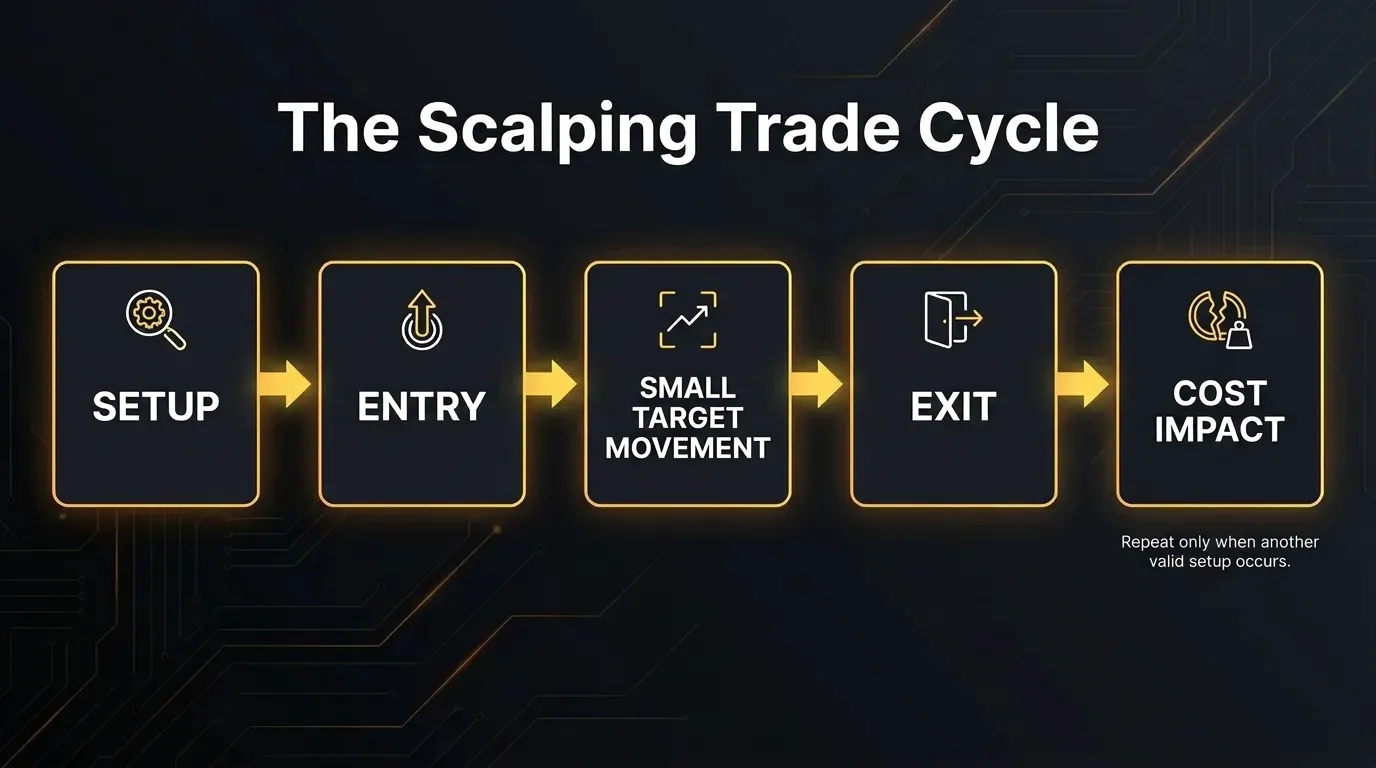
A scalping trade cycle is complete only after trading costs are included in the result.
A trader may repeat the process when another valid setup appears. Repetition alone is not an advantage: forcing extra trades can increase cost exposure and the chance of errors.
Entry, invalidation and exit rules work as one system. The entry defines when the position is opened. The invalidation rule identifies when the original reason for the trade is no longer valid. The exit rule determines when to close after a favorable move, an adverse move or the expiry of a time limit. If one part is missing, the trader may enter quickly but have no consistent basis for managing the open position.
Two trades with the same holding period can also produce very different outcomes. A two-minute trade during stable conditions may fill close to the displayed prices, while a two-minute trade during an abrupt news-driven move may face a wider spread, rapid repricing or slippage. Time in the market does not describe the conditions experienced during that time.
A simple Forex scalping example
Suppose the underlying or reference price moves 5 pips in the trader’s favour and, before trading costs and execution effects, that movement would correspond to USD 50 for the selected position size. In this illustration, the position has a pip value of USD 10, so the gross reference-price movement is:
5 pips × USD 10 per pip = USD 50
Now assume, purely for illustration, that the spread effect is USD 8, separately charged commission is USD 7 and adverse slippage is USD 3:
USD 50 − USD 8 − USD 7 − USD 3 = USD 32
The example shows why a favorable movement in a reference or chart price is not the same as the net trading result. These figures are illustrative only; actual pip values, spreads, commissions and fills depend on the instrument, position size, account conditions and market at the time.
If profit or loss is calculated directly from actual fill prices, the spread and slippage effects are already reflected in those prices. They should not then be deducted a second time. Separately charged commission and any other applicable charges still need to be included.
Why spreads and commissions matter so much
The spread is the difference between the bid and ask prices. A long position normally opens at the ask and closes at the bid, while a short position normally opens at the bid and closes at the ask.
Because a scalp trade targets a small movement, even a modest spread can represent a meaningful share of that target. Commissions can add another cost at entry, exit or both, depending on how the account is priced.
The proportional effect becomes clearer when the same cost is compared with targets of different sizes. If total trading and execution effects are equivalent to 1 pip, they represent one-third of a 3-pip gross movement but only one-tenth of a 10-pip gross movement. Neither target is recommended here; the comparison simply shows why the same cost matters more when the intended movement is smaller.
The relationship also changes the break-even requirement. A trade must first overcome its applicable spread, commission and execution effects before producing a positive net result. If those costs rise while the intended target stays the same, less of any favorable movement remains. If the gross movement is smaller than the total cost effect, a directionally correct trade can still finish with a net loss.
Trade frequency also matters. A cost that appears small on one trade is incurred repeatedly when many trades are placed. This is why scalping should be assessed using net results rather than gross winning trades or win rate alone.
For example, repeating the same cost across ten trades creates ten separate cost events. Higher trade frequency does not make those costs disappear, and a high percentage of winning trades may still be insufficient if average gains are small relative to costs and losses.
Overnight financing is usually less central to a trade closed quickly, but it can still apply if a position remains open across the product’s relevant cutoff. The exact treatment depends on the instrument and account terms.
Why execution quality matters
Execution speed is one part of execution quality, not a guarantee of a favorable result. A fast order can still fill at a different price from the one displayed when the order was submitted.
Important execution concepts include:
- Order latency: the time between submitting an instruction and receiving a response or fill confirmation.
- Fill price: the price at which the order is actually executed.
- Slippage: the difference between a relevant expected or requested price and the actual fill. Slippage can be favorable or unfavorable.
- Rejection or requote: an order may not be accepted at the original terms, depending on the execution method and market conditions.
- Partial fill: only part of the requested quantity may be executed where the relevant order and venue rules permit it.
The price visible on a screen can change before an order reaches the execution stage. Rapid price movement, available liquidity, network conditions, platform processing and order type can all affect the outcome.
The official MetaTrader 5 order-execution guide explains that execution behavior varies by mode and order type. The broker’s configuration and instrument rules determine which options are available in practice.
Low latency can reduce one source of delay, but it cannot eliminate slippage, liquidity constraints or price movement. Milliseconds alone do not determine whether a scalping approach is profitable.
Good execution is therefore multi-dimensional. It includes how quickly an order is processed, the price obtained, whether the requested quantity is filled, how consistently orders are handled and what happens during rapid repricing. A quick rejection or a fast fill at a materially worse price may be fast in a narrow technical sense without being a good outcome for the trade.
Available liquidity matters because an order needs sufficient interest at executable prices. If the full requested quantity is not available at one price, the order may be filled across several prices, partially filled or left incomplete, depending on the order, venue and provider rules. This effect can become more important as order size increases or market conditions become less stable.
How market, limit and stop orders differ
The order type changes which uncertainty the trader accepts. None is universally best for scalping.
Market orders prioritize obtaining execution at available prices. They may be useful when entering or exiting promptly matters more than controlling the exact price, but the fill can differ from the price displayed when the order was submitted.
Limit orders set the worst acceptable execution price: a buy limit should execute at the limit or lower, while a sell limit should execute at the limit or higher. The trade-off is that the market may never reach the required price or sufficient quantity may not be available. Partial filling can also be possible under the relevant rules.
Stop orders become executable after a trigger is reached. The trigger starts the execution process; it does not necessarily guarantee that the fill will occur at that exact price. During rapid movement, the resulting execution may differ from the trigger.
When market conditions make scalping harder
Spreads and execution conditions are not constant. They can change with:
- the currency pair being traded;
- available liquidity;
- volatility and rapid price movement;
- scheduled economic announcements;
- the trading session;
- the provider and account conditions.
Several conditions can be particularly difficult for a short-target approach:
- Thin liquidity: fewer orders or less available quantity near the current price can make fills less predictable and increase the market impact of an order.
- Rapidly widening spreads: the distance between bid and ask can consume a larger share of the intended movement before the trade has time to develop.
- Scheduled economic releases: prices can reprice quickly when new information arrives, increasing the possibility of slippage, gaps between quoted levels or rejected instructions.
- Unexpected news: an unplanned event can change volatility and liquidity without the advance warning provided by an economic calendar.
- Trading resumptions: conditions can be unsettled when an instrument resumes after a scheduled provider/venue break or when the broader Forex market reopens after the weekend, particularly if new information accumulated during the closure.
- Holiday or thin-session trading: reduced participation may produce irregular price movement or less depth even when the market remains open.
- Platform or connection instability: a short-duration trade allows little time to respond if prices, order status or account information cannot be observed reliably.
Different sessions and session overlaps can have different participation and liquidity characteristics. More active periods may offer greater participation, but they can also bring sharp movements and less predictable fills. News can alter otherwise normal conditions within any session.
It is therefore too simplistic to call one session or overlap universally “the best time to scalp.” The relevant question is whether the live conditions match the spread, volatility and execution assumptions used in the trader’s plan.
Scalping vs day trading vs high-frequency trading
Scalping is usually considered a particularly short-term form of day trading. Day trading is broader and can include positions held for minutes or hours, provided they are closed within the trading day. Neither term automatically means high-frequency trading.
| Feature | Forex scalping | Broader day trading | High-frequency trading |
|---|---|---|---|
| General category | Short-term trading style | Broad intraday trading category | Technology-intensive automated trading activity |
| Typical holding period | Often seconds to minutes | Often minutes to hours | Can be extremely short, but duration alone does not define it |
| Decision process | May be discretionary or systematic | May be discretionary or systematic | Generally automated and infrastructure-dependent |
| Activity level | Can involve many trades | Often lower, but varies | Usually involves very high message or order activity |
| Cost and execution focus | Small price differences and repeated costs can materially affect each result | Importance varies with the method and target size | Depends on specialized systems, market access and infrastructure |
Trading quickly through a retail platform does not by itself make an activity HFT. Professional high-frequency trading generally depends on automated systems, specialized infrastructure and very high processing and messaging capacity. This article uses “scalping” to describe the short-term trading style, not that professional market activity.
None of these categories has a guaranteed advantage. Their risks, workload and suitability depend on the rules, technology and market conditions involved.
Scalping-specific risks and challenges
Scalping concentrates several practical risks into a short period:
- Transaction-cost drag: repeated spreads and commissions can consume a large part of small gross gains.
- Slippage and execution uncertainty: a small adverse difference can materially change a narrow target.
- Rapid losses: short holding periods do not prevent sudden price moves.
- Overtrading: high decision frequency can encourage trades that do not meet the original setup.
- News risk: economic announcements can cause abrupt movement, wider spreads or uncertain fills.
- Leverage risk: leverage can amplify gains and losses; it does not improve the quality of a setup.
- Operational disruption: connection, platform or device problems can make it difficult to observe or manage a short-duration position.
- Fatigue and rushed decisions: repeated rapid decisions can reduce attention and encourage inconsistent entries or exits.
- Loss clustering: several losses can occur close together when volatility changes or the same market assumption repeatedly fails.
A stop order can help define an intended exit, but it does not guarantee an exact fill price. The position size should therefore reflect the possibility that the actual loss may differ from the planned amount.
These risks can interact. For example, a volatility spike may widen the spread, increase slippage and produce several losing trades before a trader recognizes that the original market conditions have changed. A predefined pause or session-loss limit can restrict further activity, but it cannot guarantee a particular outcome.
What to check before using a scalping approach
Before attempting Forex scalping, review:
- Current spread: check the executable bid and ask rather than relying only on an advertised minimum.
- Commission structure: confirm whether commission applies per side, per completed trade, per lot or under another calculation.
- Pip or tick value: understand how much each price increment represents for the selected instrument and position size.
- Available order types: know which market, limit, stop and other instructions are supported for the instrument.
- Fill rules: check how partial fills, rejections, requotes and order expiration are handled where relevant.
- Liquidity and volatility: assess whether live conditions are reasonably consistent with the assumptions behind the planned trade.
- Scheduled events: review the economic calendar for releases that could cause abrupt repricing.
- Trading hours: confirm the instrument’s open times, daily interruptions and relevant server-time convention.
- Stop and exit logic: define the invalidation level, target and any time-based exit before entering.
- Position size: connect the position’s pip value and invalidation distance to the acceptable monetary risk.
- Maximum acceptable loss: decide in advance when one trade, a sequence of losses or a session should end.
- Provider/account rules: check whether the intended trading activity is permitted under the applicable account, instrument and platform terms.
Grand Markets publishes current information about fees, spreads and commissions. This educational article does not establish that any particular scalping method is permitted; the applicable account, instrument and service terms should be checked directly.
Forex scalping FAQs
How long does a Forex scalp trade last?
There is no fixed duration. Scalp trades are commonly held for seconds or minutes, but the exit should follow the rules of the setup rather than an arbitrary clock.
Why are spreads important for scalping?
Scalping usually targets small price movements, so the spread can represent a large share of the intended gain. Frequent trading also repeats the spread cost.
What is slippage in Forex scalping?
Slippage is the difference between a relevant expected or requested price and the actual execution price. It can be favorable or unfavorable and may have a larger proportional effect when the target is small.
Is scalping the same as day trading?
Scalping is generally a very short-term type of day trading. Day trading is broader and may include positions held for much longer within the same trading day.
Does faster execution guarantee better scalping results?
No. Speed is only one part of execution quality. Fill price, slippage, liquidity, order handling, costs and the trading method itself also affect the result.
Is Forex scalping risky?
Yes. Scalping can involve rapid losses, repeated transaction costs, slippage, leverage and pressure from frequent decisions. Closing trades quickly does not make the approach low risk.
Forex scalping is best understood as a complete process: identify a setup, define risk, enter and exit according to clear rules, then evaluate the result after costs and actual execution. Small targets make precision important, but neither speed nor trade frequency creates an edge by itself.
This content is for educational purposes only and does not constitute personalized investment advice. Forex and CFD trading involve substantial risk of loss.

Disclaimer:
This content does not constitute any offer, solicitation or advice. You should always seek independent professional advice before making any investment decision. Please note that Grand Markets may restrict or prohibit some or all services to users from restricted regions. Please read the User Agreement for more information.