
Trading risk management connects the loss a trader is prepared to accept with position size, stop-loss placement, take-profit planning and the risk/reward ratio. Used together before entry, these controls define exposure and possible outcomes; they do not prevent losses or guarantee that orders will execute at the requested price.
What Is Trading Risk Management?
Trading risk management is the process of deciding how much capital to expose, where a trade idea is no longer valid and whether the potential reward justifies the planned risk. The aim is not to eliminate uncertainty. It is to define the consequences of a trade before the market decides the outcome.
Four building blocks work together:
| Building block | Question it answers | Role in the plan |
|---|---|---|
| Position size | How much volume should be traded? | Aligns the trade’s exposure with the chosen risk amount and stop distance. |
| Stop-loss | Where should the trade close if price moves against the idea? | Defines the planned adverse exit and helps estimate the potential loss. |
| Take-profit | Where could the trade close if price moves in the intended direction? | Defines a planned favorable exit and helps estimate the potential reward. |
| Risk/reward ratio | How does potential loss compare with potential gain? | Provides a consistent way to compare the two planned outcomes. |
These elements are interdependent. A wider stop with the same position size increases the amount at risk. If the risk amount must remain unchanged, the position size generally needs to decrease as the stop distance increases. A closer stop usually allows a larger position for the same planned risk, although the stop should still reflect the trade idea rather than be placed only to obtain a preferred volume.
Position Sizing Starts With a Risk Amount
Position sizing determines the trade volume. A trader normally starts with an account balance and chooses an illustrative monetary or percentage amount that could be lost if the stop is reached. That figure is the risk amount for the calculation, not a promise that the final loss cannot exceed it.
For example, an account balance of USD 10,000 and an illustrative risk level of 1% gives a planned risk amount of USD 100:
USD 10,000 × 1% = USD 100
The 1% figure is an example, not a recommendation. An appropriate risk limit depends on the trader’s circumstances, objectives and tolerance for loss.
The position size can then be derived from the chosen risk amount, the distance to the stop-loss and the value of each unit of price movement:
Position size = risk amount ÷ (stop distance × value per unit of movement)
For Forex examples, stop distance is often measured in pips. The pip value depends on the currency pair, trade size, account currency and current conversion rates where applicable. Instrument contract specifications must therefore be checked before relying on a calculation.
Stop-Loss Distance Connects the Trade Idea to the Position Size
A stop-loss is an instruction to close a position when the market reaches a specified adverse level. Its placement should follow the point at which the original trade idea would no longer make sense, rather than an arbitrary distance selected after the desired position size has already been chosen.
The distance between entry and stop is a core input in position sizing. Consider two trades that use the same USD 100 risk amount:
- A 25-pip stop permits twice the pip exposure of a 50-pip stop.
- A 50-pip stop requires a smaller position than a 25-pip stop if the monetary risk is to remain the same.
This is why copying the same lot size across trades with different stop distances can produce inconsistent risk.
A stop-loss helps define risk, but it cannot guarantee an exact exit price. During gaps, fast markets or limited liquidity, execution may occur at a different price from the requested stop level. The final loss may therefore differ from the pre-trade estimate.
What a Take-Profit Level Does
A take-profit is an instruction to close a position when price reaches a specified favorable level. It turns a potential objective into a planned exit and makes it possible to compare the distance to the target with the distance to the stop.
The target should be grounded in the trade setup and market context. Moving a take-profit farther away makes the displayed potential reward larger, but it does not make that outcome more likely. Likewise, a take-profit order does not guarantee that the market will reach the target or that execution will be unaffected by market conditions.
Some traders manage exits in stages or adjust orders as conditions change. Whatever method is used, the initial target remains useful because it allows the proposed trade to be assessed before entry rather than judged only after the outcome is known.
How Risk/Reward Ratio Works
The risk/reward ratio compares the planned potential loss with the planned potential gain. This article uses the convention risk:reward throughout.
If a trade risks USD 100 for a potential reward of USD 200, the ratio is:
USD 100 : USD 200 = 1:2 risk:reward
A 1:2 ratio means one unit of planned risk for two units of potential reward. It does not mean the trade has a two-thirds chance of succeeding, nor does it make a setup profitable by itself. Results also depend on win rate, execution, costs and whether the trading method has a repeatable advantage.
The same ratio can describe different monetary outcomes:
| Planned risk | Planned reward | Risk:reward |
|---|---|---|
| USD 50 | USD 100 | 1:2 |
| USD 100 | USD 200 | 1:2 |
| USD 250 | USD 500 | 1:2 |
The ratio describes proportion, while position sizing determines the amount of capital exposed.
How the Building Blocks Work Together
A practical sequence is:
- Start with the account balance.
- Choose the monetary amount that can be exposed to the trade.
- Define the entry and the stop-loss level from the trade idea.
- Measure the distance from entry to stop.
- Calculate the position size that aligns that distance with the chosen risk amount.
- Define a take-profit level and compare the potential reward with the potential loss.
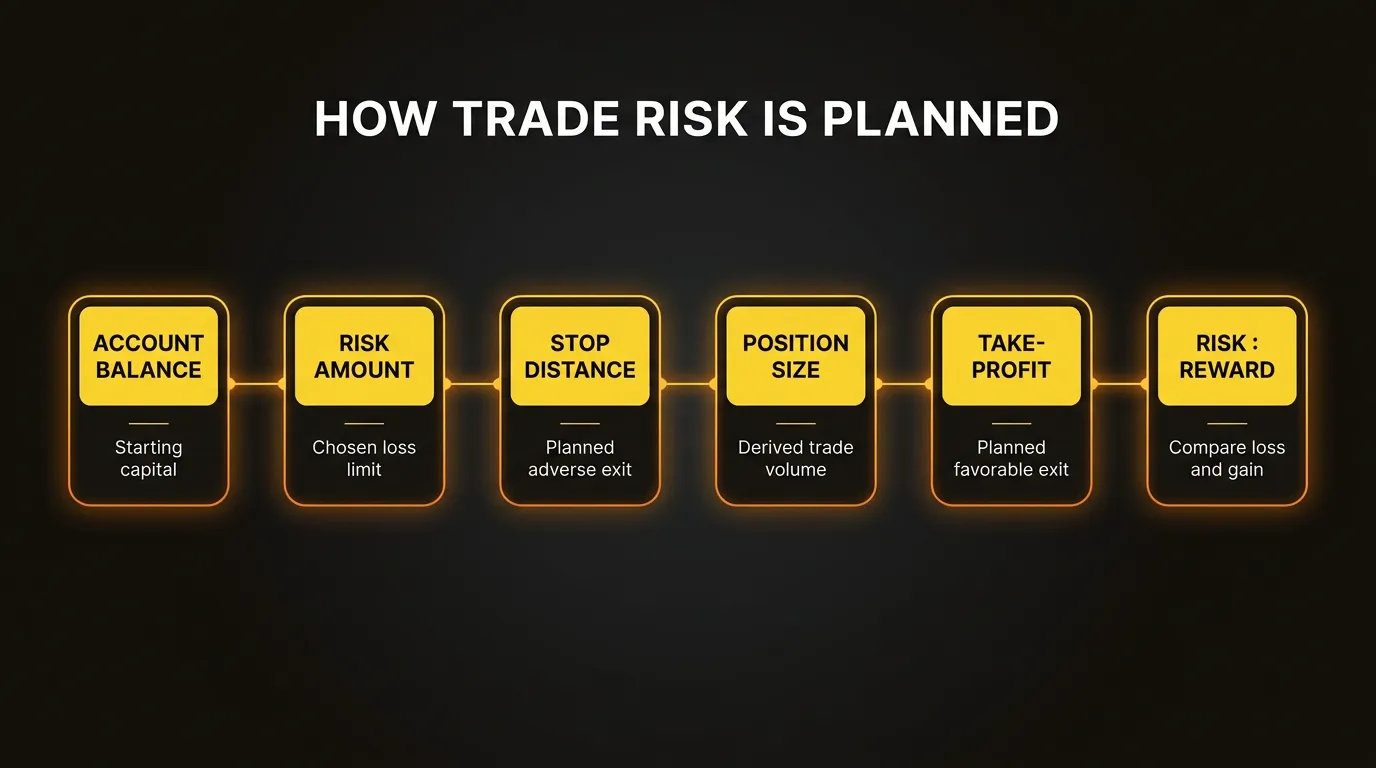
The order matters. Selecting the position size first and trying to make the stop fit afterward reverses the process. The stop distance should come from the setup; the chosen risk amount and that distance then determine the position size.
Worked Example: Position Size, Stop and Target
Assume the following illustrative Forex trade:
- Account balance: USD 10,000
- Illustrative risk amount: 1% of the balance, or USD 100
- Entry: 1.1000
- Stop-loss: 1.0950
- Stop distance: 50 pips
- Pip value for one standard lot: USD 10 per pip
The position-size calculation is:
USD 100 ÷ (50 pips × USD 10 per pip per standard lot) = 0.20 standard lots
At 0.20 standard lots, the illustrative pip value is USD 2 per pip. If the stop-loss is reached 50 pips from entry, the estimated loss is:
50 pips × USD 2 per pip = USD 100
Now assume the take-profit is set at 1.1100, which is 100 pips above the 1.1000 entry. The estimated reward is:
100 pips × USD 2 per pip = USD 200
The planned relationship is therefore:
USD 100 risk : USD 200 reward = 1:2 risk:reward
| Plan element | Illustrative value |
|---|---|
| Account balance | USD 10,000 |
| Risk amount | USD 100 |
| Entry | 1.1000 |
| Stop-loss | 1.0950 |
| Stop distance | 50 pips |
| Position size | 0.20 standard lots |
| Take-profit | 1.1100 |
| Target distance | 100 pips |
| Potential loss | USD 100 |
| Potential reward | USD 200 |
| Risk:reward | 1:2 |
This simplified example excludes spread, commission, financing, currency conversion and possible slippage. Those factors can change the final result. The assumed USD 10 pip value also applies only to the stated example; actual pip values and contract specifications vary.
Common Risk-Planning Mistakes
Using the same position size for every trade
The same volume can create very different monetary risk when stop distances or instrument values change. Position size should be recalculated when the inputs change.
Placing the stop to fit a preferred lot size
This can leave the stop unrelated to the trade idea. A more coherent process defines the invalidation point first and calculates volume afterward.
Treating a stop-loss as a guaranteed price
A stop is an execution instruction, not a guarantee of the final fill. Gaps, volatility and liquidity conditions can affect the exit price.
Moving the stop farther away to avoid a loss
Widening a stop after entry increases exposure unless position size is reduced. It also changes the original risk plan.
Choosing a distant target only to improve the ratio
A higher theoretical reward has little value if the target is disconnected from the setup or market structure. The ratio should evaluate a plausible plan, not manufacture one.
Ignoring cumulative exposure
Several positions can respond to the same market driver. Individual trade risk may look controlled while combined exposure is concentrated in one currency, asset or direction.
Leverage, Margin and Trading Costs
Leverage and margin are related to risk, but they do not replace position sizing. Position size and price movement determine market exposure, while leverage and margin rules determine how much collateral is required to support that exposure. More available leverage does not require a trader to take a larger position.
Trading costs also affect net outcomes. Spread, commission, overnight financing and currency conversion can reduce profit or add to a loss. They should be considered when judging whether the planned reward is realistic, but they do not change the basic sequence of choosing a risk amount, defining a stop and deriving position size.
Review Grand Markets Trading Account Conditions
Readers who want to compare current account structures, spreads, commissions, leverage limits and instrument conditions can review the Grand Markets trading accounts page. Conditions can differ by account type and instrument, so current specifications should be checked before placing a trade.
Frequently Asked Questions
What is risk management in trading?
Risk management in trading is the process of defining exposure and possible loss before a position is opened. It commonly combines a chosen risk amount, position size, stop-loss, take-profit and risk/reward assessment.
How is position size calculated?
Position size is calculated from the monetary risk amount, the distance between entry and stop, and the value of each unit of price movement. For a Forex example, divide the risk amount by the product of the stop distance in pips and the pip value per standard lot.
What does a stop-loss do?
A stop-loss instructs the platform to close a position when an adverse price level is reached. It helps define the planned loss, although gaps, slippage and market conditions can cause the actual exit price and loss to differ.
What is the difference between a stop-loss and a take-profit?
A stop-loss defines a planned adverse exit, while a take-profit defines a planned favorable exit. Together, their distances from the entry help estimate potential loss, potential reward and the risk/reward ratio.
What does a 1:2 risk/reward ratio mean?
Using the risk:reward convention, 1:2 means one unit of planned risk for two units of potential reward. For example, USD 100 of planned risk and USD 200 of potential reward have a 1:2 ratio. It does not guarantee that the target will be reached.
What Is a Good Risk/Reward Ratio?
There is no universally good risk/reward ratio. A ratio such as 1:2 means the potential reward is twice the planned risk, but whether that relationship is suitable depends on the strategy’s win rate, trading costs, execution and how consistently the setup performs.
Does a stop-loss guarantee the maximum loss on a trade?
No. A stop-loss defines an intended exit level, but it does not guarantee the execution price. Market gaps, volatility, liquidity and slippage can cause the final loss to be larger or smaller than the estimate.
Trading risk management is most useful when its components are treated as one plan. The risk amount sets the limit, the stop defines the distance, position sizing translates both into exposure, and the take-profit allows the potential outcome to be compared through a consistent risk:reward ratio.

Disclaimer:
This content does not constitute any offer, solicitation or advice. You should always seek independent professional advice before making any investment decision. Please note that Grand Markets may restrict or prohibit some or all services to users from restricted regions. Please read the User Agreement for more information.