

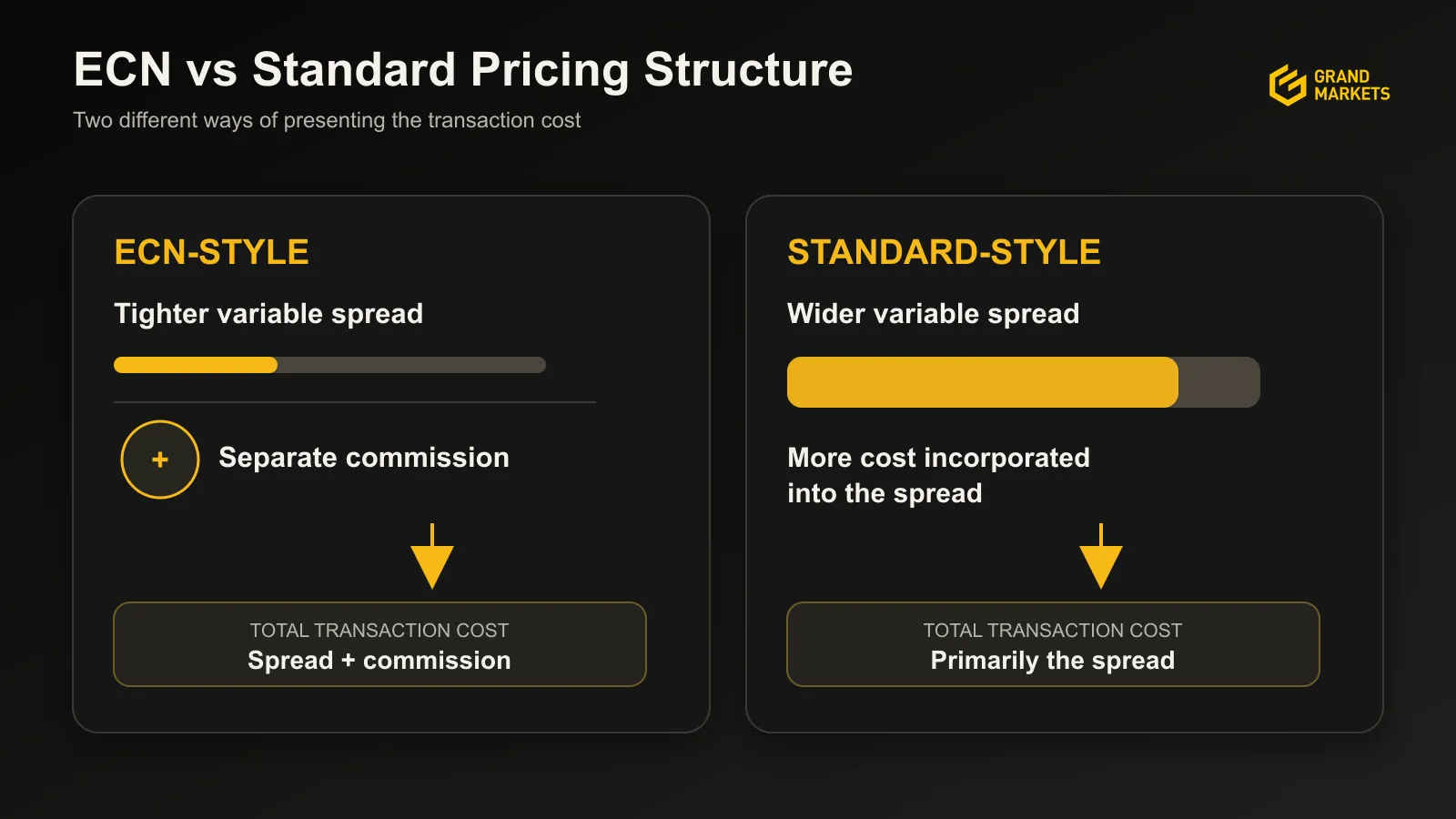
The ECN vs standard account comparison is mainly a choice between two pricing structures. An ECN-style account usually combines a tighter spread with a separate commission. A standard account usually builds more of the trading charge into a wider spread and may have no separate forex commission.
Neither account is automatically cheaper. The answer depends on the instrument, spread at the time of the trade, commission basis, position size, trade frequency and holding period. Account labels also do not prove how orders are routed or how well they will be filled.
Short answer: compare both accounts using the same position size and market conditions. Convert spread and commission into one currency, count both commission legs where applicable, then add financing and other relevant charges. A narrower spread can outweigh commission, but minimum fees and wider live spreads can reverse the result.
ECN vs Standard Account: Key Differences
The main difference between an ECN-style account and a standard account is usually how the broker presents the trading cost. Execution arrangements are a separate question.
| Comparison point | ECN-style or commission-based account | Standard-style account |
|---|---|---|
| Typical pricing | Narrower variable spread plus a separate commission | Wider variable spread, often with no separate forex commission |
| Cost visibility | Spread and commission appear separately | Most transaction cost is reflected in the spread |
| Main calculation | Spread cost plus opening and closing commission | Spread cost plus any applicable commission |
| Small-position issue | Minimum commissions or fee rounding can matter | Spread cost generally scales with position size |
| Frequent trading | A lower all-in transaction cost can compound across many trades | A wider spread can become more significant across many trades |
| Overnight positions | Financing may apply | Financing may apply |
| Execution quality | Must be assessed separately | Must be assessed separately |
| Main trade-off | Potential spread savings versus a separate fee | Simpler pricing versus a potentially wider spread |
These are common retail-forex patterns, not universal rules. A broker may use terms such as ECN, raw spread, STP, market execution or standard differently. Read the account specification and agreement rather than relying on the label alone.
What Is an ECN-Style Forex Account?
ECN stands for electronic communication network. In retail forex, an ECN-style account commonly describes a commission-based account with tight, variable spreads. The spread may start from 0.0 pips on selected instruments under favorable conditions, while a separate fee applies by trade volume. When the spread is narrow enough, the completed-trade cost may be lower than on a spread-only account even after commission.
However, “from 0.0 pips” is a minimum, not an average or guarantee. Spreads can widen during news, rollover, market open or low liquidity. Commission also needs a clear basis:
- Is it quoted per side, meaning it is charged on opening and again on closing?
- Is it quoted round turn, covering the completed open-and-close cycle?
- Does it scale proportionally for partial lots?
- Is there a minimum charge or rounding rule?
The ECN label does not establish direct access to a particular network, external routing of every order or an agency-only relationship. The broker’s execution documents matter more than the marketing name.
What Is a Standard Forex Account?
A standard account typically uses spread-inclusive pricing. Instead of showing a very narrow spread and a separate forex commission, it normally quotes a wider bid-ask spread and lists no separate commission for the currency trade.
That structure is easier to read because the main transaction charge appears in one number. It is still a real cost: a “commission-free” account is not cost-free. When a position opens at the ask and closes at the bid, the spread must be recovered before the trade becomes profitable, assuming the market is otherwise unchanged.
A standard account can remain competitive when its spread is reasonably close to the ECN-style spread, commission is high relative to position size, minimum charges affect small trades or simpler cost tracking is preferred.
ECN Spreads vs Standard Spreads
The spread is the difference between the bid and ask price. It changes the starting economics of every trade, regardless of whether a separate commission appears.
Suppose EUR/USD is quoted with a 0.2-pip spread on a commission account and a 1.2-pip spread on a standard account. The ECN-style account saves one pip on the spread, but the comparison is incomplete until its commission is converted into pips or money.
When reviewing advertised forex spreads, distinguish three different statistics:
- From or minimum spread: the lowest published value, which may occur only under favorable conditions.
- Average spread: a mean over a stated or unstated observation period.
- Live spread: the value visible on the platform at a particular moment.
A minimum cannot be compared fairly with an average. Use equivalent measures for the same instrument and, where possible, sample the sessions in which you trade.
How ECN Commissions Work
Commission is usually linked to notional trade volume or lot size. The wording determines the arithmetic.
If an account charges $3.50 per standard lot per side, opening one lot costs $3.50 and closing it costs another $3.50. The round-turn commission is therefore $7. A quote of $7 per lot round turn would produce the same completed-trade fee, but a quote of $7 per lot per side would produce a $14 round-turn fee.
Never assume what “per lot” means when the page does not define it. Commission may also vary by asset, platform, account currency or volume. Use the exact instrument and charging basis that applies to the trade.
How to Compare ECN vs Standard Trading Costs
Put the spread and commission into the same currency and use the same position size.
Spread cost = Spread in pips × Pip value for the position
Round-turn commission = Opening commission + Closing commission
Simplified completed-trade cost = Spread cost + Round-turn commission
This is a transaction-cost comparison. It does not yet include overnight financing, slippage, currency conversion, funding charges or other account-level fees.
Calculate the Correct Pip Value
For a currency pair quoted in units of quote currency per unit of base currency, first calculate the pip value:
Pip value in quote currency = Position units × Pip size
For EUR/USD, assume one standard lot represents 100,000 EUR, one pip is 0.0001 USD per EUR and the account is denominated in USD.
One standard lot therefore has a pip value of $10. A 0.10-lot position has a $1 pip value, while a 0.01-lot position has a $0.10 pip value.
Those values are not universal. JPY pairs use a different pip size, contract specifications vary, and a different account currency requires conversion. Use the contract specification in the trading platform.
Worked EUR/USD Cost Example
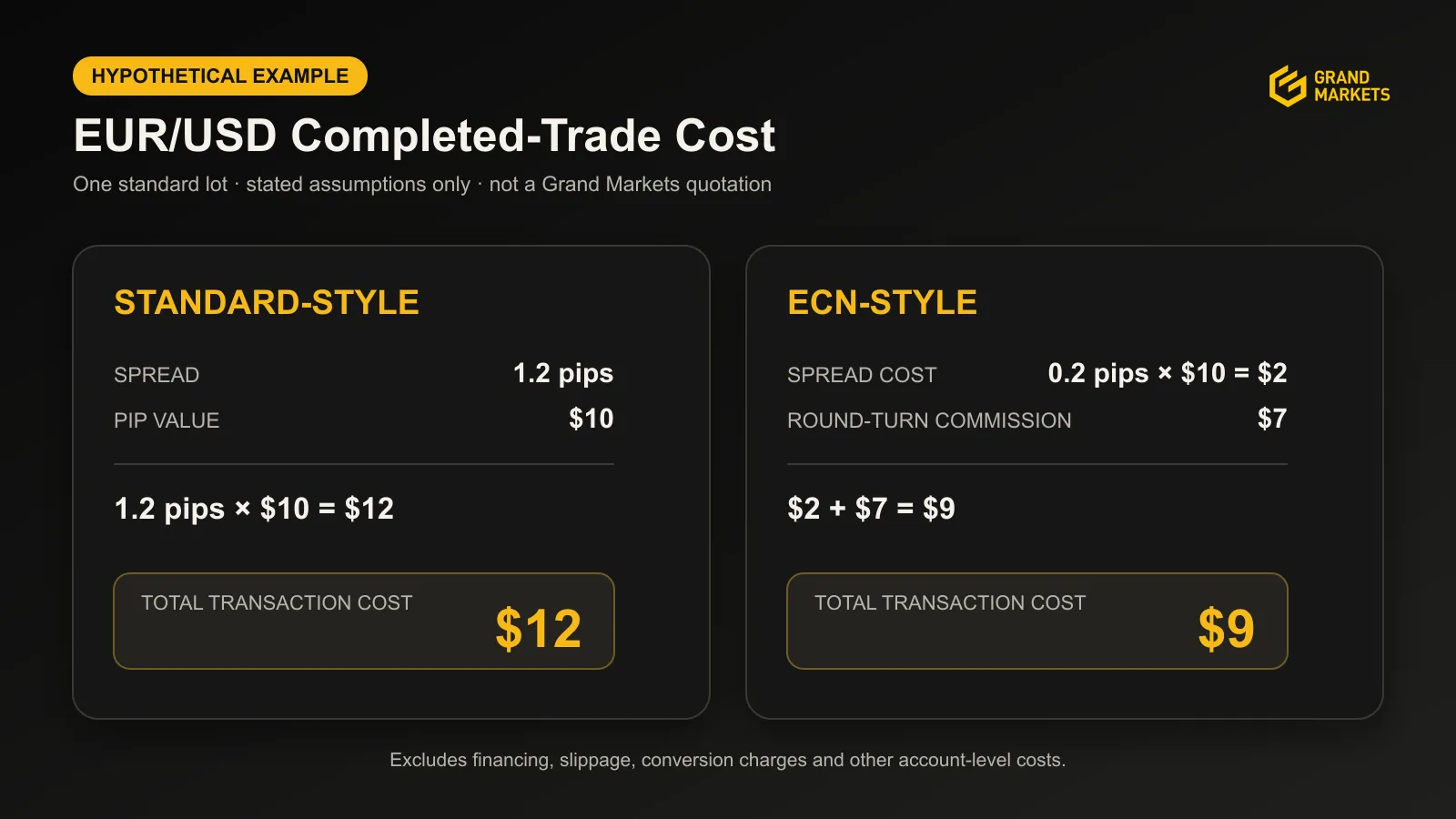
The following figures are hypothetical. They are not Grand Markets quotations or verified broker offers.
Assume:
- Standard-style spread: 1.2 pips, with no separate commission.
- Commission-account spread: 0.2 pips.
- Commission: $3.50 per standard lot per side, or $7 round turn.
- Commission scales proportionally, with no minimum fee or rounding.
- Spread remains unchanged, with no slippage, financing or conversion charge.
| Position size | Pip value | Standard spread cost | ECN-style spread cost | Round-turn commission | ECN-style total |
|---|---|---|---|---|---|
| 0.01 lot | $0.10 | $0.12 | $0.02 | $0.07 | $0.09 |
| 0.10 lot | $1.00 | $1.20 | $0.20 | $0.70 | $0.90 |
| 1.00 lot | $10.00 | $12.00 | $2.00 | $7.00 | $9.00 |
For one lot, the standard-style cost is 1.2 × $10 = $12. The ECN-style cost is 0.2 × $10 + $7 = $9. The commission account is $3 cheaper for the completed trade under these assumptions.
The result only shows how the comparison should be calculated; it cannot be generalized to every broker, pair or session.
Convert Commission Into Pips
To compare spread and commission directly:
Commission-equivalent spread = Round-turn commission ÷ Pip value
In the one-lot example:
$7 ÷ $10 = 0.7 pips
Adding the 0.2-pip spread produces a 0.9-pip transaction-cost equivalent, versus 1.2 pips on the standard account.
Why the Calculation Counts One Spread
With an unchanged market midpoint and spread, buying at the ask and selling at the bid loses one full spread. Measured against the midpoint, half is associated with entry and half with exit.
If the entry and exit spreads differ, a midpoint-based estimate is:
Spread component = [(Entry spread + Exit spread) ÷ 2] × Pip value
Do not subtract a separate spread estimate from profit or loss already calculated with actual fill prices; those prices already include the bid-ask difference.
When Is an ECN-Style Account Cheaper?
The commission-based account is cheaper on a spread-plus-commission basis only when its spread saving is larger than its additional commission.
Required spread advantage = Additional round-turn commission ÷ Pip value
In the hypothetical one-lot example, the $7 commission equals 0.7 pips. With a 1.2-pip standard spread, the ECN-style account breaks even at a 0.5-pip spread.
| ECN-style spread | Standard total | ECN-style total including $7 commission | Lower transaction cost |
|---|---|---|---|
| 0.0 pips | $12 | $7 | ECN-style |
| 0.2 pips | $12 | $9 | ECN-style |
| 0.5 pips | $12 | $12 | Equal |
| 0.8 pips | $12 | $15 | Standard |
| 1.2 pips | $12 | $19 | Standard |
The table holds the standard spread at 1.2 pips and changes only the ECN-style spread. It is not a forecast.
Minimum Commissions Can Reverse Small-Trade Results
The earlier table assumes exact proportional pricing. Suppose the commission account instead applies a minimum fee of $0.10 per side. At 0.01 lot:
- spread cost remains $0.02;
- commission becomes $0.20 round turn rather than $0.07; and
- the completed transaction cost becomes $0.22.
The standard account still costs $0.12 under the original assumptions. A low per-lot headline rate therefore does not guarantee a lower cost for micro-lot trades.
Trading Frequency Multiplies the Difference
Assume 100 completed trades of 0.10 lot using the original proportional pricing:
| Hypothetical account | Cost per completed trade | Cost for 100 completed trades |
|---|---|---|
| Standard-style | $1.20 | $120 |
| ECN-style | $0.90 | $90 |
| Difference | $0.30 | $30 |
More trades multiply an existing advantage or disadvantage. Frequency alone does not make an ECN account cheaper.
How Trade Size, Frequency and Holding Period Change the Comparison
Trade size affects pip value and commission; minimum charges or rounding can change the relationship at smaller volumes. Holding period introduces overnight financing, so check the rate, direction, rollover time, multiple-day charges and any swap-free conditions.
The useful measure is the expected total cost for the way you trade, not the lowest advertised spread.
ECN vs Standard Accounts for Different Trading Styles
| Trading behavior | What matters most | Practical interpretation |
|---|---|---|
| Scalping | Total cost relative to a small target, spread variation, slippage | A tight spread can help, but commission or poor fills may remove the saving |
| Day trading | Costs during actual trading hours, order types, execution consistency | Compare representative session conditions rather than headline minima |
| Swing trading | Financing direction, holding period, rollover schedule | Overnight charges can outweigh a modest transaction-cost difference |
| Small positions | Minimum commission, rounding, contract size | Confirm that fees scale proportionally |
| Automated trading | Platform support, strategy permissions, order limits | An ECN label does not authorize every automated strategy |
| Infrequent trading | Funding costs, inactivity charges, operational simplicity | Lower transaction costs may not mean lower overall account costs |
The suitable account depends on measured conditions. Active strategies may benefit from a consistently lower transaction cost, while financing can outweigh a modest spread difference for longer-held positions.
Does ECN Mean Better Execution?
No. A narrow displayed spread is not the same as a favorable fill, and the word ECN does not guarantee faster execution, no requotes, positive slippage or external routing. Assess execution separately using requested and actual fill prices, order type, position size, timestamp and session.
Pricing structure and execution structure answer different questions:
- Pricing structure: How are spread and commission charged?
- Execution structure: How are orders handled, routed and filled?
The account agreement and execution policy should answer the second question.
ECN vs Standard at Grand Markets
At Grand Markets, we offer Standard, ECN and Cent accounts. Our current account headline conditions are as follows:
| Published field | Standard | ECN | Cent |
|---|---|---|---|
| Minimum deposit | $10 | $10 | $10 |
| Spread wording | Average 1.6 pips | From 0.0 pips | Average 1.6 pips |
| Commission wording | No commission | Up to $7 per lot | No commission |
| Maximum leverage | Up to 1:1000 | Up to 1:1000 | Up to 1:1000 |
These figures are not a direct cost ranking. “Average 1.6 pips” and “from 0.0 pips” are different statistics. We publish floating spreads, and the displayed averages use the previous trading day; live spreads remain available in the platform.
Our ECN account card currently is “up to $7 per lot” but does not define that headline amount as per side or round turn. The hypothetical $7 round-turn example earlier is therefore not official Grand Markets pricing. Confirm the current charging basis for the intended instrument before calculating completed-trade cost.
Our fees and commissions page explains that conditions differ by account type and instrument. If the published pricing fits your intended trade size, compare the current account conditions using the same spread measure, commission basis and holding-period assumptions for every option.
How to Choose Between an ECN and Standard Account
Use this sequence:
- Check eligibility and instrument specifications. Confirm account availability, contract size, minimum order, increments and trading hours.
- Compare equivalent spreads. Use the same pair, session and statistic; do not compare an average with a minimum.
- Define the commission basis. Confirm per-side or round-turn treatment, currency, lot basis, minimums, rounding and tiers.
- Calculate your actual position size. A one-lot illustration may not represent micro-lot economics.
- Add holding and account costs. Include financing plus relevant conversion, funding or inactivity charges.
- Assess execution separately. Review fills, slippage, order restrictions and strategy compatibility. Demo testing can support platform familiarization but does not reproduce live execution.
FAQ
What is the main difference between an ECN and Standard account?
An ECN-style account usually charges a tight variable spread plus a separate commission. A standard account usually uses a wider spread with no separate forex commission. Execution arrangements must be checked separately.
Is an ECN account always cheaper?
No. It is cheaper on a spread-plus-commission basis only when its spread saving exceeds the added commission. Minimum fees, financing, slippage and other charges can change the result.
How do I compare an ECN commission with a Standard spread?
Convert the round-turn commission into pips by dividing it by the pip value, then add the ECN spread. Compare that total with the standard spread for the same pair, position size and market conditions.
Is an ECN account better for scalping?
It can be if the tighter spread produces a lower all-in transaction cost and the strategy is permitted. Commission, slippage, stop distances, execution consistency and minimum fees also matter.
Do ECN spreads stay at zero?
No. “From 0.0 pips” states a minimum. Variable spreads can widen during news, rollover, market open, low liquidity or rapid price movement.
What are Grand Markets’ ECN account conditions?
Grand Markets currently has a $10 minimum deposit, spreads from 0.0 pips, commission up to $7 per lot and maximum leverage up to 1:1000 for its ECN account. Confirm the live instrument conditions and whether the commission is per side or round turn before calculating costs.
Final Takeaway
Choose an account by comparing the cost and conditions that apply to your trades, not by treating ECN or standard as a quality ranking. An ECN-style account may be cheaper when its spread advantage covers commission; a standard account may remain competitive when the spread difference is small or minimum fees affect smaller positions.
For Grand Markets, confirm the current ECN commission basis and instrument conditions, then run the same spread-plus-commission calculation for both account options.
Risk disclaimer: This content is for general educational purposes only. It is not personalized investment advice, a recommendation, or an offer to buy or sell any financial instrument. Forex and CFDs are leveraged products and involve significant risk of loss; leverage can magnify losses. Spreads, commissions, leverage, margin requirements and product availability may vary by instrument, account type, legal entity, jurisdiction and client classification. Review current legal documents, product conditions and the Grand Markets Risk Disclosure before trading.

Disclaimer:
This content does not constitute any offer, solicitation or advice. You should always seek independent professional advice before making any investment decision. Please note that Grand Markets may restrict or prohibit some or all services to users from restricted regions. Please read the User Agreement for more information.