

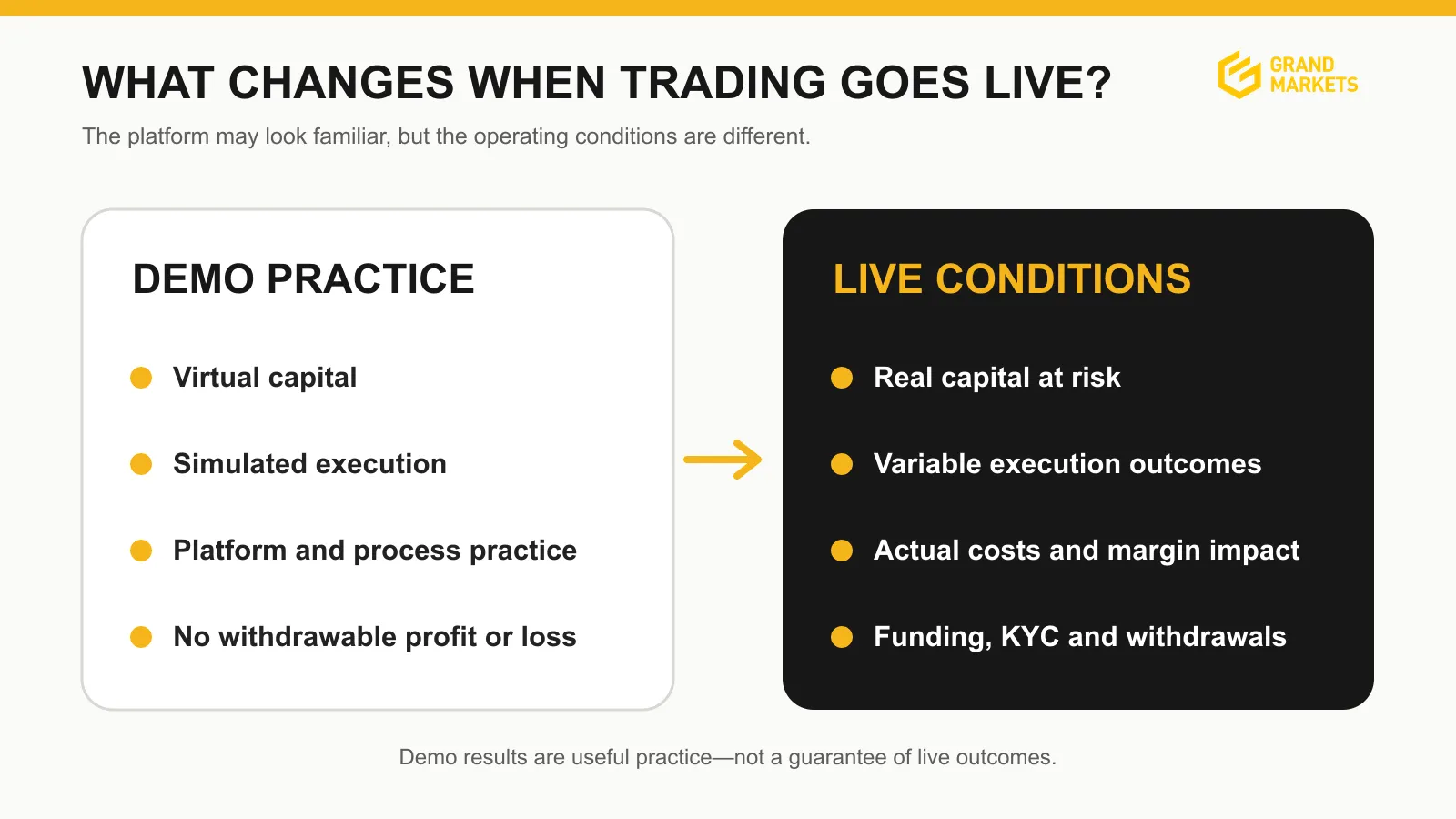
Demo and live trading accounts can use the same platform, charts and order types, but they do not create the same experience. A demo account uses virtual funds for practice. A live account puts real capital at risk and introduces actual funding, trading-cost, margin and withdrawal consequences.
Execution may also differ. Demo environments simulate trading conditions and may not reproduce every part of a live order. In a live account, outcomes can be influenced by market conditions, liquidity, spreads, latency, the instrument, the order type and the broker’s execution setup.
The practical difference is simple: a demo account helps you learn how the platform and your process work; a live account tests that process under real financial conditions. Before moving from demo to live, traders should understand position sizing and risk management, trading costs and margin, not only how to open an order.
Demo vs Live Trading Accounts at a Glance
| Feature | Demo Account | Live Account |
|---|---|---|
| Capital | Virtual funds with no withdrawable profit or real financial loss | Deposited capital is exposed to gains and losses |
| Purpose | Learn the platform, practise orders and test a process | Trade under real financial and operational conditions |
| Market prices | May use live or near-live pricing, depending on the provider | Uses pricing available to the live trading environment |
| Execution | Simulated; may not reproduce every live execution condition | Affected by market conditions, liquidity, latency, order type and execution model |
| Slippage | May be simulated, limited or behave differently | Positive or negative slippage may occur |
| Spreads | May reflect current pricing, but should not be assumed to match every live situation | Can vary with the instrument, account conditions, liquidity and volatility |
| Commissions | May be simulated depending on account settings | Applied where the selected account or instrument charges them |
| Overnight costs | May be simulated, but short tests often understate their effect | Swap or overnight financing may apply where relevant |
| Margin impact | Affects virtual equity only | Losses reduce real equity; insufficient free margin can restrict new positions or affect open ones |
| Emotional pressure | Usually lower because the funds are virtual | Often higher because financial outcomes are real |
| Deposits and withdrawals | Not applicable to virtual funds | Requires real payment and withdrawal processes |
| KYC | Requirements vary by provider and access route | Identity and account verification normally apply before full use of a funded account |
| Best use | Platform practice, process testing and familiarisation | Trading with capital the trader can afford to lose |
The table is a general comparison rather than a promise that every demo or live account behaves identically. Conditions vary by broker, platform, account type and instrument.
What Is a Demo Trading Account?
A demo trading account is a simulated environment funded with virtual money. It usually gives traders access to a trading platform, market quotes, charts, indicators and common order types without requiring them to risk deposited capital.
That makes demo trading useful for several specific jobs:
- learning how to navigate a platform;
- placing, modifying and closing orders;
- practising Stop Loss and Take Profit placement;
- understanding position size and margin displays;
- testing a repeatable trading process in current market conditions;
- checking how an Expert Advisor or indicator behaves before considering live use.
At Grand Markets, traders can use familiar platforms such as MT4 for desktop or MT5 for desktop while learning the mechanics of an account. Platform familiarity matters: opening the wrong order size or misunderstanding a pending order can have real consequences later.
A demo result is still a simulation. Virtual profit cannot be withdrawn, virtual losses do not reduce personal funds, and simulated execution may not reflect every live condition. A successful demo period therefore shows that a process worked in that test environment; it does not guarantee the same result with live funds.
What Changes With a Live Trading Account?
Real Capital Is at Risk
The most important change is not the chart – it is the consequence of the decision. Live profits and losses affect real account equity. A losing position can reduce the funds available for later trades, and the emotional impact can change how a trader follows a plan.
Before funding a live account, define how much capital you can afford to lose. Decide how risk will be measured before entering a position, size the trade relative to account equity and stop distance, and consider total exposure across all open positions. Leverage should not be used simply because it is available.
Execution Can Differ
Demo environments simulate order execution. They can be valuable for practising order entry, but they may not reproduce every aspect of a live market or every account configuration.
Live execution can be affected by:
- current market conditions and available liquidity;
- spread changes;
- the instrument and order size;
- the selected order type;
- network latency and broker infrastructure;
- volatility, market gaps and trading-session conditions;
- the execution model used for the account.
Possible outcomes include positive or negative slippage, rejected orders, partial fills where applicable and requotes on execution models that use them. None of these outcomes should be presented as universal: the result depends on the order and the conditions in which it is submitted.
This is why traders should not assume that a demo market order will always behave exactly like a live market order. It is also why a strategy that relies on very small price movements may be more sensitive to execution differences than a process with wider tolerances.
Trading Costs Matter
Live performance is measured after costs, not before them. Depending on the account and instrument, those costs may include:
- the spread between Bid and Ask;
- a trading commission;
- overnight financing or swap where applicable;
- currency conversion where applicable;
- slippage;
- other account-specific charges.
A demo environment may simulate some spreads, commissions or financing charges, but traders should not assume that simulated results will reproduce every live cost. Short demo tests can also understate expenses that become more visible over longer holding periods.
Our guide to trading costs explains how spreads, commissions, overnight charges and other expenses can combine. Review the current terms for the account and instrument you intend to use rather than relying on a headline spread alone.
Margin Has Real Consequences
Margin is the amount of account equity set aside to support a leveraged position. In a demo account, margin changes affect virtual funds. In a live account, losses reduce real equity and can reduce free margin.
If free margin becomes insufficient, the account may be unable to support new positions. Depending on the applicable account rules, margin close-out or stop-out processes may also affect open positions. Traders should understand the relevant leverage and margin rules before placing a live order.
Leverage can increase market exposure relative to deposited capital, but it also magnifies the effect of adverse price movements. A smaller deposit does not make an oversized position safer.
Funding, Verification and Withdrawals Become Real Processes
A demo account can usually be opened for practice without completing the same full funding workflow as a live account. A live account introduces operational steps such as identity verification, selecting a payment method, funding the account and submitting withdrawals.
These processes are not part of trading performance, but they are part of using a real account. Traders should make sure their account details and payment information are accurate and should review applicable processing requirements before depositing.
Why Trading Psychology Feels Different With Real Money
Virtual losses are easier to treat as information because they do not reduce personal funds. Live losses can feel more significant, even when the market setup and position size appear similar on screen.
Common behavioural differences include:
- hesitation: avoiding a planned trade after previous losses;
- loss aversion: closing a profit too early or allowing a loss to run because accepting it feels uncomfortable;
- overtrading: taking more positions than the original process allows;
- revenge trading: trying to recover a recent loss with an impulsive trade;
- FOMO: entering after a sharp price move because of fear of missing it;
- plan changes: moving a stop, increasing size or abandoning an exit rule once money is at risk.
These reactions are not proof that a trader lacks discipline, nor do they require a pseudo-clinical explanation. They show why position size matters. If the exposure feels materially different from demo, decision-making may also change.
A useful response is to reduce complexity: define the risk before the order, use exposure appropriate to your circumstances, record why the trade was taken, and review whether the process was followed. Completing a checklist cannot guarantee profitability, but it can make decisions more consistent and easier to evaluate.
Demo vs Live: Key Differences Explained
The Same Platform Does Not Mean the Same Outcome
A trader may use the same MT4 or MT5 interface for demo and live accounts. The buttons, charts and order ticket can look nearly identical. That continuity is useful because it reduces platform-learning friction.
However, an identical interface does not remove the differences in capital, execution, costs or margin. The account credentials and server determine which trading environment the platform connects to. Traders should confirm they are logged into the intended account before submitting an order.
A Large Demo Balance Can Distort Position Sizing
A demo balance that is much larger than the amount a trader expects to deposit live can create unrealistic habits. A position that produces a small percentage change in a large virtual balance may represent a much larger percentage of a smaller live account.
When possible, configure the demo balance, or mentally treat it, as if it had roughly the same capital and leverage conditions expected in the live account. This makes position sizing, margin use, drawdown and percentage risk more comparable.
Stops Reduce Risk but Do Not Guarantee an Exact Exit Price
Stop-loss orders are an important risk-control tool, but a stop can be executed at the next available price when markets move quickly or gap. That means the realised loss can differ from the amount estimated from the stop level.
Demo practice should include placing stops and reviewing how the platform displays them. Live planning should also account for the possibility of slippage rather than treating the stop price as an absolute guarantee.
When Might a Trader Consider Moving From Demo to Live?
There is no universal number of weeks or trades that proves someone is ready. A profitable demo period does not establish that live trading will be profitable. Instead, consider whether the following practical checks are true:
- You can place, modify and close the order types you intend to use without confusion.
- You understand how position size changes the amount at risk.
- You can set and review Stop Loss and Take Profit orders.
- You understand the account’s spreads, commissions and overnight costs.
- You understand how margin and leverage affect equity and free margin.
- You have tested a repeatable process rather than changing the method after every result.
- You understand that live execution and costs can differ from demo.
- You can afford to lose the capital being deposited.
- You plan to begin with exposure appropriate to your financial circumstances and experience.
The purpose of this checklist is to identify avoidable gaps. It does not certify skill, remove market risk or guarantee a positive result.
How to Make Demo Practice More Realistic
Demo trading is more useful when the practice conditions resemble the intended live setup.
- Use a realistic balance. Choose a virtual balance close to the capital you expect to fund, where the platform allows it.
- Match the intended leverage conditions. Do not use much higher simulated leverage simply to open larger positions.
- Include costs in the review. Track spreads, commissions and overnight financing where applicable, even if the demo environment does not model each one perfectly.
- Use realistic position sizes. Calculate size from account equity, the planned stop distance and the amount you can afford to risk.
- Practise during the sessions you expect to trade. Spreads, liquidity and volatility can vary through the trading day.
- Record execution details. Note the requested price, displayed spread, fill and exit so the process can be reviewed.
- Treat virtual losses as useful information. Resetting the balance after every setback can hide weaknesses in position sizing or the trading process.
The goal is not to make demo and live trading identical – they are not. The goal is to make the practice relevant enough to reveal platform mistakes, unrealistic risk and inconsistent decisions before capital is exposed.
Moving From Demo to Live With Grand Markets
At Grand Markets, traders can practise on demo, compare live account types and choose an account that fits their intended setup. Our current trading account options include Standard, ECN and Cent accounts.
A Cent account can be one option for traders who want to use smaller nominal exposure while gaining experience with live account processes. It is not a required stage and it is not automatically the right choice for every beginner. Standard and ECN accounts have different pricing structures and use cases, so the decision should be based on the current account conditions, instruments, costs and intended trading approach.
Before opening a live position:
- compare the available account types;
- review the current terms and costs;
- confirm the platform and server details;
- choose exposure appropriate to your circumstances;
- fund the account only with capital you can afford to lose.
Demo practice remains useful after a live account is opened. Traders may return to demo to learn a new platform feature, test a change in process or check an automated strategy without putting live funds at risk.
Final Takeaway
The central difference between a demo and live trading account is consequence. Demo trading uses virtual funds to practise platform mechanics and a trading process. Live trading introduces real financial risk, actual account costs, variable execution outcomes, margin consequences and operational requirements such as KYC, deposits and withdrawals.
Use demo trading to build familiarity and identify mistakes. If you later consider moving to live trading, make the transition based on practical readiness—not a fixed trade count, a short winning streak or the assumption that demo results will repeat.
Risk warning: Leveraged trading involves significant risk and can result in losses exceeding the amount expected from normal market movement. Trade only with capital you can afford to lose, review the applicable account terms and consider whether leveraged products are appropriate for your circumstances.

Disclaimer:
This content does not constitute any offer, solicitation or advice. You should always seek independent professional advice before making any investment decision. Please note that Grand Markets may restrict or prohibit some or all services to users from restricted regions. Please read the User Agreement for more information.