
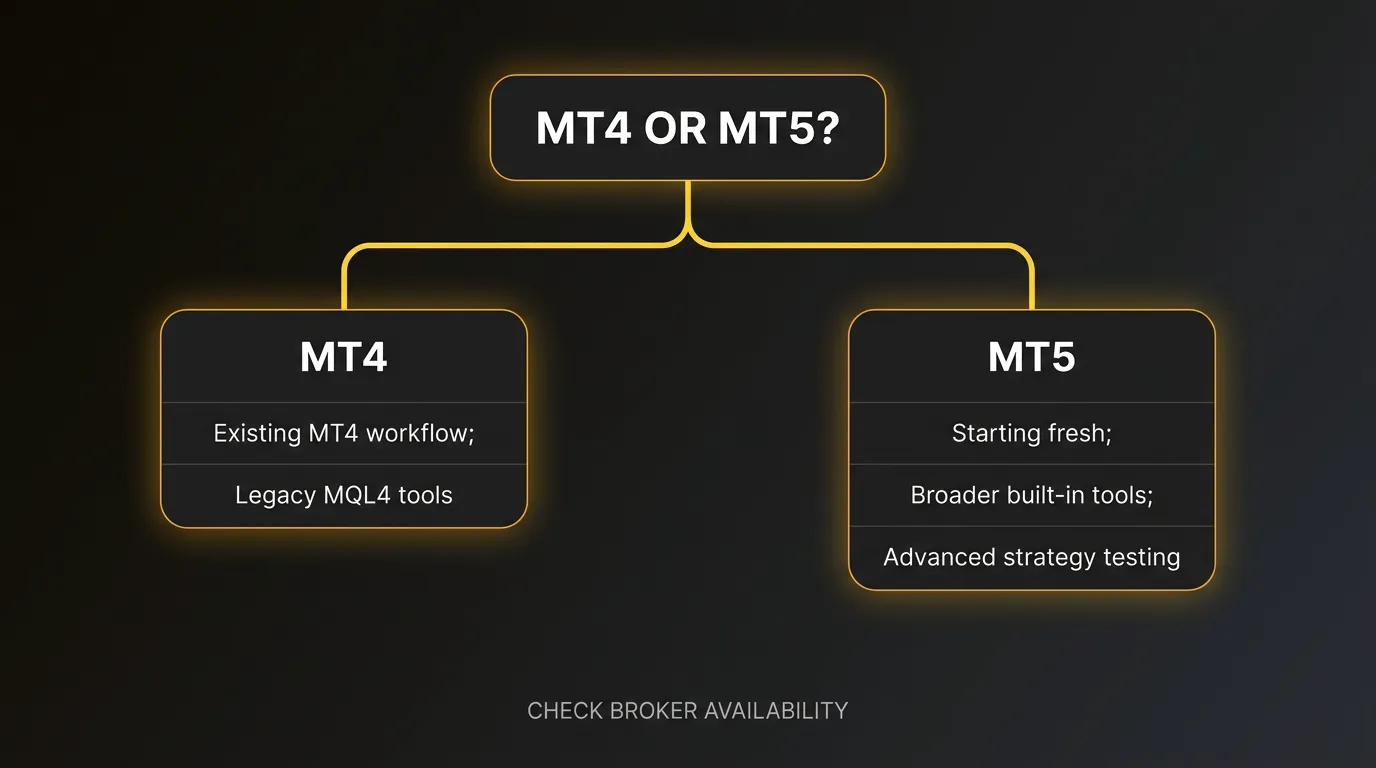
MT4 may suit traders who already rely on an established MetaTrader 4 workflow or MQL4 tools. MT5 may be the stronger starting point for traders who want broader built-in analysis, more order types and more advanced strategy testing. Neither platform is universally better; the right choice depends on how you trade.
MetaTrader 4 and MetaTrader 5 are separate trading platforms developed by MetaQuotes. They share a familiar trading-terminal format, but MT5 is not simply a visual update to MT4. The platforms use different programming languages, offer different analytical toolsets and support different approaches to order handling and strategy testing.
The practical question is therefore not which platform is newer. It is which one better fits your instruments, workflow, automated tools and broker setup.
MT4 vs MT5 at a Glance
The clearest differences appear in the platforms’ built-in capabilities. MetaQuotes describes MT4 as a Forex trading platform, while MT5 is designed as a multi-asset platform for Forex as well as exchange-traded markets. The instruments you can actually trade still depend on the broker and account you use.
| Feature | MetaTrader 4 | MetaTrader 5 | Why It May Matter |
|---|---|---|---|
| Typical platform focus | Established Forex-focused workflow | Broader multi-asset and exchange-oriented design | MT5 may be more suitable when a wider platform architecture is needed |
| Pending order types | 4 | 6 | MT5 adds buy-stop-limit and sell-stop-limit orders |
| Chart timeframes | 9 | 21 | MT5 provides more built-in intervals for analysis |
| Built-in technical indicators | 30 | 38 | MT5 includes a larger default analytical toolkit |
| Graphical and analytical objects | 31 | 44 | MT5 provides more built-in drawing and analysis objects |
| Programming language | MQL4 | MQL5 | Existing custom tools may need adaptation rather than direct transfer |
| Strategy testing | Single-platform Strategy Tester | Multi-threaded, multi-currency testing and optimization | MT5 offers a more advanced environment for complex testing workflows |
| Additional built-in tools | Core charting and trading functions | Depth of Market and economic calendar | MT5 brings more functions into the terminal itself |
Official platform documentation lists four pending-order types for MT4 and six for MT5. The respective MT4 technical-analysis specifications and MT5 chart-analysis documentation list 9 versus 21 timeframes, 30 versus 38 indicators, and 31 versus 44 analytical or graphical objects.
These figures describe platform capability, not a promise that every broker, account or instrument will expose every function in the same way.
Which Platform Is Better for Different Traders?
MT4 May Suit You Better If
- You already have a stable MT4 workflow and do not need MT5-only tools.
- You depend on an Expert Advisor, custom indicator or script written for MQL4.
- Your required instruments and order functions are available through MT4.
- You prefer the platform you already know and have no practical reason to migrate.
MT5 May Suit You Better If
- You are starting fresh and do not need to preserve an MQL4 setup.
- You want more built-in timeframes, indicators and analytical objects.
- You need the additional pending-order types available in MT5.
- You want multi-threaded, multi-currency strategy testing and optimization.
- Your broker offers the instruments and account conditions you need on MT5.
This is why there is no universal answer whether MT4 or MT5 is better. MT5 has the broader native feature set, while MT4 can remain the practical choice for traders whose tools and routines are already built around it.
Why Traders Still Use MT4
MT4 remains relevant because platform choice is partly about continuity. A trader may have years of experience with its interface, saved chart templates, custom indicators or an established automated strategy. Replacing that environment can require testing, adaptation and operational changes that offer little benefit if the existing setup already does what the trader needs.
Its more focused design can also be enough for traders who primarily need Forex charting, common order types and MQL4-based automation. A larger feature list does not automatically improve a workflow that is already efficient.
That does not mean MT4 and MT5 are interchangeable. It means an established MT4 setup can be a legitimate reason to stay with MT4 rather than migrating solely because MT5 is newer.
Where MT5 Has the Advantage
MT5 provides more built-in analytical options and a broader market architecture. The additional chart timeframes can support more granular or flexible analysis, while the extra pending-order types allow traders to define stop-limit instructions that MT4 does not provide natively.
MT5 also includes Depth of Market and an integrated economic calendar. The usefulness of Depth of Market depends on the market structure and data supplied by the broker: MetaQuotes notes that exchange instruments can display real prices and volumes, while over-the-counter instruments may show a broker’s own quotes and volumes where that information is provided.
For traders who are choosing a platform without legacy constraints, these additions can make MT5 the more capable starting point. The decision should still be checked against the broker’s available instruments, account types and platform access.
MT4 or MT5 for Forex Trading?
Both platforms can support Forex trading, so choosing between them requires more than confirming that currency pairs are available.
MT4 may be sufficient for a trader who uses standard Forex orders, familiar charting tools and MQL4-based automation. MT5 may be preferable for a trader who wants more timeframes, more built-in analysis, stop-limit orders or a more advanced testing environment.
Broker implementation remains important. A platform may be technically capable of supporting a feature or market, but the available instruments, symbols, account conditions and execution settings are determined by the broker. Platform capability and broker availability should therefore be evaluated separately.
Expert Advisors and Strategy Testing
Both platforms support algorithmic trading through Expert Advisors, but MT4 uses MQL4 and MT5 uses MQL5. The languages and platform APIs are different enough that an existing MQL4 program should not be assumed to run unchanged on MT5. MetaQuotes’ MQL4-to-MQL5 migration guidance documents areas that may require code review and adaptation.
MT4 includes a Strategy Tester for testing and optimizing Expert Advisors. MT5 extends this with a multi-threaded testing environment, multi-currency testing and additional optimization methods.
For a trader who already depends on a particular EA, compatibility should be checked before changing platforms. For someone developing or evaluating a new automated workflow, MT5’s testing architecture may provide more flexibility.
Should a New Trader Start With MT4 or MT5?
For a new trader with no existing platform dependency, MT5 will often be the more forward-looking choice because it offers a broader set of native tools. That conclusion changes if the broker, educational material, trading system or required automated tool is specifically built around MT4.
Before choosing, check:
- whether the required instruments are offered on that platform;
- whether the intended account type supports it;
- whether any EA or custom indicator is available in MQL4 or MQL5;
- whether the needed order types and analysis tools are present;
- whether desktop or mobile access fits the intended workflow.
The best platform is the one that supports the complete trading setup, not the one with the longest specification list.
Compare MT4 and MT5 at Grand Markets
Readers who want to inspect the current desktop options can explore Grand Markets’ MetaTrader 4 desktop page and MetaTrader 5 desktop page. Review the current platform access, downloads and available conditions before choosing.
Frequently Asked Questions
Is MT4 or MT5 Better?
MT5 may be better for traders starting fresh who want more built-in analysis, order types and advanced strategy testing. MT4 may be better for traders who already depend on an established MQL4 workflow, indicator or Expert Advisor. The practical winner depends on the complete trading setup.
What Is the Main Difference Between MT4 and MT5?
MT4 is an established Forex-focused platform built around MQL4, while MT5 has a broader multi-asset architecture, more order types, more built-in analysis and a more advanced strategy-testing environment. The instruments and features available to an individual trader still depend on the broker.
Is MT5 Newer Than MT4?
Yes. MT5 is the newer platform, but that does not automatically make it the better choice for every trader. Existing MQL4 tools, established workflows and broker-specific availability can still make MT4 the more practical option.
Is MT4 or MT5 Better for Forex Trading?
MT5 offers more built-in timeframes, analytical objects, pending-order types and testing capabilities. MT4 can still be sufficient for a Forex trader who values an established workflow and does not need those additional functions.
Is MT4 or MT5 Better for Expert Advisors?
MT4 may be the practical choice for an existing MQL4 Expert Advisor, while MT5 offers a more advanced native testing environment for MQL5 programs. Do not assume an MQL4 EA will run unchanged on MT5; migration may require code adaptation, recompilation and fresh testing.
Should Beginners Use MT4 or MT5?
MT5 may be a stronger starting point for beginners who have no legacy tools because it offers a broader native feature set. MT4 may still be the better practical choice when a course, broker setup, indicator or EA specifically requires MT4.
Trading leveraged products involves risk. Understand the product, platform and account conditions before trading.

Disclaimer:
This content does not constitute any offer, solicitation or advice. You should always seek independent professional advice before making any investment decision. Please note that Grand Markets may restrict or prohibit some or all services to users from restricted regions. Please read the User Agreement for more information.