
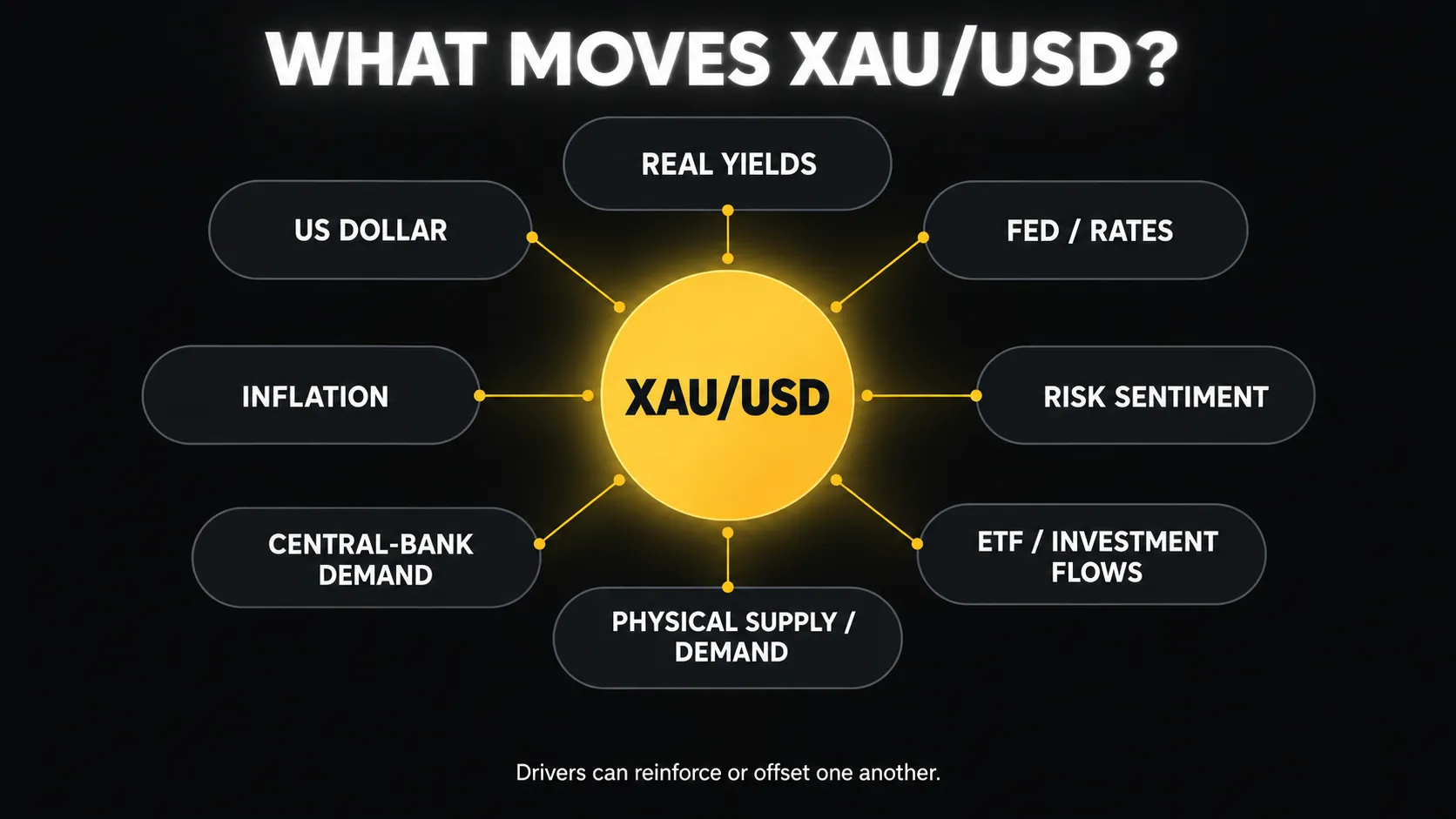
Gold and XAU/USD move because several forces act on the market at the same time. The most important include real interest rates, the US dollar, monetary-policy expectations, inflation, safe-haven demand, central-bank buying, investment flows, physical demand and supply, and market positioning. Which factor matters most can change from one day, or even one hour, to the next.
That is why simple rules such as “higher inflation means higher gold” or “a stronger dollar always pushes gold down” often fail. A useful analysis asks two questions: what changed relative to expectations, and which transmission channel is dominating the price now?
What affects Gold and XAU/USD at a glance?
XAU/USD shows the price of gold in US dollars. It therefore reflects both the forces affecting gold and changes in the currency used to quote it. The relationships below are common tendencies, not guaranteed outcomes.
| Driver | Why it can affect Gold | Common interpretation | Why the relationship can break |
|---|---|---|---|
| Real yields | Gold pays no interest, so inflation-adjusted returns on competing safe assets affect its opportunity cost | Falling real yields can support Gold; rising real yields can weigh on it | Risk demand or strong investment buying can dominate |
| US dollar | Gold is widely quoted in USD, and dollar moves change its cost in other currencies | A weaker USD can support XAU/USD | Gold and the dollar can rise together during stress |
| Monetary policy | Expected policy affects yields, liquidity, the dollar and risk sentiment | Expected easing can be supportive | The decision may already be priced in |
| Inflation | It changes purchasing-power concerns and policy expectations | Inflation concerns can increase demand for Gold | Tighter-policy expectations may lift real yields and USD |
| Risk and geopolitics | Uncertainty can increase demand for defensive assets | Severe stress can support Gold | Investors may sell Gold to raise cash |
| Central-bank demand | Reserve purchases add a large, longer-horizon source of demand | Persistent buying can support the market backdrop | Purchases are delayed, uneven and not a price floor |
| ETF and investor flows | Funds and futures positions can move more quickly than physical supply | Inflows and new long positions may reinforce momentum | Crowded positions can reverse sharply |
| Physical supply and demand | Mine output, recycling, jewellery, bars, coins and technology affect the balance | Strong demand or constrained supply can be supportive | Large above-ground stocks and financial flows can dominate short-term pricing |
Real yields change the opportunity cost of holding Gold
Gold does not pay a contractual coupon or dividend. When investors can earn a higher inflation-adjusted return on assets such as government bonds, holding non-yielding Gold may become less attractive. When those real returns fall, the opportunity cost of holding Gold may decline.
This is why real yields often matter more than nominal interest rates alone. A nominal yield is quoted before inflation. A real yield adjusts for expected inflation, so it is closer to the return investors expect to retain in purchasing-power terms.
The 10-year US Treasury inflation-indexed yield published through FRED is one commonly followed market measure. It is still only one maturity and one proxy; it is not a complete model for Gold.
The important word is often. Rising real yields can create a headwind, but they do not force Gold lower. Central-bank purchases, defensive demand or strong investment flows may outweigh the opportunity-cost effect. Markets also trade expectations: if higher yields were already anticipated, the price reaction may occur before the published data or policy decision.
How the US dollar affects XAU/USD
Because XAU/USD is quoted in US dollars, the currency side of the pair matters. When the dollar strengthens against other currencies, Gold becomes more expensive for many non-dollar buyers if its USD price is unchanged. That can restrain demand and coincide with pressure on XAU/USD.
Dollar strength may also reflect the same forces that weigh on Gold. For example, stronger US data can raise expected interest rates, lift Treasury yields and support the dollar. In that situation, several linked channels can point in the same direction.
But the relationship is not mechanical. Gold has its own supply-and-demand conditions, and correlations change. During periods of acute uncertainty, demand for dollar liquidity and demand for Gold can rise together. Strong official-sector or investor buying can also offset the currency headwind.
For that reason, “USD up, Gold down” is a starting hypothesis—not a trading rule. It is more useful to ask why the dollar is moving and whether Gold-specific demand is reinforcing or resisting that move.
Federal Reserve policy matters through several channels
Federal Reserve decisions can affect Gold through interest rates, the dollar, inflation expectations, liquidity expectations and broader risk sentiment. The Fed explains that changes in its policy rate influence other interest rates and financial conditions, although the transmission is neither direct nor immediate (Federal Reserve).
Markets usually react to the expected path of policy rather than the headline decision alone. A rate cut can coincide with falling Gold if the cut was already fully expected and accompanying guidance suggests fewer future cuts. Conversely, Gold can rise before a cut if traders have already repriced yields and the dollar in anticipation.
This makes central-bank communication important. Statements, projections and press conferences may change expectations even when the current policy rate does not move. Balance-sheet policy and broader liquidity conditions can matter too, but neither creates an automatic one-way result for Gold.
Inflation can help or hurt Gold depending on the response
Gold is often described as an inflation hedge because some investors use it to preserve purchasing power over long periods. Yet the short-term relationship between inflation and Gold is conditional.
Higher or unexpectedly persistent inflation can work through two opposing channels:
- It can increase demand for assets perceived as stores of value.
- It can raise expectations for tighter monetary policy, higher real yields and a stronger dollar.
The outcome depends on which channel dominates. Expected inflation also differs from inflation already reported. A high CPI reading may have little effect if markets anticipated it, while a smaller surprise can move Gold sharply if it changes the expected policy path.
This is why “inflation rose” is not a complete explanation for an XAU/USD move. A better sequence is: compare the release with expectations, observe the reaction in real yields and the dollar, and then consider whether Gold-specific demand is adding a separate influence.
Safe-haven and geopolitical demand are not automatic
Periods of financial stress, banking concern, geopolitical uncertainty or sharp risk aversion can increase demand for Gold. Investors may value its liquidity, scarcity and lack of issuer credit risk when confidence in other assets or institutions weakens.
However, a risk event does not guarantee an immediate Gold rally. Investors facing margin calls or redemptions may sell liquid assets to obtain cash. The US dollar and government bonds may also attract defensive demand. The initial reaction can therefore differ from the longer-term response.
The severity, duration and degree of surprise matter. A widely anticipated event may already be reflected in prices, while an unexpected escalation can trigger a stronger repricing. Safe-haven demand is best treated as one channel among several rather than a permanent property that overrides every other driver.
Central-bank buying can reshape the longer-term demand backdrop
Central banks hold Gold as part of official reserves and may buy it for diversification, liquidity, crisis performance or reduced dependence on a particular issuer or currency. The World Gold Council’s central-bank market primer describes these reserve-management motives and the official sector’s role in the market.
Central-bank purchases can create a durable source of demand because reserve managers often operate on longer time horizons than short-term traders. They may help explain periods when Gold remains firm despite higher yields or a stronger dollar.
Still, official buying is not a guaranteed price floor. Purchases and sales are uneven, reported with delays and sometimes estimated. Other market participants can sell at the same time. Reserve data also need careful interpretation: a rise in the dollar value of a country’s Gold reserves may reflect a higher price rather than an increase in the quantity held.
ETF flows, futures positioning and sentiment can amplify moves
Financial demand can change more quickly than mine production. Physically backed Gold exchange-traded funds allow investors to add or reduce exposure without handling bullion directly. Changes in holdings and fund flows can therefore contribute to price movement, especially when investors across regions move in the same direction.
Holdings, flows and assets under management are not interchangeable. Assets under management can rise because Gold becomes more expensive even without new money entering a fund. The World Gold Council’s Gold ETF research tracks both holdings and flows, which helps preserve that distinction.
Futures positioning can also reinforce momentum. When many traders hold similar positions, additional buying or selling may accelerate a move. The same crowding can later make the market vulnerable to profit-taking, stop orders or liquidation. The CFTC’s Commitments of Traders reports provide a delayed view of participant positioning; they are context, not a real-time signal or forecast.
Physical supply and demand matter differently from other commodities
Gold demand includes jewellery, bars and coins, technology, investment products and official reserves. Supply comes mainly from mine production and recycling. China and India can be important to physical consumption, but demand within either market changes with local prices, income, currency moves, policy, seasonality and buyer preferences.
Gold also differs from consumable commodities. Most Gold mined throughout history still exists in some form, so the above-ground stock is large relative to annual mine output. The current World Gold Council market primer explains the market’s mix of consumer, investment and official demand and the importance of existing stocks.
That means a small change in mine production does not by itself explain short-term price movement. Existing holders can release metal through selling and recycling, while investors and central banks can absorb available supply. New mine capacity also tends to respond slowly because exploration, permitting and construction take time.
Physical demand still matters. High prices may reduce jewellery volumes while increasing the value spent, and strong bar-and-coin demand can absorb supply. The key is to distinguish tonnes, spending value and investment flows rather than treating them as the same measure.
Economic data can move Gold by changing expectations
Major data releases often affect XAU/USD because they change expectations for interest rates, inflation, growth and Federal Reserve policy. Common examples include:
- Consumer Price Index and other inflation data
- Employment, unemployment and wage data
- GDP and activity indicators
- Consumer spending and PCE inflation
- Central-bank decisions, projections and speeches
The headline number is only the first step. Markets compare the result with expectations, review revisions and assess whether the composition changes the policy outlook. Strong employment data could lift yields and the dollar if it reduces expected rate cuts. But it could have a smaller effect if the details are weak or the result was already priced in.
Timing and liquidity also influence the reaction. US data and Federal Reserve events can create short-term volatility in USD-denominated Gold, while activity varies across global sessions. That affects how quickly a move develops, not whether it will produce a profitable outcome.
Why the same news can produce different Gold reactions
Gold rarely responds to one headline in isolation. The following scenarios show how competing channels can change the outcome. They are conceptual examples, not trading signals.
Inflation falls and policy expectations ease
Softer-than-expected inflation may increase expectations for lower rates. Real yields and the dollar may fall, reducing Gold’s opportunity cost and supporting XAU/USD.
But if the same report also reduces economic risk and weakens defensive demand, the Gold response may be smaller than expected.
Inflation rises and tighter policy becomes more likely
Higher inflation may increase interest in Gold as a store of value. At the same time, it may push expected policy rates, real yields and the dollar higher. Gold can fall if the monetary-policy channel dominates the inflation-hedge channel.
A major risk event increases demand for both USD and Gold
Investors may seek dollar liquidity while other buyers add Gold exposure. Both can rise together, temporarily weakening their usual inverse relationship. If cash needs become urgent, Gold may initially fall before defensive demand re-emerges.
The Fed eases, but less than markets expected
A rate cut can still disappoint if investors expected a larger cut or faster future easing. Yields and the dollar may rise after the announcement, creating pressure on Gold despite the nominal reduction in rates.
These examples share one principle: price reacts to the change in expectations and the balance of channels, not to the headline label alone.
Short-term and longer-term drivers
Some factors tend to move quickly. Economic surprises, central-bank communication, dollar moves, changes in real yields, geopolitical headlines, positioning and liquidity can affect XAU/USD over minutes, hours or days.
Other forces may influence the backdrop over months or years. These include reserve diversification, sustained central-bank demand, real-rate regimes, mine development, structural investment demand and long-term confidence in currencies or institutions.
The distinction is useful but not absolute. A long-term theme can become a short-term catalyst when new information changes expectations, and a sharp daily move can occur inside a broader trend driven by different forces.
A practical framework for reading XAU/USD drivers
When Gold moves, use a consistent sequence rather than searching for a single universal explanation:
- Define the move. Note the instrument, currency, timeframe and whether you are viewing a live quote, benchmark, futures price or retail price.
- Identify the surprise. Ask what changed relative to expectations, including revisions and policy guidance.
- Check real yields and the dollar. These often show how the market interpreted the information.
- Look for Gold-specific demand. Consider central banks, ETFs, physical buying, safe-haven flows and positioning.
- Test competing explanations. If Gold resists a typical headwind, another driver may be stronger.
- Separate analysis from product risk. Understanding direction does not remove spread, financing and execution costs, or leverage and timing risk.
The LBMA Gold Price is an administered benchmark established through auctions; it is not identical to every continuously changing platform quote. Always compare like with like when evaluating a move.
Explore XAU/USD with Grand Markets
Grand Markets provides access to supported Forex and CFD markets, including XAU/USD. Readers who want to review current instruments and account conditions can compare Grand Markets trading accounts, while those looking for mobile platform access can download the Grand Markets trading app.
Availability and trading conditions can vary by account, instrument and jurisdiction. Understanding the drivers of Gold does not predict its next move or remove the risks of leveraged trading.
Frequently asked questions
What affects the price of Gold most?
There is no permanently dominant factor. Real yields, the US dollar and monetary-policy expectations often matter for short-term XAU/USD moves. Investment flows, central-bank demand, physical demand or risk sentiment can dominate in other periods.
Why does Gold sometimes fall when interest rates rise?
Higher real yields can increase the opportunity cost of holding non-yielding Gold. The relationship can break when defensive demand, official buying or investment flows are strong enough to outweigh that pressure.
Why does the US dollar affect XAU/USD?
Gold is widely quoted in US dollars. A stronger dollar can make it more expensive for buyers using other currencies and may coincide with higher US yields. But Gold and USD can rise together during stress, so the relationship is not fixed.
Does inflation always make Gold rise?
No. Inflation concerns can increase demand for Gold, but they can also raise expectations for tighter monetary policy, higher real yields and a stronger dollar. The net response depends on which channel dominates and what markets already expected.
Can Gold and the US dollar rise at the same time?
Yes. During severe uncertainty, investors may seek both dollar liquidity and Gold. Strong central-bank or investment demand can also support Gold despite a firm dollar.
What economic reports can move XAU/USD?
Inflation, employment, wages, GDP, consumer spending and central-bank decisions can all affect XAU/USD when they change expectations for rates, real yields, the dollar or economic risk. No report produces the same reaction every time.
Gold is best understood as the result of interacting forces rather than a one-variable market. Real yields and the dollar often provide the first clues, but inflation, policy expectations, risk demand, official purchases, investment flows, physical demand and positioning can reinforce or offset them. Following those relationships is more useful than memorizing a rule that eventually fails.
This article is for educational purposes only and is not personalized investment advice. Gold prices can rise or fall, and leveraged products can produce substantial losses.

Disclaimer:
This content does not constitute any offer, solicitation or advice. You should always seek independent professional advice before making any investment decision. Please note that Grand Markets may restrict or prohibit some or all services to users from restricted regions. Please read the User Agreement for more information.