

XAU/USD represents Gold priced in US dollars. XAU is the internationally used code for Gold, while USD is the US dollar. Under the usual market convention, an XAU/USD quote shows approximately how many US dollars one troy ounce of Gold is worth.
The quotation is not the same thing as a specific tradable product. Contract size, ownership rights, costs and trading conditions depend on the instrument and provider.
What XAU/USD means
XAU/USD, also written as XAUUSD, combines a precious-metal code with a currency code:
- XAU — the internationally used code for Gold.
- USD — the US dollar.
- XAU/USD — Gold priced in US dollars.
SIX maintains the official ISO 4217 currency-code lists, which include codes for currencies, funds and precious metals. XAU is the code used for Gold; USD identifies the US dollar.
XAU/USD resembles the notation used for a Forex currency pair, but XAU is a precious-metal code rather than a currency issued by a country. It can therefore be read using base/quote logic without treating Gold as a sovereign currency.
How to read an XAU/USD quote
Suppose XAU/USD is quoted at 2,500.
Under the conventional reference framework, that means one troy ounce of Gold is valued at approximately USD 2,500. The figure is illustrative and is not a current market price.
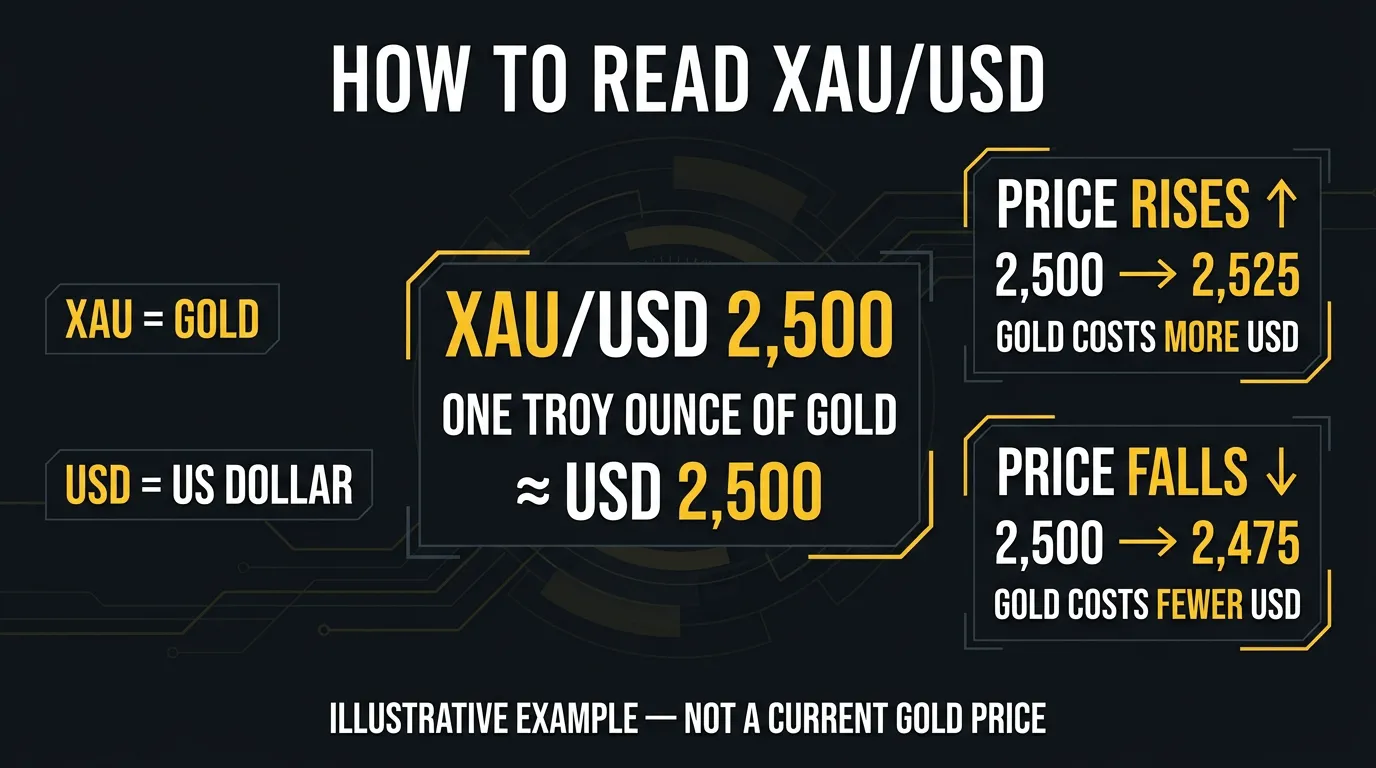
The direction describes Gold’s value relative to the US dollar. It does not automatically show how Gold has moved in euros, dirhams, rupiah or another currency, because the relevant exchange rate also matters.
Bid, ask and the displayed price
A trading platform may show both a bid and an ask price:
- The bid is generally the price available when selling.
- The ask is generally the price available when buying.
- The spread is the difference between the two.
A chart may display the bid, ask, midpoint or another reference price. That is why the chart value and the price available for an order may not be identical.
Why Gold is commonly quoted in US dollars
The US dollar is a widely used reference currency in international commodity and precious-metals markets. Quoting Gold in USD gives market participants a shared unit for expressing its value.
The LBMA’s precious-metals market conventions state that Gold prices are expressed in US dollars per fine troy ounce. Prices can also be expressed in other currencies or weight units, but USD per troy ounce is the common international convention.
One troy ounce equals approximately 31.1035 grams. This is different from the ordinary avoirdupois ounce used for many everyday goods.
The quoted international reference should not be confused with the retail price of a Gold bar or coin. Physical products can include fabrication premiums, dealer margins, delivery, storage, insurance, purity differences and applicable taxes.
What it means when XAU/USD rises or falls
When XAU/USD rises, Gold costs more US dollars per troy ounce. When XAU/USD falls, Gold costs fewer US dollars per troy ounce.
This relationship does not explain why the price moved. Interest rates, currency movements, investment demand, central-bank activity, economic expectations and geopolitical events may all matter, often at the same time. Those price drivers require a separate analysis and cannot be reduced to a single rule.
The same XAU/USD movement can also look different to someone measuring Gold in another currency. For example, a local-currency Gold price reflects both the international USD Gold quotation and the exchange rate between USD and that local currency.
Is XAU/USD the same as physical Gold?
No. XAU/USD is a price notation. Physical Gold is a tangible asset such as a bar or coin.
Gold exposure can be obtained through several product structures. XAU/USD is commonly used for the Gold-versus-US-dollar quotation, while physical Gold, futures, funds and other products use their own structures and identifiers.
| Form of Gold exposure | What the buyer or trader holds | Key distinction |
|---|---|---|
| Physical Gold | A bar, coin or custody claim under the purchase arrangement | Price can include premiums, storage and delivery costs |
| Broker derivative referencing Gold | A contract whose value refers to Gold prices | A provider may use the XAU/USD label; the position usually does not confer bullion ownership |
| Gold futures | A standardized exchange-traded contract with its own contract identifier | Exchange rules define contract size, margin and expiry terms |
| Gold fund or ETP | Shares or securities with their own ticker and product structure | Rights, costs and tracking depend on the fund documents |
Someone trading an XAU/USD derivative normally gains exposure to price changes rather than taking delivery of physical Gold. The exact position, settlement and ownership terms must be confirmed in the applicable product documents.
Is XAU/USD a Forex pair?
XAU/USD is commonly displayed beside Forex pairs and uses the same base/quote reading logic: XAU is the asset being valued and USD is the quote currency.
It is not a conventional currency pair such as EUR/USD, because Gold is a precious metal rather than a sovereign currency. A broker or platform may therefore categorize XAU/USD under metals, commodities, spot products or derivatives.
On a broker platform, the XAU/USD label alone does not tell you the exact contractual structure of the instrument. Check the provider’s specification to determine whether it is a CFD, another OTC derivative or another form of Gold exposure.
How XAU/USD exposure works at a high level
For an XAU/USD derivative, a long position generally benefits before costs if Gold rises relative to the entry price and loses if it falls. A short position generally has the opposite relationship.
The actual monetary profit or loss depends on the instrument’s contract size, the position size and applicable costs. Those values must be taken from the current instrument specification rather than inferred from the XAU/USD label.
What to check before trading a provider’s XAU/USD instrument
Before using a Gold instrument, establish:
| Item | What to verify |
|---|---|
| Product type | CFD, other OTC derivative, futures contract, security or another structure |
| Reference unit | The quantity of Gold represented by the contract or lot |
| Price increments | Tick, point or pip terminology used by the platform |
| Costs | Bid–ask spread, commission, overnight financing and currency conversion |
| Margin and leverage | Initial requirement, applicable leverage and close-out rules |
| Schedule | Trading hours, maintenance breaks and holiday changes |
| Settlement and contract terms | Cash settlement, expiry, rollover, delivery provisions and applicable agreement |
Grand Markets lists XAUUSD among the instruments shown on its current website and states that leverage, spreads and trading hours are subject to the information displayed in the trading terminal and applicable account rules. Those current symbol-level details should be checked before trading rather than inferred from a general XAU/USD guide.
Frequently Asked Questions
What does XAU/USD mean?
XAU/USD means Gold priced in US dollars. XAU is the code for Gold and USD is the US dollar. Under the common market convention, the quote represents the approximate dollar value of one troy ounce of Gold.
What does XAU stand for?
XAU is the internationally used code for Gold. It belongs to the ISO 4217 system of currency, fund and precious-metal codes.
Is XAU/USD the same as Gold?
XAU/USD expresses Gold’s value in US dollars. It is a quotation, not a physical Gold holding.
What happens when XAU/USD rises?
When XAU/USD rises, one troy ounce of Gold costs more US dollars. When it falls, Gold costs fewer US dollars. This describes the relative price change and does not identify its cause.
Does trading XAU/USD mean I own physical Gold?
Generally not. A broker derivative normally provides exposure to Gold price movements without giving you ownership or delivery of physical bullion.
Is XAU/USD a currency pair?
It uses pair-style notation and is often displayed on Forex platforms, but XAU is a precious-metal code rather than a national currency. The product may be categorized as a metal, commodity or derivative depending on the provider.
XAU/USD is easiest to understand by separating the quotation from the product: the quotation shows Gold’s value in US dollars, while the product specification explains the contract, position unit, costs and rights involved.
Gold and leveraged derivatives can move sharply and may produce losses. This article provides general educational information, not personalized investment advice.

Disclaimer:
This content does not constitute any offer, solicitation or advice. You should always seek independent professional advice before making any investment decision. Please note that Grand Markets may restrict or prohibit some or all services to users from restricted regions. Please read the User Agreement for more information.