
Beginners should compare Grand Markets, Pepperstone, Capital.com, Exness and XM because each addresses a different need: low-entry Cent access, broad platform choice, education and proprietary usability, explicit cent-lot sizing, or a USD 5 entry point. The best fit still depends on trade size, total cost, margin rules and product access.
The shortlist below gives readers real options to investigate rather than a universal winner. First, the framework explains how to compare those brokers on a like-for-like basis and why an attractive minimum deposit does not settle the decision.
What Beginners Should Compare First
Start with the conditions that determine whether an account is practical to use. Treat promotional entry figures as supporting information, then confirm the legal entity and terms that apply before opening an account.
| Criterion | What to check | Why it matters |
|---|---|---|
| Minimum trade size | Minimum order volume, contract units and instrument specifications | The smallest permitted position determines how finely exposure can be controlled |
| Total trading cost | Spread, commission, overnight financing, conversion and other disclosed charges | A low headline spread does not show the whole cost of a trade |
| Platform clarity | Where order size, contract details, margin, profit or loss, costs and account history appear | Important information should be understandable before an order is placed |
| Account and product fit | Pricing model, available instruments, platform access and account specifications | Account names alone do not establish suitability |
| Margin and risk controls | Margin required, close-out rules, stop-loss and take-profit controls, and risk disclosures | These affect how much collateral is tied up and how positions are managed |
| Funding and support | Deposit and withdrawal process, payment methods, help channels and service availability | Operational friction matters before and after trading begins |
| Legal entity | The company you contract with, its regulator or registration, country eligibility and the terms that apply | A global brand can operate through different entities with different rules and protections |
| Minimum deposit | The funding threshold for the selected account | It shows how little can be deposited, not whether that amount is practical for the intended trade |
This order is deliberate. A broker with a very low deposit threshold can still be a poor fit if its smallest position is too large, its costs are hard to calculate or its account terms are unclear.
CFD Brokers Beginners May Want to Compare
The five brokers below offer different account structures, platform options and entry requirements, making them useful points of comparison for beginners. Features, pricing and availability can vary by account type and region, so check the latest terms before choosing a broker.
| Broker | Notable beginner angle | Verified entry or sizing evidence | Platform or learning angle | Important check |
|---|---|---|---|---|
| Grand Markets | Low account-entry threshold with a Cent option | USD 10 minimum deposit shown for Standard, ECN and Cent accounts | MT4, MT5 and a Grand Markets mobile app | Minimum order volume and contract specifications for the intended CFD |
| Pepperstone | Broad platform choice | Standard and Razor pricing models; position specifications depend on the market and platform | Pepperstone platform, MT4, MT5, cTrader and TradingView, with demo access | Which platforms, account types and prices apply under the relevant entity |
| Capital.com | Proprietary-platform usability and structured learning resources | Its international fees page lists a USD/EUR/GBP 10 minimum for bank cards and Apple Pay; payment-method minimums differ | Web and mobile platform, MT4, MT5, TradingView, demo and education hub | Payment, platform and product terms for the applicable account |
| Exness | Explicit smaller-volume Cent structure | Standard Cent publishes a 0.01 cent lot minimum position; first-deposit requirements vary by payment method and location | Standard Cent is available through supported MT4 and MT5 account configurations | Instrument availability and the real exposure represented by a cent lot |
| XM | Published low entry point with demo access | Standard and Ultra Low accounts currently show a USD 5 minimum deposit | Demo access and MT5 across desktop, mobile and web | Whether the required account format, minimum volume and platform are available locally |
Grand Markets: low entry threshold with Cent-account access
Grand Markets combines a low minimum deposit with a choice of Standard, ECN and Cent accounts. With a USD 10 minimum deposit, traders can compare not only the cost of getting started but also which account structure suits them best. MT4 and MT5 are also available on desktop.
The key follow-up is position sizing. The USD 10 threshold does not show the minimum exposure for every CFD, so readers should check the selected instrument’s minimum order volume, contract specifications and margin requirement before deciding whether the account fits their capital.
Pepperstone: broad platform choice
Pepperstone is the clearest platform-choice in the group. Its platform page currently has the Pepperstone platform, MT4, MT5, cTrader and TradingView across desktop, browser and app formats, while demo access is available for platform testing.
That breadth is useful for beginners who want to compare how different interfaces display orders, margin and account history. They should still verify which platform works with the selected Standard or Razor account and compare its spread-plus-commission structure for the markets they intend to trade.
Capital.com: proprietary usability and education
Capital.com is worth comparing for readers who want an in-house web/mobile experience supported by a large education section and demo access. Its currently also lists MT4, MT5, TradingView and Web Terminal, providing a useful contrast with brokers centred mainly on third-party terminals.
The international fees page currently lists a USD/EUR/GBP 10 minimum for bank cards and Apple Pay, while wire-transfer and other payment minimums differ. That makes it a good example of why the headline deposit must be matched to the actual payment route, platform and account.
Exness: explicit Cent-account sizing information
Exness earns a place because its official Standard Cent documentation provides more than an account label: it gives a minimum position volume of 0.01 cent lots and explains that initial deposit requirements vary by payment method and geographic location. This directly supports the distinction between deposit threshold and usable trade size.
Beginners comparing Exness should translate the cent-lot specification into actual exposure for the instrument they plan to trade and confirm which Standard Cent instruments and MT4 or MT5 configurations are available to them.
XM: a published USD 5 entry point and demo route
XM’s current account page lists a USD 5 minimum deposit for Standard and Ultra Low accounts and provides a demo-account route. Its current MT5 resources cover desktop, mobile and web access, giving readers a low-entry option with a familiar third-party platform to evaluate.
The useful next step is to look beyond the USD 5 figure. Users should confirm whether the required Standard, Ultra Low Standard or Ultra Low Micro format is available through their entity, then compare minimum volume, contract units and the account’s actual cost model.
Why a Low Minimum Deposit Is Not Enough
A minimum deposit answers one narrow question: how much money is required to fund or open the relevant account. It does not show what position sizes are available, how much margin a trade requires or how quickly costs and price movement could affect a small balance.
Low entry thresholds can be useful because they reduce the amount needed to activate an account. But beginners should not interpret them as recommended starting capital or evidence of lower risk. The practical test is whether the account’s smallest permitted position, product specifications and costs allow the intended exposure to be managed sensibly.
The same principle applies to Cent accounts. A Cent account and a low minimum deposit are different features. Cent-account structure is relevant only when the actual contract and minimum-volume specifications support the smaller exposure the user wants.
Minimum Deposit vs Trade Size vs Margin
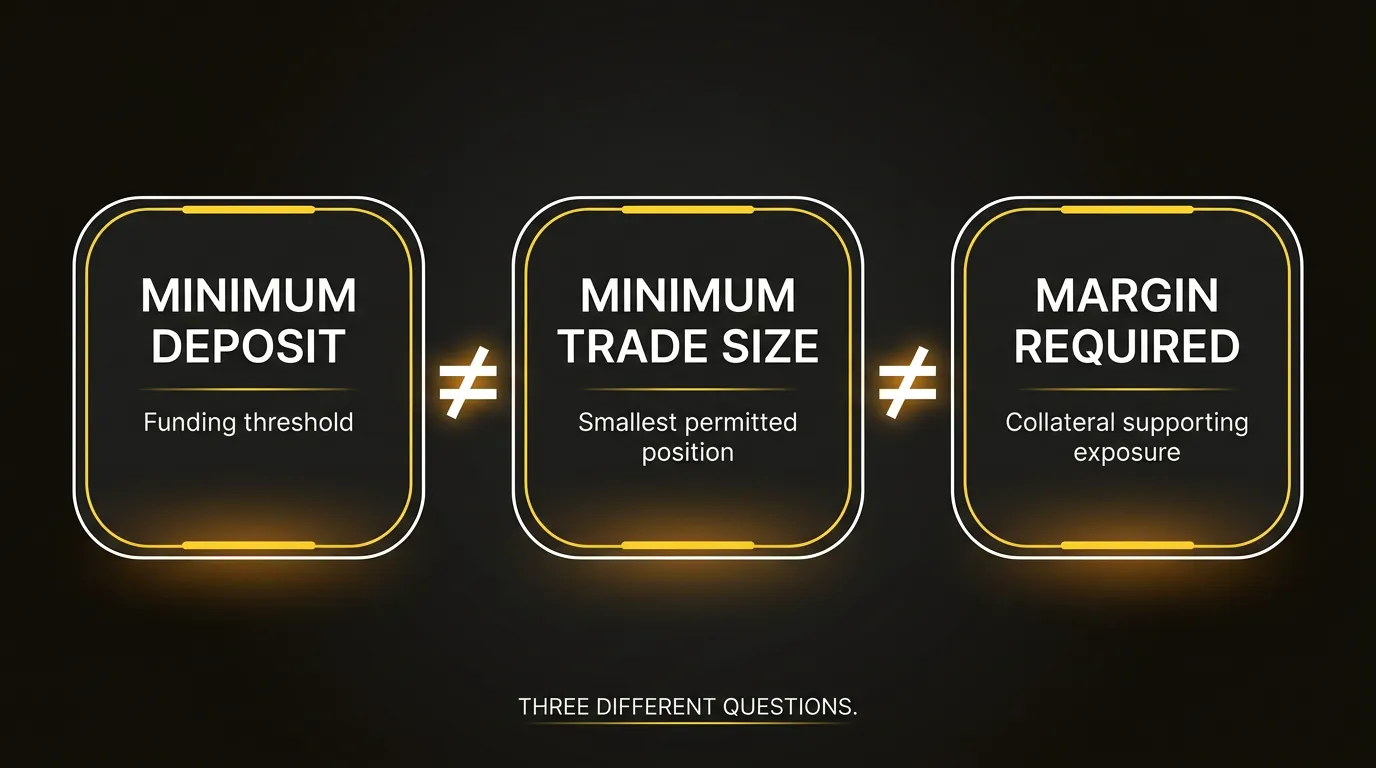
- Minimum deposit is the minimum amount needed to fund or open the account.
- Minimum trade size is the smallest position permitted for a particular instrument and account.
- Margin requirement is the collateral needed to support a leveraged position.
They are not interchangeable. A broker may allow an account to be funded with a small amount while the margin required for a particular CFD is higher than that amount. Even when a position can be opened, the remaining free margin may provide little room for adverse movement or costs.
Consider a simple hypothetical example. A CFD position with USD 1,000 of market exposure and a 5% margin requirement needs USD 50 of margin. If the exposure moves 1% against the position, the loss is approximately USD 10 before applicable costs.
The USD 50 margin requirement does not cap the loss at USD 50. Margin supports the exposure; it is not a maximum-loss figure. This is why deposit, margin, exposure and potential loss must be evaluated separately.
Compare the Real Cost of Trading
Spread is only one part of total trading cost. Compare brokers using the same instrument, account type, trade size and holding period, then check:
- the bid–ask spread;
- any commission charged when opening or closing;
- overnight financing or swap for positions held across the applicable cut-off;
- currency-conversion charges; and
- other disclosed account, market-data or payment costs.
A spread-only comparison can be misleading. One account may show a tighter spread and charge a separate commission, while another incorporates more of the cost into the spread. The relevant figure is the expected all-in cost for the way the account will actually be used.
Beginners should also check where costs are disclosed. A clear broker should make current pricing and the basis of variable charges accessible before funding and inside the relevant platform or account documentation.
Check Margin and Risk Controls
For broker evaluation, the first question is not how much leverage is advertised. It is whether the broker clearly shows how margin works for the selected product and what happens when account equity falls.
Before trading, locate the initial margin or margin-rate information, the platform’s used and free margin fields, and the broker’s margin-call or close-out terms. Confirm whether margin conditions can change by instrument or market conditions, and understand how open positions may be affected.
Risk controls also need to be operationally clear. A beginner should be able to enter, review and amend stop-loss and take-profit levels, while understanding that these controls do not guarantee execution at a particular price during gaps or fast markets.
What Should Beginners Look for in a Trading Platform?
A beginner-friendly trading platform should make the basics easy to understand and easy to find. Traders should be able to see the information they need before placing an order without having to search through complicated menus.
Useful things to check include:
- position or order size and the units being used;
- contract specifications for the selected instrument;
- bid and ask prices;
- required margin and available margin;
- current open profit or loss;
- stop-loss and take-profit controls;
- trading costs, where shown;
- trade and account history; and
- access to help or customer support.
A demo account can also be useful for getting familiar with the platform and practising the order process before trading live. It does not fully reflect the experience of trading with real money, but it can help beginners understand how the platform works.
Compare Account Types and Product Access
Labels such as Standard, Cent and ECN are not universal specifications. Two brokers can use the same label for accounts with different contract sizes, pricing models, minimum volumes, instruments or platform access.
Compare the details behind the label:
- minimum order volume and contract units;
- spread and commission structure;
- available CFDs and their specifications;
- margin conditions;
- supported platforms; and
- any account-specific limits or eligibility rules.
This approach also prevents a common mistake: choosing an account because its name sounds beginner-oriented without checking whether its actual smallest position and costs suit the intended balance.
Review Funding, Withdrawals and Support
Deposit convenience is only the beginning of the operational relationship. Before funding, review the available payment methods, withdrawal process, identity-verification requirements, processing information and any disclosed third-party or conversion costs.
Support should be judged by usefulness rather than the number of contact icons on a page. Check whether the broker provides a clear route for account, funding and platform questions, and whether support is available in a language and schedule that work for you.
Verify the Legal Entity and Applicable Terms
A global broker brand may operate through more than one legal entity. Before opening an account, identify the contracting company in the registration journey, verify the regulator or registration it names, confirm country eligibility and read the terms for that account. The objective is simply to know who the contract is with and which rules apply.
A Practical CFD Broker Checklist for Beginners
Before choosing or funding an account, make sure you can answer these questions:
- What is the smallest position I can place in the CFD I intend to trade?
- What spread, commission, overnight and conversion costs could apply to that position?
- How much margin will it require, and where are the close-out rules explained?
- Can I clearly see order size, contract units, margin, open profit or loss and risk controls on the platform?
- Does the selected account provide the products and platform access I need?
- Are the funding, withdrawal and support processes clear before I deposit?
- Which legal entity will hold my account, and what regulator or registration applies?
- Only then: what is the minimum deposit, and is a higher practical balance required for the intended position?
The strongest beginner choice is the broker that answers these questions clearly and whose actual conditions fit the trader’s plan—not the broker with the lowest isolated marketing number.
Compare Grand Markets Accounts, Fees and Platforms
Grand Markets currently has Standard, ECN and Cent options on its Trading Accounts page, with a USD 10 minimum deposit shown for each account type. That USD 10 figure is an account-entry threshold. It does not establish the minimum position for every CFD, the margin needed for a specific trade or an appropriate starting balance.
Users can apply the framework above by reviewing the current account cards and instrument tables, then checking Grand Markets’ fees and spreads. Platform access can be reviewed through the current MetaTrader 4 desktop and MetaTrader 5 desktop pages. Confirm the selected instrument, account conditions and order specifications before funding or placing a trade.
Frequently Asked Questions
Which CFD brokers should beginners compare?
Grand Markets, Pepperstone, Capital.com, Exness and XM form a useful shortlist because they represent different priorities: low-entry cent access, broad platform choice, proprietary usability and education, explicit cent-lot sizing, and a USD 5 entry point. Compare their current terms using the same instrument, trade size and holding period.
What is the best CFD broker for beginners?
The best choice is the broker whose minimum trade size, all-in costs, margin controls, platform clarity, product access, support and applicable legal terms fit the beginner’s intended markets and capital. Compare those conditions rather than choosing from a ranking or one promotional number.
What is the best CFD broker for low deposits?
A low minimum deposit is useful only when the account’s minimum position size, margin requirement, trading costs and available products also work for the intended balance. Compare the actual account and instrument specifications; do not treat the lowest deposit threshold as proof that a broker is the best fit.
Does a low minimum deposit make CFD trading less risky?
No. A low minimum deposit reduces the funding threshold, not the market risk of a CFD. Risk depends on the exposure created, position size, leverage and margin, price movement, costs and how the position is managed.
What should a beginner check before choosing a CFD broker?
Check minimum trade size, total cost, margin and close-out information, platform clarity, account and product fit, and the funding, withdrawal and support process. Also confirm the contracting legal entity and applicable terms. Consider the minimum deposit only after these factors are understood.
Are low spreads always cheaper?
No. A low spread can still be accompanied by commission, overnight financing, conversion or other disclosed charges. Compare the expected all-in cost for the same instrument, account, position size and holding period.
What is the difference between minimum deposit and minimum trade size?
Minimum deposit is the amount required to fund or open an account. Minimum trade size is the smallest position permitted for a particular instrument. A low deposit threshold does not guarantee that the smallest available trade is appropriately sized for that balance.
CFDs are leveraged products and involve a high risk of loss. This article provides a comparison framework, not personal financial advice or a recommendation to open an account. Review the current product terms and risk disclosures and consider whether CFD trading is appropriate for your circumstances.

Disclaimer:
This content does not constitute any offer, solicitation or advice. You should always seek independent professional advice before making any investment decision. Please note that Grand Markets may restrict or prohibit some or all services to users from restricted regions. Please read the User Agreement for more information.