
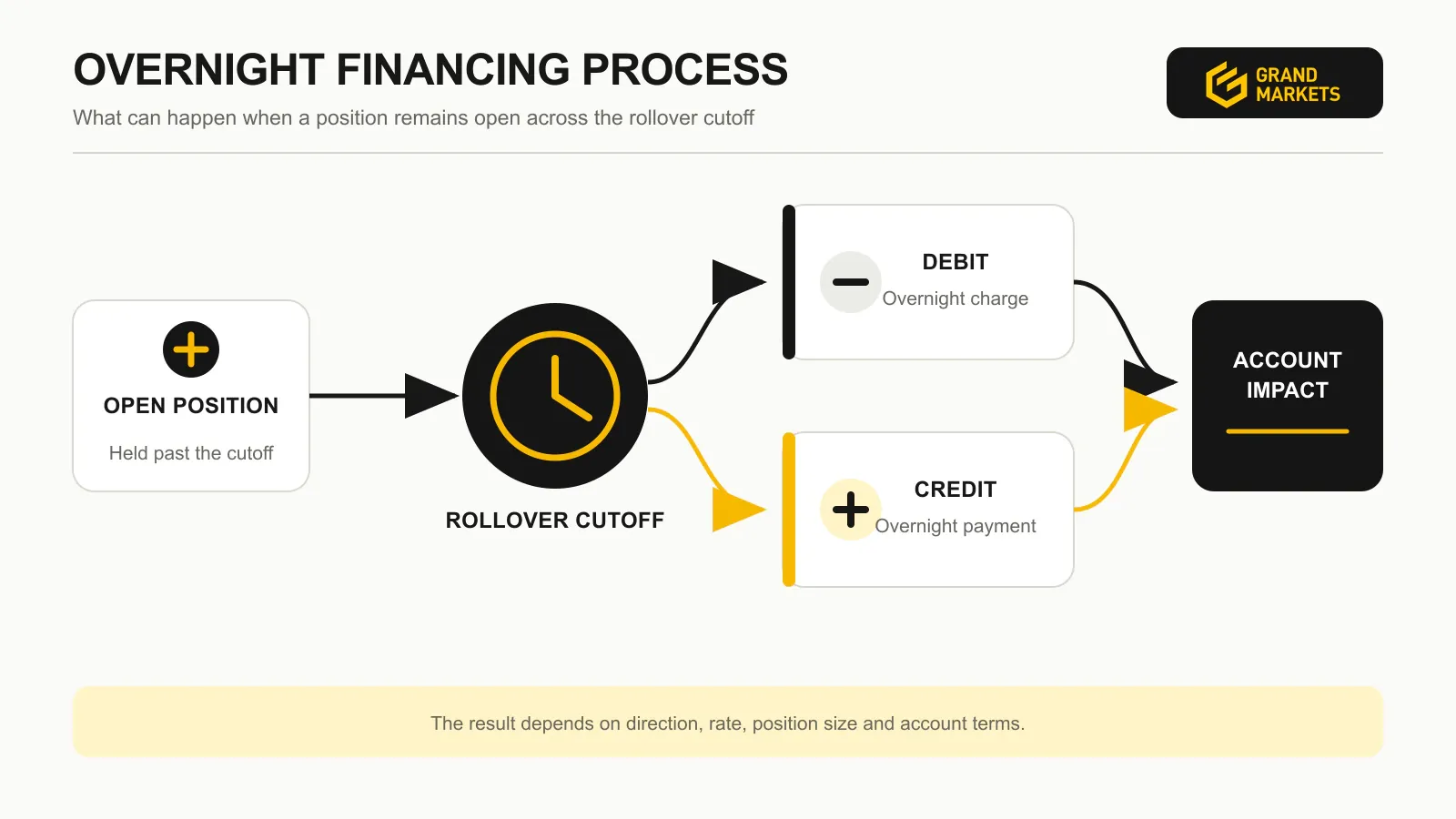
Forex swap and rollover adjust the financing cost of eligible positions that remain open across a broker’s daily cutoff. The adjustment can be a debit or a credit, depending on the currency pair, trade direction, position size, applicable rate, and account terms.
The important trigger is crossing the cutoff, not holding a trade for a full 24 hours. A position opened shortly before rollover can qualify for financing, while one held for several hours and closed beforehand may not. Understanding the cutoff also means distinguishing local time from platform-server time.
How forex swap and rollover create overnight charges or credits
Rollover is the continuation of an open position into the next trading or value-date period. Swap commonly refers to the financing adjustment associated with that continuation. Brokers may also call it overnight financing, funding, or rollover interest.
These terms describe related processes, but they are not interchangeable with every financial product containing the word "swap."
| Term | Meaning | Practical distinction |
|---|---|---|
| Retail forex swap | A contractual financing debit or credit | Usually an adjustment on an existing position |
| Rollover | Continuing exposure into the next applicable period | Does not necessarily require manual closing and reopening |
| Institutional FX swap | Two currency exchanges agreed for different value dates | A separate wholesale-market transaction |
| Currency swap | An agreement exchanging currency principal and/or interest obligations | Different from a retail overnight adjustment |
| Futures roll | Replacing an expiring futures contract with a later-dated contract | Involves different contracts |
The BIS instrument definitions distinguish institutional transactions from the retail financing discussed here.
A forex CFD provides exposure to a currency pair under a derivative contract. Explaining its financing does not mean the retail customer literally borrows one currency and deposits another.
Why currency funding affects the rate
A long EUR/USD position is economically long euros and short US dollars. A short position reverses that exposure. Differences between the currencies’ funding conditions help explain why holding the two directions can produce different financing outcomes.
However, actual swap fees in forex are not simply the difference between two central-bank policy rates. Pricing can also reflect:
- Short-dated market funding, including tom-next pricing.
- Liquidity-provider quotes.
- Currency funding demand and market conditions.
- Broker adjustments and administration charges.
- Instrument-specific contract terms.
Tom-next refers to short-dated FX transactions used to move settlement dates forward. It helps explain the market mechanism behind retail financing, but it is not itself a complete customer-pricing formula.
Traders searching for "rollover interest forex" should therefore check the published long and short rates rather than calculate a charge from policy rates alone.
Why both buy and sell swaps can be negative
The favorable funding component on one side can be smaller than the applicable adjustment or funding spread. Both directions can consequently incur a debit.
Never obtain the short swap by reversing the long swap’s sign. They are separate rates.
Positive financing also does not establish that a trade is profitable. A small daily credit can be overwhelmed by an adverse exchange-rate move.
When forex swap and rollover apply
Many brokers assess overnight forex charges at a defined daily event. Under this arrangement, the relevant question is whether the position remains eligible and open at the cutoff.
For example, a position opened five minutes before the cutoff and closed five minutes afterward can qualify for financing. A position opened earlier and fully closed before that event may avoid that particular adjustment.
A submitted close instruction is not necessarily an executed close. Execution delays, market conditions, and the broker’s boundary rules can affect whether the position remains open.
Local time, UTC, and server time
A rollover cutoff may be stated in local time, broker/server time, UTC/GMT, or a named market’s local time. These references are not interchangeable.
| Time reference | What to verify |
|---|---|
| Local time | Your current offset from UTC/GMT |
| Broker/server time | The server’s UTC offset and whether it changes seasonally |
| Fixed UTC or GMT+0 | The local-time conversion for your location |
| Named local market time | Whether daylight-saving changes shift its UTC equivalent |
When reviewing Forex market hours, trading sessions and time zones, check whether the stated rollover boundary is fixed or changes with daylight saving.
At Grand Markets, our current account information states that Forex swap is applied daily at 22:00 GMT+0, excluding weekends. Convert that fixed reference to your local time and confirm that it applies to the relevant account and instrument.
Why triple rollover commonly occurs on Wednesday
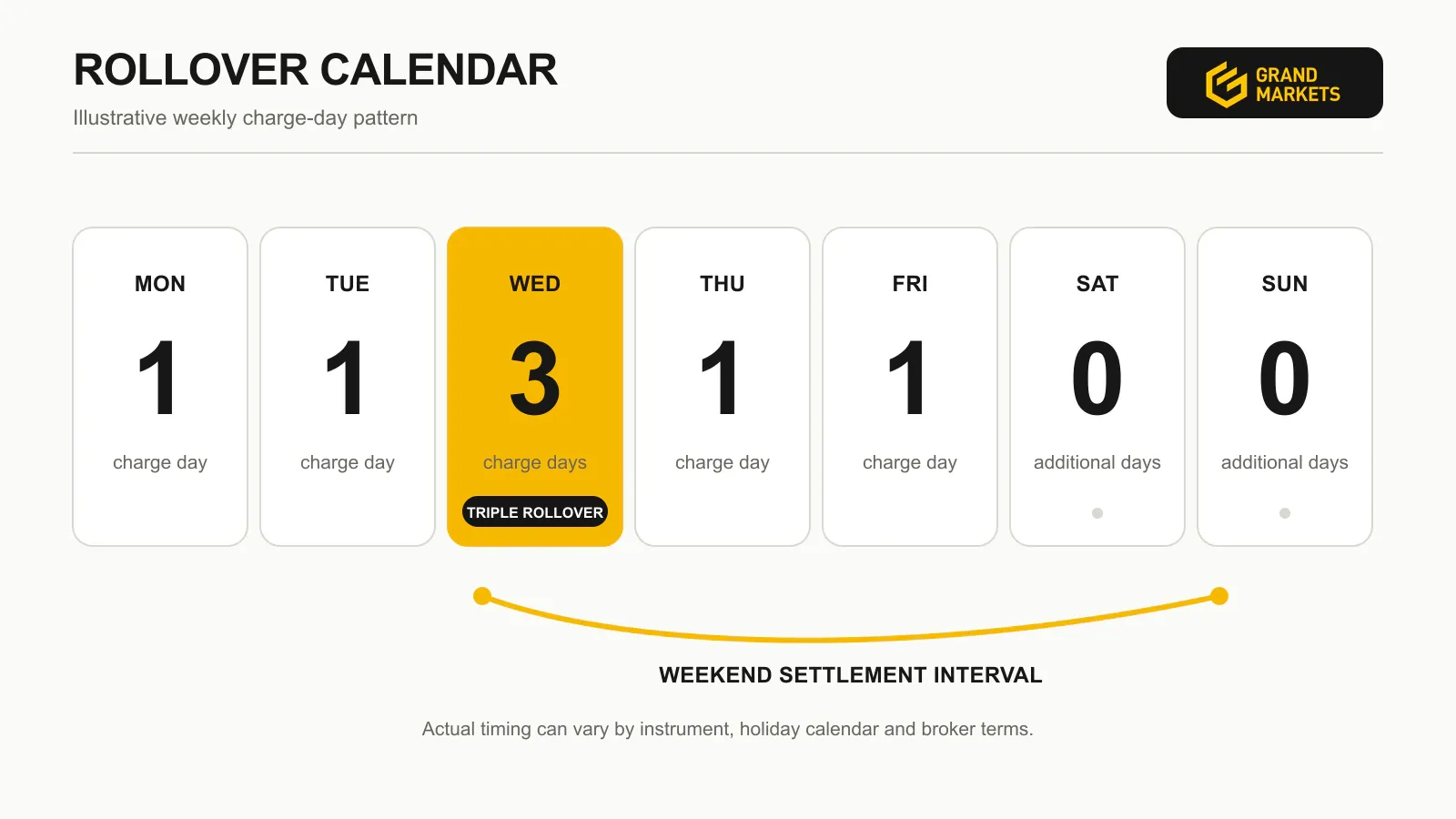
Many underlying spot currency pairs follow a two-business-day settlement convention. In a conventional Wednesday rollover, the value date moves from Friday to Monday, spanning three calendar days.
Retail financing can reflect that interval through a three-day adjustment. A trader does not necessarily need to hold the position through Saturday and Sunday to receive the Wednesday adjustment.
Here is an illustrative schedule, not a live broker calendar:
| Posting event | Financing charge days |
|---|---|
| Monday | 1 |
| Tuesday | 1 |
| Wednesday | 3 |
| Thursday | 1 |
| Friday | 1 |
| Saturday and Sunday | 0 additional |
| Weekly total | 7 |
Wednesday triple rollover is common, not universal. Pair-specific settlement, holidays, product rules, and broker terms can change the day or multiplier. A market-open day is not necessarily a settlement business day.
Also check whether a displayed estimate already includes the multi-day adjustment. Multiplying an already adjusted amount by three would overstate the cost.
How forex swap and rollover calculations work
The first step in understanding how forex swap works is identifying the displayed rate’s unit. A number such as "-6.5" is incomplete without knowing whether it represents points, pips, a percentage, or money.
MetaTrader 5 specification documentation describes multiple swap modes and relevant instrument fields. Platform capabilities do not establish which configuration applies to a particular broker.
| Rate format | Required calculation inputs |
|---|---|
| Points | Lots, contract size, point size, signed rate, charge days |
| Pips | Lots, contract size, pip size, signed rate, charge days |
| Annual percentage | Financing value, annual rate, day-count denominator, charge days |
| Cash per lot | Lots, stated cash amount, applicable charge period |
| Reopening mode | The configured broker and platform rollover method |
Where the financing currency differs from the account currency, conversion may also be required.
Points-based example: A debit and a credit
For a straightforward points-based calculation:
Financing cash flow = Lots x Contract size x Point size x Signed swap rate x Charge-day factor
Convert the result into the account currency if necessary. Here, a positive result means a credit and a negative result means a debit.
The following inputs are hypothetical, not Grand Markets quotes:
| Input | Assumption |
|---|---|
| Currency pair | EUR/USD |
| Position size | 0.50 lot |
| Contract size | 100,000 EUR per lot |
| Exposure | 50,000 EUR |
| Point size | 0.00001 USD per EUR |
| Account currency | USD |
| Long swap | -6.5 points per charge day |
| Short swap | +2.0 points per charge day |
First, calculate the position’s value per point:
0.50 x 100,000 x 0.00001 = USD 0.50
For one charge day:
- Long position: USD 0.50 x -6.5 = USD -3.25, a debit.
- Short position: USD 0.50 x 2.0 = USD +1.00, a credit.
For a hypothetical three-day event, the long adjustment becomes:
USD 0.50 x -6.5 x 3 = USD -9.75
On this five-decimal EUR/USD quotation, one pip equals ten points. The pip value is USD 5.00. Using that pip value with a points-denominated rate would overstate the adjustment tenfold.
Annual-percentage example
A position-value-based annual calculation follows this structure:
Financing cash flow = Financing value x Signed annual rate x Charge days / Annual day-count denominator
Assume these hypothetical inputs:
- Exposure: 50,000 EUR.
- Cutoff price: 1.10000 USD per EUR.
- Financing value: USD 55,000.
- Annual rate: -3.65%, expressed as -0.0365.
- Charge days: 1.
- Annual denominator: 365.
The calculation is:
55,000 x -0.0365 x 1 / 365 = USD -5.50
For a GBP account, using a hypothetical conversion rate of GBP 0.8000 per USD produces a debit of GBP 4.40. No separate conversion markup is assumed.
Do not automatically use 365. The contract may specify a different denominator, financing base, or valuation method.
Notional exposure is different from margin
Notional exposure is the economic size of the position. Margin is the collateral supporting it.
Under an exposure-based formula, changing the leverage setting without changing position size does not mechanically multiply financing. Increasing exposure does.
The same financing debit also consumes a larger proportion of a smaller account’s equity. Debits can reduce available margin, making overnight costs relevant to risk management as well as profitability.
How overnight financing changes total forex trading costs
Financing is only one part of forex trading costs. Evaluating a trade by spread alone can overlook a substantial holding-period expense.
| Cost component | What to check |
|---|---|
| Spread | Bid-ask difference and expected execution conditions |
| Commission | Per-side or round-trip charging |
| Financing | Direction, rate, position size, and accumulated charge days |
| Slippage | Difference between expected and actual execution |
| Currency conversion | Conversion rate and any separate markup |
| Alternative holding fees | Charges applicable under specific account arrangements |
The FCA’s review of CFD pricing and value reinforces the importance of assessing funding alongside other costs. Its regulatory scope is the UK, but the cost-comparison principle is useful more broadly.
Compare the entire holding period
Consider two hypothetical pricing structures for the same 0.50-lot EUR/USD exposure. Neither represents a named broker.
| Cost input | Structure A | Structure B |
|---|---|---|
| Spread | 0.8 pip | 1.4 pips |
| Spread cost at USD 5 per pip | USD 4.00 | USD 7.00 |
| Round-trip commission | USD 3.50 | USD 0.00 |
| Financing cost per charge day | USD 3.25 | USD 4.50 |
Assuming constant rates and spreads, with no slippage or conversion fees:
| Financing charge days | Structure A total cost | Structure B total cost |
|---|---|---|
| 0 | USD 7.50 | USD 7.00 |
| 1 | USD 10.75 | USD 11.50 |
| 3 | USD 17.25 | USD 20.50 |
| 7 | USD 30.25 | USD 38.50 |
Structure B has a slightly lower upfront cost but becomes more expensive once financing accrues.
These are financing charge days, not necessarily separate posting events. A triple event can account for three days in one adjustment.
The spread is counted once as a full round-trip cost under the simplified constant-spread assumption. When reconciling actual profit or loss from bid-ask execution prices, do not subtract an estimated spread again.
Closing before rollover is not automatically cheaper, either. Closing and reopening can introduce additional execution costs, slippage, and price-gap exposure.
What swap-free terms mean for Grand Markets accounts
A swap-free arrangement removes ordinary swap for eligible positions under specified terms. It does not, by itself, establish that every instrument or holding period is cost-free.
Some arrangements impose administration charges or other conditions. Others do not substitute an administration fee. The applicable account terms determine the result.
Before holding forex positions overnight under a swap-free arrangement, check:
- Customer and jurisdiction eligibility.
- Eligible account types and instruments.
- Grace periods or holding-period restrictions.
- Administration fees, where applicable.
- Spread and commission differences.
- Conditions that change or remove eligibility.
Grand Markets Swap and Swap-Free Conditions
According to our current Grand Markets trading account information, Forex swap is charged daily at 22:00 GMT+0, excluding weekends, and that triple swap is charged on Wednesdays. Swap rates may update daily. Accounts in Muslim countries are automatically set to Swap-Free.
These are general website conditions rather than an instrument-level rate or account-specific eligibility decision. Check the current long and short rates, units, exclusions, and any alternative charges in the relevant account documents and instrument specifications.
Review the applicable client agreement alongside the account page. Ask for clarification when general website information and account-specific information differ.
Forex swap and rollover checks before holding a position overnight
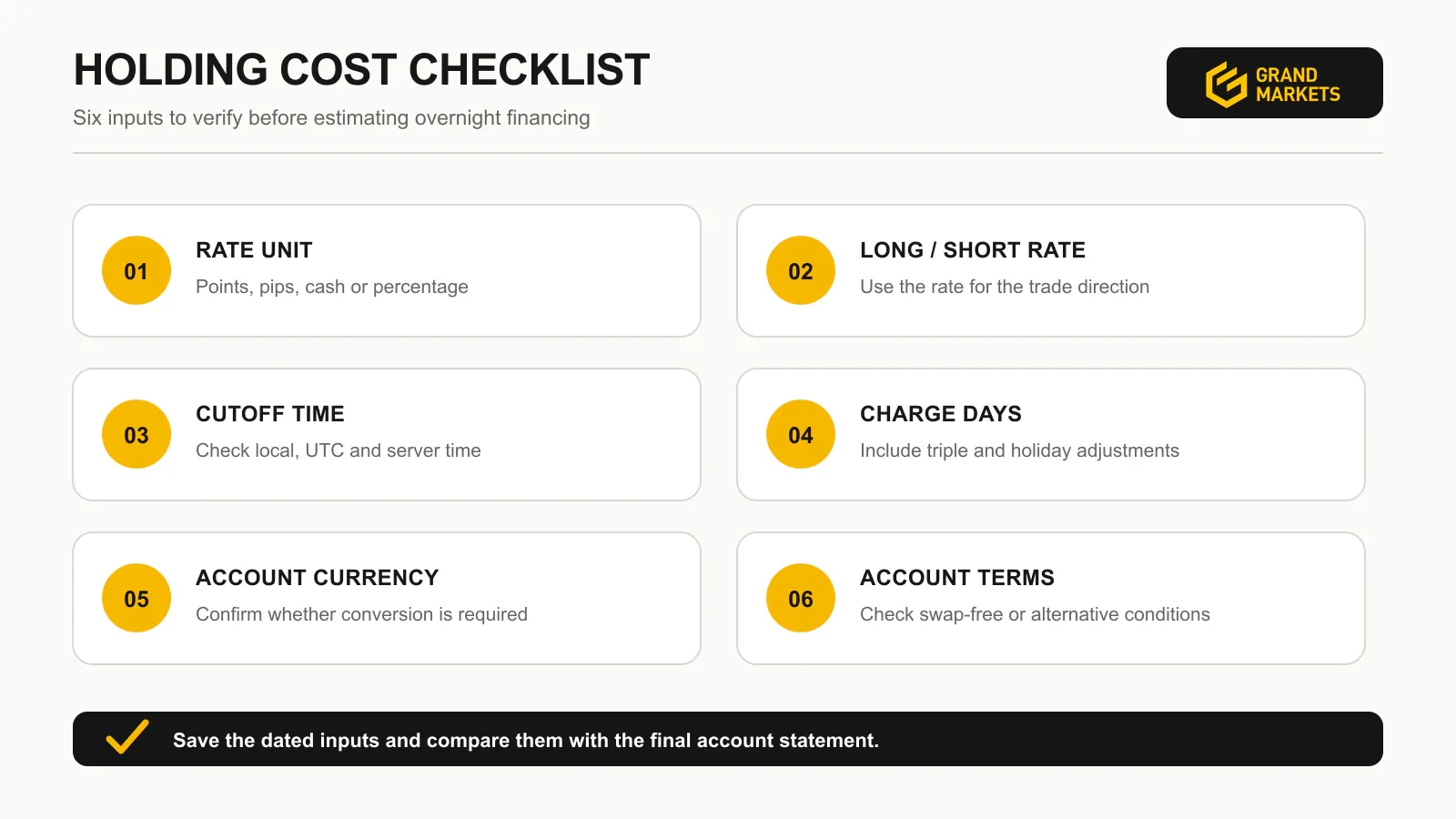
A useful estimate starts with the exact account and instrument, not a general calculator result.
- Identify the contract. Confirm the contracting entity, account type, and instrument symbol.
- Record the exposure. Note direction, lots, contract size, and account currency.
- Read the rate fields. Check long swap, short swap, and calculation type.
- Verify the units. Distinguish points, pips, annual percentages, and cash amounts.
- Confirm timing. Convert the cutoff into your local time and check broker/server-time differences.
- Check the calendar. Identify multi-day events and holiday adjustments.
- Check account conditions. Establish whether ordinary swap or an alternative arrangement applies.
- Save the inputs. Keep a dated record for comparison with the eventual statement.
Rates can change during a holding period. Multiplying today’s daily rate by a planned number of days is an estimate, not a guaranteed final charge.
Why does the statement differ from the calculator?
Common causes include different rate dates, incorrect point/pip interpretation, contract-size differences, currency conversion, rounding, or an overlooked multi-day event.
A calculator may also show an amount that already includes the multiplier. Compare the inputs and covered dates before concluding that the statement is wrong.
Can positive swap offset a losing trade?
A financing credit contributes to the net result, but it may be much smaller than the exchange-rate loss. Favorable carry does not eliminate market risk, and the rate itself can change.
Does rollover always close and reopen the position?
No. Platforms support different implementations, including monetary adjustments and configured reopening modes. Do not assume that rollover requires a manual transaction.
What is the most important final check?
Confirm the applicable rate, its units, the cutoff, and the charge-day factor for the exact position. Those details turn a general explanation into a usable cost estimate.
Forex and CFDs are leveraged products that can produce substantial losses. Financing credits do not protect against adverse price movements. Review the Grand Markets leveraged trading risk disclosure and your current account terms. This material is educational, not personalized investment advice.

Disclaimer:
This content does not constitute any offer, solicitation or advice. You should always seek independent professional advice before making any investment decision. Please note that Grand Markets may restrict or prohibit some or all services to users from restricted regions. Please read the User Agreement for more information.