
XAU/USD pip value and lot size determine the US-dollar effect of each gold price movement on an open position. The operational calculation is:
Profit or loss = Price change per ounce × ounces controlled
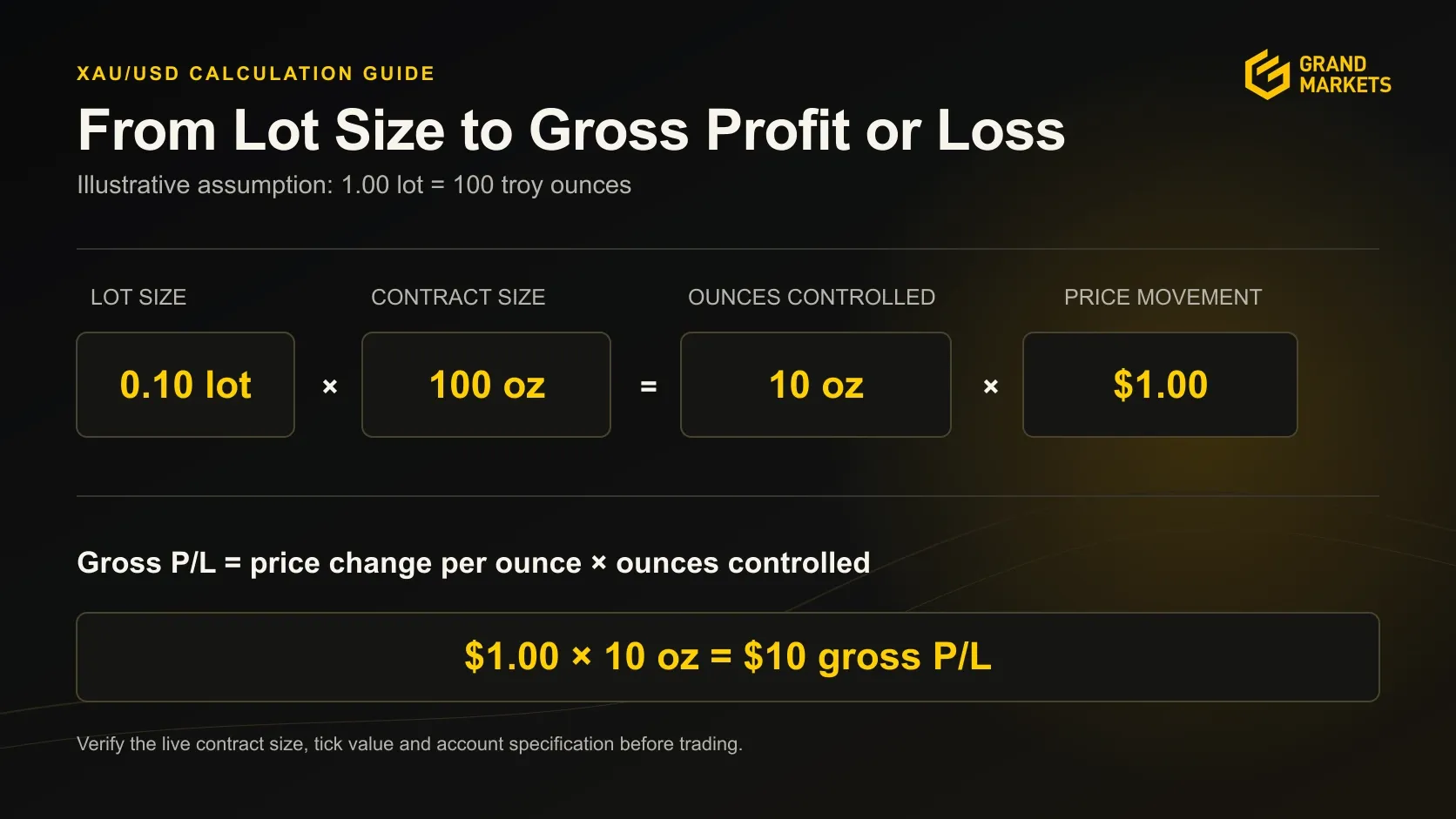
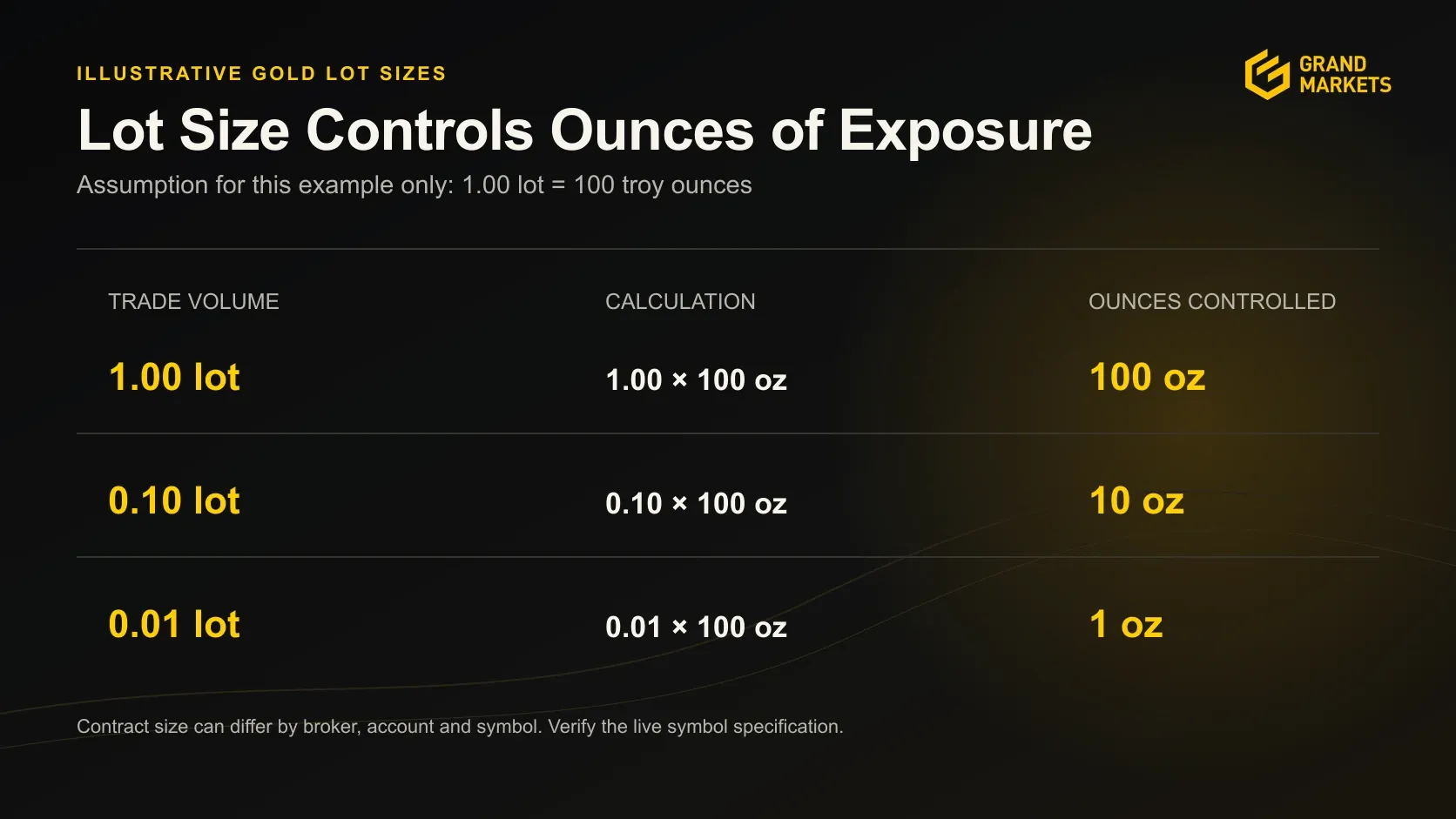
For a common retail-CFD illustration, 1.00 XAU/USD lot controls 100 troy ounces. Under that assumption, a $0.01 price movement equals $1.00 for 1.00 lot. Confirm the exact contract specification for the tradable symbol before placing an order.
| Lot size | Ounces controlled* | Value of $0.01 move | Value of $1.00 move |
|---|---|---|---|
| 1.00 | 100 oz | $1.00 | $100 |
| 0.10 | 10 oz | $0.10 | $10 |
| 0.01 | 1 oz | $0.01 | $1 |
Illustrative 100-ounce contract. XAU/USD contract size, tick size and pip terminology can differ by broker, account and symbol. Verify the live symbol specification before trading.
Check the XAU/USD Contract Size Before Calculating
XAU/USD quotes the US-dollar price of one troy ounce of gold. In retail trading, the symbol commonly represents a CFD or spot-metal-style contract, not physical ownership of bullion.
Gold trading conditions can vary by platform, account type, jurisdiction, and the exact symbol suffix. Check the platform specification for XAUUSD, GOLD, XAUUSDm, or any other displayed symbol before using a calculation.
Use these fields from the symbol specification:
| Item to check | Why it affects the calculation |
|---|---|
| Contract size | Defines the number of ounces represented by 1.00 lot. |
| Minimum volume | Defines the smallest position that can be opened. |
| Volume step | Defines valid lot-size increments, such as 0.01. |
| Tick size | Defines the smallest permitted price increment. |
| Tick value | Shows the cash value of one tick for the instrument. |
| Spread | Creates an immediate trading cost at entry. |
| Commission | May apply separately from the spread. |
| Swap or financing | May apply to positions held overnight. |
| Margin rate or leverage | Affects required collateral, not price-movement exposure. |
| Account currency | Can require P/L conversion from USD. |
A common educational convention is shown below. It is not a universal broker rule.
| Lot size | Assumed contract size | Ounces controlled |
|---|---|---|
| 1.00 lot | 100 oz per lot | 100 oz |
| 0.50 lot | 100 oz per lot | 50 oz |
| 0.30 lot | 100 oz per lot | 30 oz |
| 0.10 lot | 100 oz per lot | 10 oz |
| 0.01 lot | 100 oz per lot | 1 oz |
Use this formula for any verified contract size:
Ounces controlled = Lot size × contract size in ounces
For example, if the verified contract size is 100 ounces and the order volume is 0.15 lot:
0.15 × 100 = 15 ounces
The volume is valid only when the platform accepts 0.15 as an available volume increment.
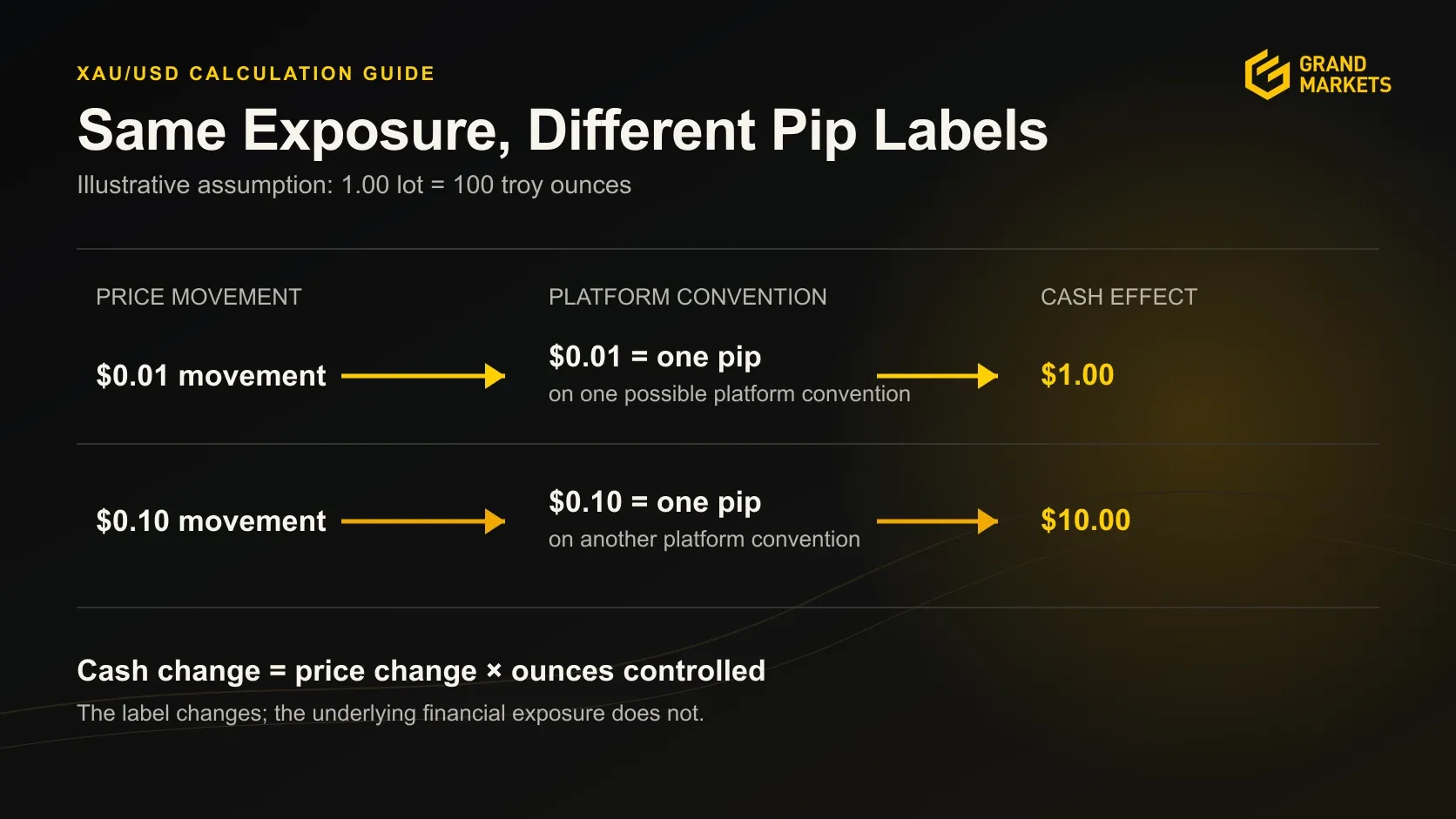
The terms pip, point, and tick do not automatically describe the same unit on gold. Some platforms describe a $0.01 movement as one pip. Others describe a $0.10 movement as one pip and a $0.01 movement as a point. The terminology changes, but the financial result does not.
For a 100-ounce position:
- A $0.01 move equals $1.00.
- A $0.10 move equals $10.00.
- A $1.00 move equals $100.00.
The price movement and ounces controlled always determine the result.
How to Calculate XAU/USD Pip Value
Use the actual price movement first. Apply the platform pip definition only after calculating the dollar value.
Pip value in USD = Pip size × contract size in ounces × lot size
Profit or loss in USD = Price change × ounces controlled
The following examples assume:
- Contract size: 100 ounces per 1.00 lot.
- Account currency: USD.
- Pip convention: $0.01 equals one pip.
- Costs such as spread, commission, swap, and slippage are excluded.
Pip values under a $0.01 convention
| Trade volume | Ounces controlled | Calculation | Value per $0.01 movement |
|---|---|---|---|
| 1.00 lot | 100 oz | $0.01 × 100 × 1.00 | $1.00 |
| 0.50 lot | 50 oz | $0.01 × 100 × 0.50 | $0.50 |
| 0.30 lot | 30 oz | $0.01 × 100 × 0.30 | $0.30 |
| 0.10 lot | 10 oz | $0.01 × 100 × 0.10 | $0.10 |
| 0.01 lot | 1 oz | $0.01 × 100 × 0.01 | $0.01 |
Pip values under a $0.10 convention
Some providers define one gold pip as $0.10. The underlying movement value remains unchanged.
| Trade volume | Ounces controlled | Calculation | Value per $0.10 movement |
|---|---|---|---|
| 1.00 lot | 100 oz | $0.10 × 100 × 1.00 | $10.00 |
| 0.10 lot | 10 oz | $0.10 × 100 × 0.10 | $1.00 |
| 0.01 lot | 1 oz | $0.10 × 100 × 0.01 | $0.10 |
This distinction resolves a common gold trading pip value error. A platform using a $0.10 pip convention does not create greater exposure than a platform using a $0.01 pip convention. It labels the same underlying movements differently.
Use the tick value shown in the platform as the final operational reference. The tick size and tick value are contract terms. A generic online formula cannot override the symbol specification.
XAU/USD Pip Value Examples
These XAU/USD pip calculation examples use a 100-ounce contract size. They show gross P/L before any spread, commission, financing, conversion, or slippage costs.
Example 1: 1.00-lot long position
Open a long position at $2,400.00 and close it at $2,405.00.
| Item | Calculation | Result |
|---|---|---|
| Lot size | 1.00 | 1.00 lot |
| Ounces controlled | 1.00 × 100 | 100 oz |
| Price change | $2,405.00 minus $2,400.00 | $5.00 |
| Gross P/L | $5.00 × 100 oz | $500.00 |
Under a $0.01 pip convention, the move equals 500 pips.
| Item | Calculation | Result |
|---|---|---|
| Pip count | $5.00 divided by $0.01 | 500 pips |
| Pip value | $0.01 × 100 oz | $1.00 |
| Gross P/L | 500 × $1.00 | $500.00 |
Example 2: 0.30-lot losing long position
Open a long position at$2,400.00. Price reaches $2,397.50.
| Item | Calculation | Result |
|---|---|---|
| Lot size | 0.30 | 0.30 lot |
| Ounces controlled | 0.30 × 100 | 30 oz |
| Price change | $2,397.50 minus $2,400.00 | -$2.50 |
| Gross P/L | -$2.50 × 30 oz | -$75.00 |
The price moved 250 increments of $0.01. The pip value for 0.30 lot is $0.30 per $0.01 movement.
250 × $0.30 = $75.00 loss
Example 3: 0.10-lot short position
Sell XAU/USD at $2,410.00 and close the position at $2,407.20.
| Item | Calculation | Result |
|---|---|---|
| Lot size | 0.10 | 0.10 lot |
| Ounces controlled | 0.10 × 100 | 10 oz |
| Favorable price decline | $2,410.00 minus $2,407.20 | $2.80 |
| Gross P/L | $2.80 × 10 oz | $28.00 |
A short position benefits when the closing buy price is lower than the opening sell price. A $2.80 rise instead of a decline would create an estimated $28.00 gross loss.
Example 4: Non-USD account conversion
XAU/USD profit and loss is initially calculated in USD. A non-USD trading account can show a converted result.
Assume the trade produces a gross profit of $75.00 and the applicable EUR/USD conversion rate is 1.1000.
| Item | Calculation | Result |
|---|---|---|
| USD profit | Gross XAU/USD result | $75.00 |
| Conversion rate | EUR/USD | 1.1000 |
| EUR result | $75.00 divided by 1.1000 | EUR 68.18 |
Conversion rates, timing, and charges depend on the broker and account terms. Verify how the platform converts realized P/L, floating P/L, commissions, and financing charges.
How to Calculate Gold Lot Size From Risk
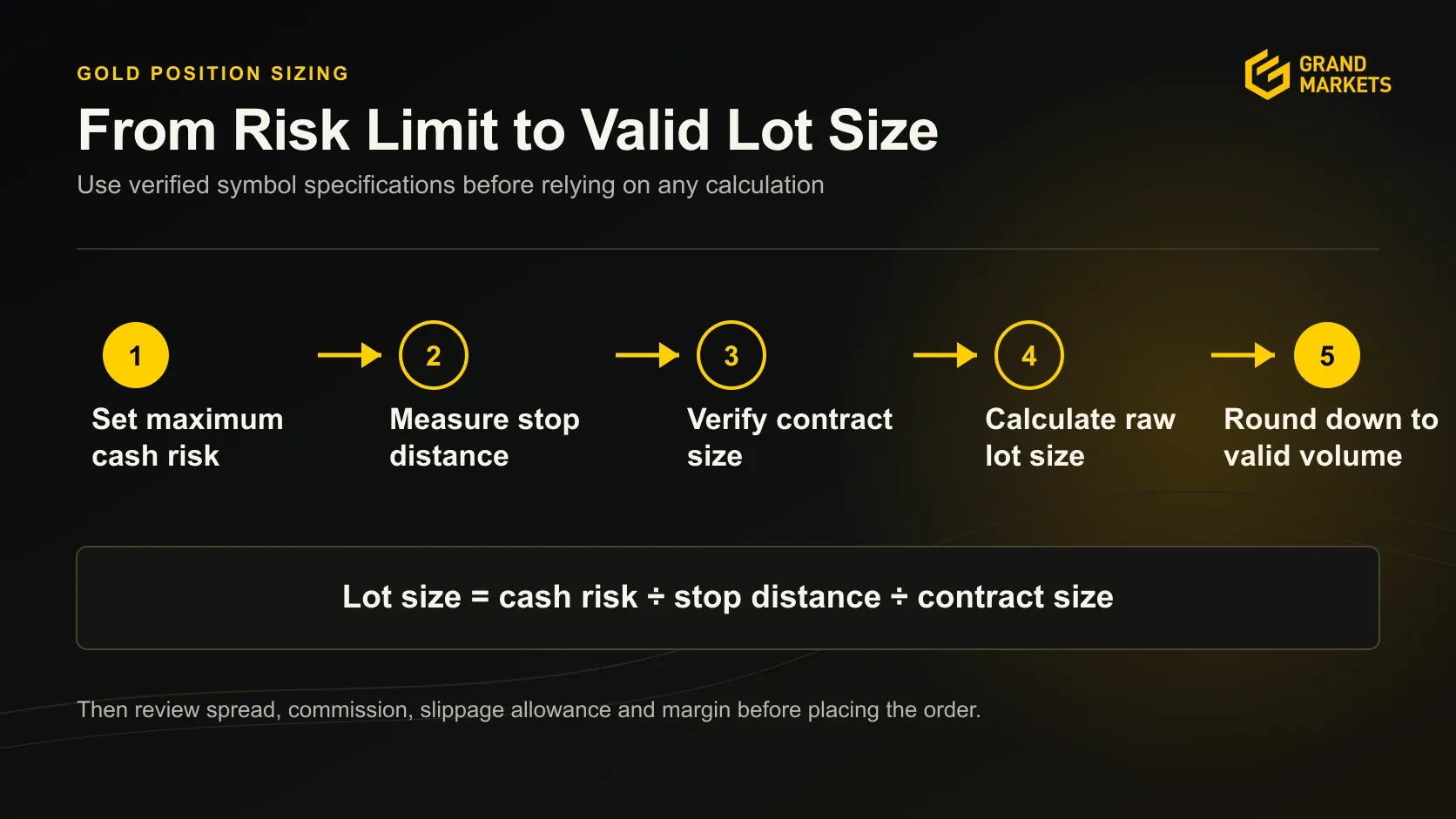
Position sizing for gold trading starts with the maximum cash loss allowed at the stop-loss level. Do not select volume from margin availability alone.
Use this formula under the verified pip convention:
Lot size = Maximum dollar risk divided by stop-loss distance in pips divided by pip value per 1.00 lot
A simpler calculation avoids pip terminology:
Lot size = Maximum dollar risk divided by stop-loss price distance divided by contract size in ounces
For a 100-ounce contract:
Lot size = Maximum dollar risk divided by stop distance in dollars divided by 100
Example 1: $5,000 account, 1% risk, $2.50 stop
| Item | Calculation | Result |
|---|---|---|
| Account balance | Given | $5,000 |
| Risk percentage | Given | 1% |
| Maximum risk | $5,000 × 1% | $50 |
| Stop distance | Given | $2.50 |
| Calculated lot size | $50 divided by $2.50 divided by 100 | 0.20 lot |
| Ounces controlled | 0.20 × 100 | 20 oz |
| Estimated stop loss | $2.50 × 20 oz | $50 |
The raw calculation produces 0.20 lot. Round down when the platform volume step prevents an exact order size.
Example 2: $12,000 account, 1.5% risk, $6.00 stop
| Item | Calculation | Result |
|---|---|---|
| Account balance | Given | $12,000 |
| Maximum risk | $12,000 × 1.5% | $180 |
| Stop distance | Given | $6.00 |
| Calculated lot size | $180 divided by $6.00 divided by 100 | 0.30 lot |
| Ounces controlled | 0.30 × 100 | 30 oz |
| Estimated stop loss | $6.00 × 30 oz | $180 |
Example 3: $2,000 account, 0.5% risk, $1.25 stop
| Item | Calculation | Result |
|---|---|---|
| Account balance | Given | $2,000 |
| Maximum risk | $2,000 × 0.5% | $10 |
| Stop distance | Given | $1.25 |
| Calculated lot size | $10 divided by $1.25 divided by 100 | 0.08 lot |
| Ounces controlled | 0.08 × 100 | 8 oz |
| Estimated stop loss | $1.25 × 8 oz | $10 |
The estimated loss at a stop is not a guaranteed maximum loss. Spread, slippage, commission, overnight financing, and price gaps can increase the final result.
Use a demo trading account to test volume steps, symbol details, order placement, and P/L display before relying on a calculation in live conditions.
Gold Lot Size, Margin and Risk Checks
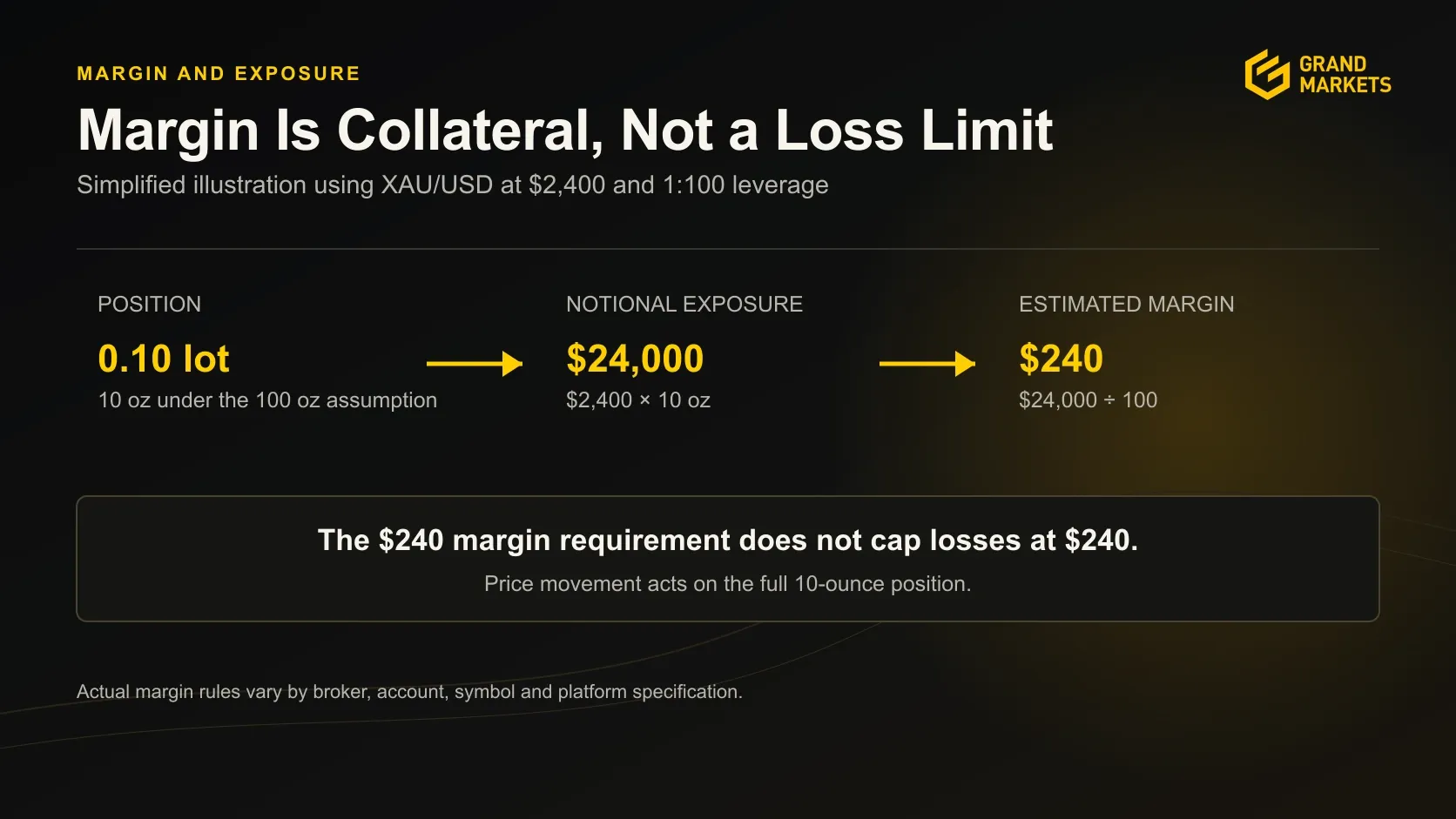
Margin, leverage, and price risk are separate calculations. Required margin is collateral for opening or maintaining a position. It does not cap the dollar loss from a gold price movement.
Notional value = XAU/USD price × contract size × lot size
For a simplified leverage-based illustration, estimated margin can be calculated as notional value divided by leverage. Actual XAU/USD margin requirements can depend on the broker, account, symbol and platform specification.
Estimated margin = Notional value ÷ leverage
Margin example
Assume:
- XAU/USD price: $2,400.
- Contract size: 100 ounces.
- Trade volume: 0.10 lot.
- Leverage: 1:100.
| Item | Calculation | Result |
|---|---|---|
| Ounces controlled | 0.10 × 100 | 10 oz |
| Notional value | $2,400 × 10 oz | $24,000 |
| Estimated margin | $24,000 ÷ 100 | $240 |
| Loss from a $1 adverse move | $1 × 10 oz | $10 |
| Loss from a $10 adverse move | $10 × 10 oz | $100 |
The $240 margin requirement does not limit the loss to $240. A larger adverse price movement can produce a larger loss, subject to the broker’s applicable margin and close-out rules.
The Financial Conduct Authority guidance on CFDs states that leverage magnifies gains and losses. Treat leverage as a margin mechanism, not a reduction in exposure.
Use this XAU/USD risk management checklist before submitting an order:
- Confirm the exact XAU/USD symbol and suffix.
- Confirm the contract size in troy ounces.
- Confirm tick size and tick value.
- Confirm the platform definition of a pip, point, and tick.
- Confirm minimum volume and volume-step rules.
- Calculate ounces controlled from the proposed lot size.
- Calculate the loss at the planned stop-loss price.
- Add estimated spread and commission costs.
- Review swap or overnight financing when holding beyond rollover.
- Check margin requirements for the selected account and volume.
- Check scheduled economic releases and market trading hours.
- Allow for slippage and gaps around volatile conditions.
- Confirm account-currency conversion treatment when the account is not USD.
Trading costs can materially change a result. The FCA describes spread as the difference between buy and sell prices, while its CFD materials also identify financing charges and execution differences as relevant considerations.
Common Calculation Errors
| Error | Result | Required correction |
|---|---|---|
| Assuming 1.00 lot always equals 100 oz | Incorrect exposure estimate when the symbol uses another contract size. | Check the current symbol specification. |
| Treating $0.01 as a universal pip | Incorrect pip count or value on platforms using another convention. | Use actual price change and tick value first. |
| Selecting lot size from available margin | Position can exceed the planned stop-loss risk. | Size the trade from cash risk and stop distance. |
| Treating margin as maximum loss | Underestimates exposure from adverse price movement. | Calculate loss from price change × ounces. |
| Ignoring spread and commission | Stop-loss risk estimate is too low. | Include all expected transaction costs. |
| Ignoring swap | Holding costs can accumulate on overnight positions. | Review swap rates and rollover time. |
| Ignoring account conversion | USD P/L can differ from account-currency P/L. | Check the conversion method and applicable fees. |
| Assuming a stop order guarantees a price | Gaps and fast markets can create slippage. | Add a slippage allowance to risk planning. |
A CFD trading position provides exposure to price movements under broker-specific contract terms. It is distinct from physical bullion, exchange-traded gold futures, and gold ETFs. For platform-specific verification, inspect the instrument details before entering an order.
XAU/USD pip value and lot size should always be calculated from the verified contract size, the actual gold price movement, and the selected trade volume. The base rule remains:
Gross P/L in USD = Price change per ounce × ounces controlled
Check XAU/USD Trading Conditions at Grand Markets
Before trading XAU/USD through Grand Markets, open the live symbol specification for the actual account and platform you use. Confirm, where applicable:
- contract size, minimum volume and volume step;
- tick size and tick value;
- current spread and any commission;
- leverage and margin requirements;
- swap or overnight financing; and
- trading hours.
Grand Markets’ current trading accounts page provides account-level information. The official MT4 and MT5 pages provide the platform download routes. The live instrument specification remains the operational reference for the XAU/USD symbol available to your account; do not assume that the illustrative 100-ounce example on this page is the live contract specification.
Frequently Asked Questions
How much is 1 pip on XAU/USD?
It depends on the platform’s pip convention, the contract size and the trade volume. Under an illustrative 100-ounce contract where $0.01 is one pip, 1.00 lot changes by $1 for each pip. If the platform defines $0.10 as one pip, the same 1.00-lot position changes by $10 per pip. Verify the symbol specification before calculating.
How much is 0.01 lot of gold worth per pip?
Under an illustrative 100-ounce contract, 0.01 lot controls 1 ounce. If one pip is $0.01, the value is $0.01 per pip. If one pip is $0.10, the value is $0.10 per pip. Other contract sizes produce different results.
How many ounces are in 1 lot of XAU/USD?
Many educational examples use 100 troy ounces for 1.00 lot, but this is not universal. The actual contract size can differ by broker, account and symbol, so check the live instrument specification.
How do you calculate XAU/USD lot size?
Divide the maximum cash risk by the stop-loss distance in dollars and then by the verified contract size in ounces. Round the result down to a valid volume step and account for spread, commission and possible slippage.
Why does gold pip value differ between brokers?
Brokers and platforms can use different contract sizes, tick sizes, tick values and pip terminology. Trade volume and account-currency conversion can also affect the displayed result. The live symbol specification is the operational reference.
Risk warning: These examples and calculations are educational and illustrative. Actual contract specifications and trading conditions vary by broker, account and symbol. Leveraged CFD trading involves substantial risk, and losses can occur rapidly. This content is general information, not investment advice or a recommendation to trade.

Disclaimer:
This content does not constitute any offer, solicitation or advice. You should always seek independent professional advice before making any investment decision. Please note that Grand Markets may restrict or prohibit some or all services to users from restricted regions. Please read the User Agreement for more information.